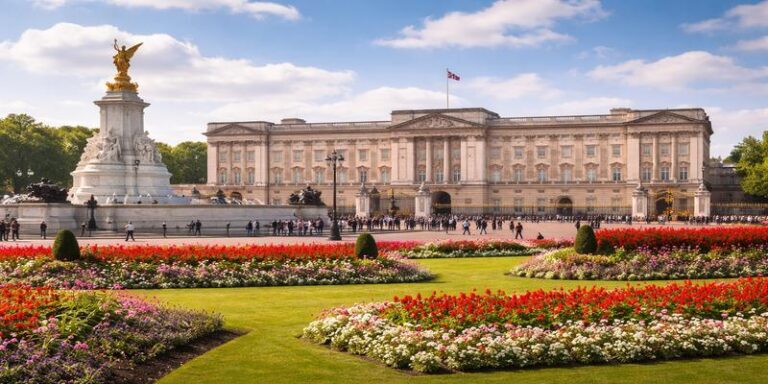
There are few landmarks in Britain that capture the imagination quite like Buckingham Palace. Rising behind its ornate gates and grand forecourt, this iconic royal residence is more than a postcard image or ceremonial backdrop: it is a living symbol of the British monarchy, a working palace, and one of London’s most compelling historic attractions. For many travellers, the first glimpse of Buckingham Palace comes with a flicker of recognition — the famous balcony, the scarlet-coated guards, the sweep of The Mall — yet the real fascination lies deeper, in its layered history, refined interiors, and enduring place in the national story.
Whether you come for the pageantry, the architecture, or the chance to step inside rooms still used for state occasions, Buckingham Palace offers a rare combination of heritage, spectacle, and cultural meaning. It is not simply somewhere to tick off a sightseeing list; it is a destination that invites visitors to think about monarchy, power, taste, and tradition in the heart of modern London.
1.0 Brief Background and History of the Royal Place
The site of Buckingham Palace began rather modestly. According to the official Royal website, the land once contained a mulberry garden planted under James I, though the silk-making venture never truly prospered (The Royal Family, n.d.). The house that stood there, Buckingham House, was purchased in 1761 by George III for Queen Charlotte, becoming known as the Queen’s House. It functioned primarily as a private family home rather than the grand ceremonial seat recognised today (The Royal Family, n.d.).
The transformation came under George IV, who in 1820 commissioned architect John Nash to enlarge and remodel the house into a palace. Nash’s vision drew on French neoclassical influences, though rising costs caused controversy and eventually cost him his position (Healey, 2012). Edward Blore later completed much of the work, including the famous quadrangle, while Queen Victoria became the first sovereign to take up residence there in 1837 (The Royal Family, n.d.).
Since then, Buckingham Palace has evolved into the administrative and symbolic centre of the monarchy. It has hosted state banquets, royal audiences, investitures, balcony appearances, and national celebrations, from wartime commemorations to jubilees (Baxendale, 2007; The Royal Family, n.d.). As scholars of royal tourism note, royal residences in Britain have long functioned as places where history, national identity, and public fascination converge (Palmer, 2008; Otnes and Maclaran, 2015).
2.0 Architecture and Interior Highlights
Architecturally, Buckingham Palace is a blend of adaptation, enlargement, and image-making. Nash’s early work expanded the original house, while later additions and Aston Webb’s 1913 refacing in Portland stone gave the palace the formal appearance most visitors recognise today (The Royal Family, n.d.; Wright, 2008). The East Front, facing the Victoria Memorial, provides the palace’s most famous public face, especially during Changing the Guard and royal appearances.
Inside, the palace is celebrated for its State Rooms, which remain among the finest ceremonial interiors in Britain. These rooms are noted for their opulent decoration, chandeliers, gilded details, historic furniture, and displays from the Royal Collection, one of the world’s most important art collections (Healey, 2012). Spaces such as the Throne Room, White Drawing Room, and Music Room are not merely decorative; they are deeply tied to royal ritual and memory.
The gardens add another dimension. Set behind the palace, they create an unexpectedly tranquil retreat in central London. Farrell (2003) argues that Buckingham Palace and its setting should be understood not only as architecture, but as part of a wider royal landscape linking building, parkland, and ceremonial approach. This combination of formal design and urban greenery helps explain why the palace feels both imposing and strangely intimate.
3.0 Visitor Experience
For visitors, Buckingham Palace offers a distinctive experience because it remains a working royal residence. Unlike a museum frozen in time, it is a place where contemporary constitutional and ceremonial life still unfolds. The palace is generally opened to the public during the summer, with limited seasonal openings at other times of year, allowing access to the State Rooms through organised visits (The Royal Family, n.d.).
A visit usually centres on the interiors, where carefully curated routes guide guests through rooms used for receptions, official events, and grand occasions. Audio guides and interpretation materials help explain the significance of the art, furnishings, and architecture, making the palace accessible to general audiences rather than only royal enthusiasts. The atmosphere is polished rather than stuffy: visitors encounter a space designed to impress, yet one that also tells human stories about monarchs, family life, diplomacy, and public image.
Outside, the forecourt delivers one of London’s most recognisable spectacles. Changing the Guard remains a major draw, not simply because of military precision, but because it stages monarchy as performance in public space. Research on royal tourism suggests such ceremonies help sustain the palace’s emotional and symbolic appeal for international visitors (Palmer, 2008; Otnes and Maclaran, 2015).
4.0 Things to Do Nearby
One of the pleasures of visiting Buckingham Palace is how easily it connects with the wider royal and historic landscape of Westminster. Directly adjacent is St James’s Park, one of London’s most beautiful green spaces, ideal for a stroll before or after your visit. Its lake, flowerbeds, and views back towards the palace soften the grandeur of the setting and provide excellent photo opportunities.
A short walk away lies Westminster Abbey, where coronations and royal weddings have shaped the nation’s ceremonial life for centuries. Nearby too are The Houses of Parliament and Big Ben, making it easy to place the palace within the broader framework of British statehood. Travellers interested in art may also head to The National Gallery, while those looking for shopping and dining can continue towards Piccadilly, Regent Street, or Mayfair.
This compact cluster of attractions is one reason Buckingham Palace works so well in a London itinerary: it sits at the crossroads of royal history, politics, architecture, and leisure.
5.0 Sample Itinerary
A rewarding full-day visit can begin early with a walk along The Mall, arriving in time to watch the crowds gather outside Buckingham Palace. Spend the morning exploring the forecourt, taking photographs, and, if timing allows, seeing the guard ceremony.
Next, head inside the palace for a State Rooms tour. Allow time not only to move through the principal interiors, but to pause and absorb the paintings, craftsmanship, and ceremonial symbolism. Afterwards, enjoy lunch nearby in St James’s or Victoria.
In the afternoon, walk through St James’s Park towards Westminster Abbey and Parliament. This creates a satisfying historical progression from monarchy to church and state. End the day with tea or an early supper in Mayfair, reflecting on how Buckingham Palace anchors so much of London’s public identity.
6.0 When to Visit
The best time to visit Buckingham Palace is usually during the summer opening, when access to the State Rooms is most established. London’s warmer months also make the palace gardens, surrounding parks, and ceremonial routes especially pleasant. Morning visits are often best for a fresher atmosphere and a fuller day of sightseeing afterwards.
Travellers interested in pageantry may wish to plan around Changing the Guard or notable royal and national occasions, though these can also draw larger crowds. Spring and early autumn can be particularly appealing for those who prefer milder weather and less congestion around central London. Even from the outside, Buckingham Palace remains impressive year-round, but interior access naturally adds much more depth to the experience.
7.0 Travel Tips
Book tickets through official channels whenever possible, especially in peak season. Arriving early helps with security procedures and gives you time to enjoy the exterior setting before entering. Use the London Underground, buses, or a central walking route rather than relying on taxis, as the area can be congested.
Wear comfortable shoes, since a palace visit often pairs well with a wider walking tour of Westminster and St James’s. Photography rules may vary, particularly inside ceremonial rooms, so check guidance in advance. Visitors should also remember that Buckingham Palace is not only a tourist site but a functioning royal building; a respectful tone and patience during entry procedures are well advised.
8.0 Why It’s Worth Visiting
What makes Buckingham Palace truly worth visiting is its rare ability to feel both mythic and real. On one level, it is the palace of balcony appearances, uniforms, flags, and royal headlines. On another, it is a place shaped by practical needs, architectural revisions, family life, public scrutiny, and national ceremony over nearly three centuries.
It also offers something broader than monarchy alone. As Baxter and others have suggested in studies of royal heritage, these spaces become stages on which nations present themselves to both citizens and outsiders (Baxendale, 2007). In that sense, Buckingham Palace is not only about kings and queens. It is about Britain’s relationship with continuity, tradition, and spectacle.
For general travellers, that makes the palace emotionally resonant. Even those with little interest in royal biography often leave struck by the scale of the rooms, the precision of the ceremony, and the curious intimacy of seeing a place still used for official life.
To visit Buckingham Palace is to encounter one of Britain’s most recognisable and symbolically charged places at close quarters. Its story stretches from an 18th-century house to a global emblem of monarchy; its rooms speak of ceremony, craftsmanship, and power; and its setting places you at the very centre of historic London. For travellers seeking a destination that combines architecture, history, ritual, and atmosphere, Buckingham Palace remains not just worth seeing, but worth savouring.
References
Baxendale, J. (2007) ‘Royalty, romance and recreation: The construction of the past and the origins of royal tourism in nineteenth-century Britain’, Cultural and Social History, 4(4), pp. 499–517. Available at: https://www.tandfonline.com/doi/abs/10.2752/147800407X219232.
Farrell, T. (2003) Buckingham Palace Redesigned: A Radical New Approach to London’s Royal Parks. London: T. Farrell & Partners. Available at: https://books.google.com/books?id=dZiLY8Nv-ucC.
Healey, E. (2012) The Queen’s House: A Social History of Buckingham Palace. London: The History Press. Available at: https://books.google.com/books?id=XISeDvSS_rAC.
Otnes, C.C. and Maclaran, P. (2015) Royal Fever: The British Monarchy in Consumer Culture. Oakland: University of California Press. Available at: https://books.google.com/books?id=SWSDDwAAQBAJ.
Palmer, N.J. (2008) ‘International royal tourist expectations, experiences and reflections on royal encounters: a demand-side perspective’, in Royal Tourism: Excursions Around Monarchy. Bristol: Channel View Publications, pp. 232–248. Available at: https://books.google.com/books?id=EznE61Gfn-0C.
Pospíšilová, M. (n.d.) English Historical Buildings as Symbols of National Identity. Available at: https://is.muni.cz/th/t8mvu/BA_Thesis_Pospisilova.pdf.
The Royal Family (n.d.) ‘Royal Residences: Buckingham Palace’. Available at: https://www.royal.uk/royal-residences-buckingham-palace.
Wright, P. (2008) The Strange History of Buckingham Palace. Stroud: The History Press. Available at: https://books.google.com/books?id=IJQ7AwAAQBAJ.