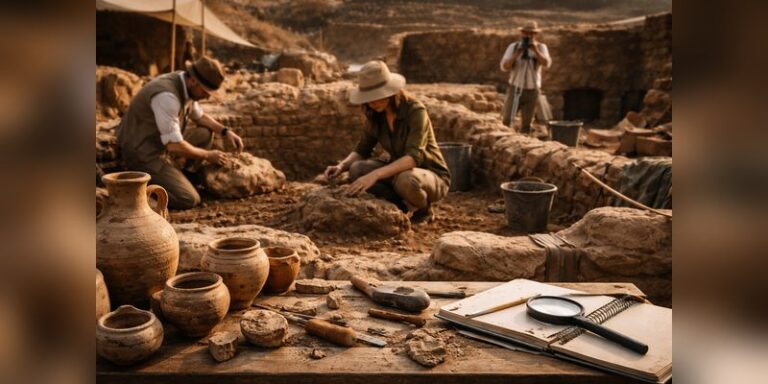
✧ The History of Archaeology begins not with laboratories or satellites, but with curiosity. A broken pot, a ruined wall or an inscribed stone has long inspired wonder about earlier societies. Over time, that curiosity developed into a disciplined attempt to understand the human past through material remains. What was once driven largely by collecting and display gradually became a field shaped by method, context, science and ethical debate (Renfrew and Bahn, 2020).
The History of Archaeology is important because it shows that archaeology did not appear fully formed. It emerged through centuries of changing ideas about history, evidence and civilisation. The discipline was influenced by antiquarianism, geology, empire, museums, scientific dating and critical theory (Trigger, 2006). It has also been shaped by mistakes, including destructive excavation, colonial appropriation and narrow interpretations of past societies. For that reason, the history of archaeology is not simply a background story. It helps explain why archaeology today places such importance on careful recording, interpretation and public responsibility.
1.0 The Early History of Archaeology: Antiquarian Curiosity
The earliest stage in the History of Archaeology is usually linked with antiquarianism. From the Renaissance onwards, scholars and collectors across Europe took an interest in ruins, inscriptions, coins and monumental remains. Their work was not archaeology in the modern sense, yet it was significant because it preserved objects, recorded sites and encouraged the belief that physical traces could illuminate earlier worlds (Daniel, 1981).
This early interest often focused on the classical past. Ancient Greece and Rome were admired as models of art, politics and learning, so their remains attracted particular attention. Excavations at Herculaneum and Pompeii in the eighteenth century showed that buried settlements could reveal not only beautiful artefacts but also streets, houses, foodways and daily life (Schnapp, 1996). However, methods were often inconsistent. Finds were frequently removed for display, while the soil layers and original positions of objects were poorly documented.
Even so, antiquarianism mattered. It established a habit of looking at objects as evidence, and that habit later became central to archaeology. In Britain, the study of Roman sites and monuments such as Stonehenge helped widen attention beyond the classical Mediterranean and encouraged interest in local pasts.
2.0 History of Archaeology in the Nineteenth Century
A decisive transformation in the History of Archaeology took place in the nineteenth century. During this period, archaeology became more systematic and increasingly tied to scientific ideas. One of the most influential developments was the Three Age System of Stone, Bronze and Iron Ages, associated with Christian Jürgensen Thomsen. By arranging artefacts in a chronological sequence, this framework gave prehistory a clearer structure and allowed the deep past to be studied more coherently (Trigger, 2006).
At the same time, geology revolutionised historical thinking. The growing acceptance of deep time challenged shorter biblical chronologies and made the great antiquity of humankind more plausible. Stone tools found alongside extinct animals suggested that human history extended far beyond written records (Renfrew and Bahn, 2020). This was a major intellectual shift.
Field methods also improved. The work of General Pitt-Rivers is especially important in the History of Archaeology because excavation was treated as a matter of careful observation and full recording, not merely the recovery of impressive treasures. Ordinary artefacts were documented alongside prestigious objects, reflecting the idea that everyday items could reveal social life just as clearly as gold or sculpture (Daniel, 1981). Archaeology was beginning to move from collecting towards evidence-based investigation.
3.0 History of Archaeology in the Early Twentieth Century
By the early twentieth century, the History of Archaeology had entered a phase of professionalisation. Museums, learned societies and universities increasingly supported specialist training, excavations and publications. Archaeology expanded across Egypt, Mesopotamia, the Mediterranean, Africa and the Americas, although much of this work unfolded within the framework of imperial expansion. As a result, many artefacts were removed to European and North American institutions, raising ethical questions that still shape debate today (Schnapp, 1996).
The main interpretive model of this period is often called culture-historical archaeology. Artefacts were grouped into archaeological cultures and traced through time and space. This approach was valuable because it built regional chronologies and clarified patterns of change, yet it could also oversimplify cultural identities (Trigger, 2006).
One of the most influential figures in this stage of the History of Archaeology was V. Gordon Childe, whose work linked archaeological evidence to large-scale historical transformations. Childe’s ideas about the Neolithic Revolution and the Urban Revolution framed the rise of farming and cities as turning points in human development (Childe, 1950). Meanwhile, major discoveries such as Tutankhamun’s tomb, Sutton Hoo and the royal graves of Ur captured public attention and made archaeology widely popular.
4.0 History of Archaeology and the Rise of Scientific Explanation
Another turning point in the History of Archaeology came in the 1960s with the emergence of processual archaeology, often called the New Archaeology. Dissatisfied with description alone, scholars such as Lewis Binford argued that archaeology should explain cultural processes rather than simply classify objects (Binford, 1962). This approach encouraged archaeology to become more explicitly scientific.
Questions changed as a result. Greater attention was given to environment, subsistence, settlement patterns, adaptation and social organisation. Statistical analysis, survey methods and laboratory work became more important. One of the most transformative scientific advances was radiocarbon dating, which greatly improved chronological precision and allowed sites to be placed within firmer timeframes (Renfrew and Bahn, 2020).
The strengths of processual archaeology were considerable. It promoted hypothesis testing, interdisciplinary research and methodological clarity. Yet it also attracted criticism for being overly detached and for underestimating the role of belief, symbolism and human agency.
5.0 History of Archaeology Since the 1980s: Meaning, Ethics and New Voices
From the 1980s onwards, the History of Archaeology was shaped by post-processual and critical approaches. Scholars such as Ian Hodder argued that artefacts could not be understood through function and environment alone. Material culture also carries symbolic, social and political meanings, and archaeological interpretation is influenced by the perspective of the archaeologist (Hodder, 1986).
This phase broadened the discipline significantly. Feminist archaeology challenged male-centred assumptions in earlier scholarship, while Indigenous and community archaeology called for more collaborative and respectful forms of research (Conkey and Gero, 1991; Atalay, 2006). The History of Archaeology therefore became not just a story of improved methods, but also a story of expanding voices and competing interpretations.
In recent decades, archaeology has been transformed again by remote sensing, isotopic analysis, digital modelling and ancient DNA. At the same time, professional organisations and heritage bodies have emphasised standards, conservation and public benefit in fieldwork and interpretation (Historic England, 2024; CIfA, 2024).
6.0 Why the History of Archaeology Still Matters
The History of Archaeology remains highly relevant because it reveals that archaeology is shaped by the societies that practise it. Nationalism, colonialism, museum culture and scientific ambition all influenced what was excavated and how the past was explained (Trigger, 2006). That history is a reminder that archaeology is never entirely neutral.
It also shows real progress. Excavation is now generally more careful, context is treated as essential, and destructive digging is more widely condemned. There is also greater recognition that archaeology should not only recover the past but also respect descendant communities, protect heritage and communicate findings responsibly.
Conclusion
The History of Archaeology is the story of a discipline that moved from curiosity and collecting to scientific analysis and ethical reflection. Antiquaries preserved fragments of earlier worlds, nineteenth-century scholars built chronological frameworks, twentieth-century archaeologists professionalised the field, and recent decades have made archaeology more self-critical and inclusive.
For that reason, the history of archaeology is more than an academic timeline. It reveals how knowledge about the past is created, corrected and debated. Archaeology does not simply uncover lost worlds; it interprets them through changing methods and values. In that sense, the discipline remains both a science of evidence and a continuing conversation about human memory, identity and history.
References
Atalay, S. (2006) ‘Indigenous archaeology as decolonizing practice’, American Indian Quarterly, 30(3/4), pp. 280–310.
Binford, L.R. (1962) ‘Archaeology as anthropology’, American Antiquity, 28(2), pp. 217–225.
CIfA (2024) About archaeology. Available at: https://www.archaeologists.net/ (Accessed: 16 April 2026).
Childe, V.G. (1950) ‘The urban revolution’, Town Planning Review, 21(1), pp. 3–17.
Conkey, M.W. and Gero, J.M. (1991) ‘Tensions, pluralities, and engendering archaeology: An introduction to women and prehistory’, in Gero, J.M. and Conkey, M.W. (eds.) Engendering Archaeology: Women and Prehistory. Oxford: Blackwell, pp. 3–30.
Daniel, G. (1981) A Short History of Archaeology. London: Thames & Hudson.
Historic England (2024) Archaeology. Available at: https://historicengland.org.uk/advice/caring-for-heritage/archaeology/ (Accessed: 16 April 2026).
Hodder, I. (1986) Reading the Past: Current Approaches to Interpretation in Archaeology. Cambridge: Cambridge University Press.
Renfrew, C. and Bahn, P. (2020) Archaeology: Theories, Methods and Practice. 8th edn. London: Thames & Hudson.
Schnapp, A. (1996) The Discovery of the Past. London: British Museum Press.
Trigger, B.G. (2006) A History of Archaeological Thought. 2nd edn. Cambridge: Cambridge University Press.