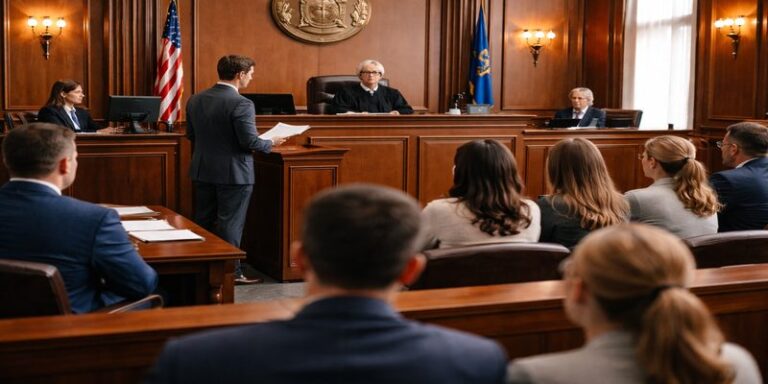
Most people have heard of a criminal court, where the state prosecutes someone accused of breaking the law. A civil court, by contrast, deals with disputes between individuals, businesses, organisations, or public bodies. In simple terms, civil courts are where people go when they believe a legal wrong has been done to them and they want a remedy such as compensation, an injunction, or a declaration of their rights. A disagreement over an unpaid invoice, a boundary dispute between neighbours, a claim for medical negligence, or a complaint about a faulty product may all end up in a civil court.
Civil courts matter because they help turn abstract legal rights into something practical. A right is of limited value if there is no effective way to enforce it. As Genn (2010) argues, the civil justice system is not merely a forum for private quarrels; it also supports social order, economic confidence and the rule of law. For ordinary citizens, civil courts provide a structured method of resolving conflict without violence or self-help. This article explores what civil courts do, how they work, why they matter, and the challenges they face in the modern justice system.
1.0 What Is a Civil Court?
1.1 A Court for Private Legal Disputes
A civil court hears cases where one party, known as the claimant or plaintiff, brings a claim against another party, usually called the defendant. Unlike criminal proceedings, the aim is generally not punishment but resolution. The court decides whether a legal duty has been breached and what remedy, if any, should follow.
For example, if a builder is paid to renovate a kitchen but leaves the work incomplete and unsafe, the homeowner may bring a civil claim for breach of contract. If a driver causes a road accident through careless driving, the injured person may sue in civil court for damages in the law of negligence.
1.2 Civil Court versus Criminal Court
The difference between civil and criminal courts is important. In a criminal case, the state alleges that a person has committed an offence against society. In a civil case, one party alleges that another has caused a private wrong. The standard of proof is also different. In civil proceedings, the court usually decides the case on the balance of probabilities, meaning what is more likely than not, whereas criminal cases usually require proof beyond reasonable doubt or its equivalent (Zuckerman, 2021).
2.0 The Main Types of Cases Heard in Civil Courts
2.1 Contract Disputes
A large proportion of civil cases involve contracts. These arise when one side claims that the other failed to keep a legally binding promise. Examples include unpaid debts, disputes over construction work, failed business agreements, and disagreements between landlords and tenants.
2.2 Tort Claims
Civil courts also hear claims in tort, a branch of law covering wrongful acts that cause harm. The best-known example is negligence. A patient harmed by poor medical treatment, a customer injured by a dangerous floor in a supermarket, or a pedestrian struck by a careless cyclist may all seek compensation through the civil courts. Lunney and Oliphant (2024) explain that tort law aims both to compensate injury and to reinforce standards of reasonable behaviour.
2.3 Property, Housing and Consumer Disputes
Many everyday disputes are more modest but still important. Civil courts may hear cases about housing disrepair, deposit disagreements, ownership of land, consumer rights, or nuisance between neighbours. These cases may not attract headlines, but they can have major effects on people’s homes, health and finances.
2.4 Claims Involving Public Bodies
Sometimes civil courts review disputes involving the state or public authorities. A person may challenge an unlawful administrative decision or seek redress where a public body has breached a duty. In that sense, civil justice is not just about private conflict; it is also a way of holding power to account.
3.0 How Civil Court Proceedings Work
3.1 Starting a Claim
A civil case usually begins when the claimant files a formal claim setting out the facts, legal basis and remedy sought. The defendant then has an opportunity to admit, deny, or defend the claim. Courts increasingly encourage early settlement and the exchange of information before a full hearing.
3.2 Case Management and Evidence
Modern civil justice is not simply a dramatic courtroom battle. Much of the real work happens through documents, witness statements, expert evidence and judicial case management. Judges often control timetables, narrow the issues and encourage proportionality so that cases do not become unnecessarily expensive or complex. Zuckerman (2021) notes that procedure is not a technical sideshow; it shapes whether justice is practical, fair and affordable.
3.3 Settlement, Trial and Remedies
Many civil claims settle before trial. That is not necessarily a failure of justice. In fact, negotiated settlement can save time, reduce stress and allow more flexible outcomes. Still, where parties cannot agree, the case proceeds to a hearing or trial. If the claimant succeeds, the court may award damages, order specific performance, grant an injunction, or make a declaration clarifying legal rights.
4.0 Why Civil Courts Matter
4.1 Protecting Everyday Rights
Civil courts are often the place where ordinary life meets the law. They help people enforce rights that affect work, home, health, trade and reputation. A small business chasing an unpaid bill may depend on civil justice for survival. A tenant living with severe damp may rely on the court to force repairs. A person injured by unsafe equipment may need compensation to pay for treatment and lost earnings.
4.2 Supporting the Economy and the Rule of Law
Civil courts also serve a wider public purpose. Businesses are more willing to invest and trade when contracts can be enforced, and disputes resolved in a predictable way. Genn (2010) argues that civil justice is a form of public infrastructure: it underpins confidence in markets, institutions and legal order. Without it, rights may exist only on paper.
4.3 Encouraging Fair Behaviour
The possibility of civil liability can shape conduct long before a case reaches court. Employers may improve safety procedures, manufacturers may strengthen quality control, and service providers may take complaints more seriously because they know legal accountability exists.
5.0 Challenges Facing Civil Courts
5.1 Cost and Delay
One of the most persistent criticisms of civil courts is that they can be expensive, slow and intimidating. Legal fees, expert reports and court costs may deter people from bringing even strong claims. Rhode (2004) and Sandefur (2008) both emphasise that access to civil justice is deeply unequal, with poorer and marginalised groups often facing the greatest barriers.
5.2 Access to Justice
This creates a serious problem. If only wealthy people or large organisations can realistically enforce their rights, the promise of equal justice is weakened. Greene (2015) highlights how race and class can shape access to civil justice, while Shapiro (2020) argues that court access is unevenly distributed across society.
5.3 The Rise of Alternatives
Because of these difficulties, many systems now encourage mediation, arbitration and other forms of alternative dispute resolution. Cappelletti (1993) saw such methods as part of a broader access-to-justice movement. These approaches can be helpful, but they are not a complete substitute for courts. The authority of a public court remains vital, especially where there is a power imbalance or a need for enforceable precedent.
A civil court is far more than a place for technical legal arguments. It is where people and organisations turn when they need a peaceful, lawful way to resolve disputes and enforce rights. Civil courts hear cases about contracts, negligence, property, consumer issues, and many other matters that shape daily life. They matter not only because they offer remedies to individuals, but because they support trust, accountability and the rule of law across society. Yet civil justice also faces serious challenges, especially around cost, delay and unequal access. A well-functioning civil court system is therefore essential: not glamorous perhaps, but fundamental to any fair and stable society.
References
Cappelletti, M. (1993) ‘Alternative dispute resolution processes within the framework of the world-wide access-to-justice movement’, The Modern Law Review, 56(3), pp. 282–296. Available at: https://onlinelibrary.wiley.com/doi/10.1111/j.1468-2230.1993.tb02673.x (Accessed: 6 March 2026).
Genn, H. (2010) Judging Civil Justice. Cambridge: Cambridge University Press.
Greene, S.S. (2015) ‘Race, class, and access to civil justice’, Iowa Law Review, 101(4), pp. 1263–1321. Available at: https://papers.ssrn.com/sol3/papers.cfm?abstract_id=2592150 (Accessed: 6 March 2026).
Judiciary of England and Wales (no date) About the courts and tribunals judiciary. Available at: https://www.judiciary.uk/about-the-judiciary/our-justice-system/ (Accessed: 6 March 2026).
Lunney, M. and Oliphant, K. (2024) Tort Law: Text and Materials. 7th edn. Oxford: Oxford University Press.
Ministry of Justice (no date) Civil justice statistics quarterly: England and Wales. Available at: https://www.gov.uk/government/collections/civil-justice-statistics-quarterly (Accessed: 6 March 2026).
Rhode, D.L. (2004) Access to Justice. Oxford: Oxford University Press.
Sandefur, R.L. (2008) ‘Access to civil justice and race, class, and gender inequality’, Annual Review of Sociology, 34, pp. 339–358. Available at: https://doi.org/10.1146/annurev.soc.34.040507.134534 (Accessed: 6 March 2026).
Shapiro, M.A. (2020) ‘Distributing civil justice’, Georgetown Law Journal, 109(1), pp. 77–141. Available at: https://papers.ssrn.com/sol3/papers.cfm?abstract_id=3675848 (Accessed: 6 March 2026).
Zuckerman, A.A.S. (2021) Zuckerman on Civil Procedure: Principles of Practice. 4th edn. London: Sweet & Maxwell.