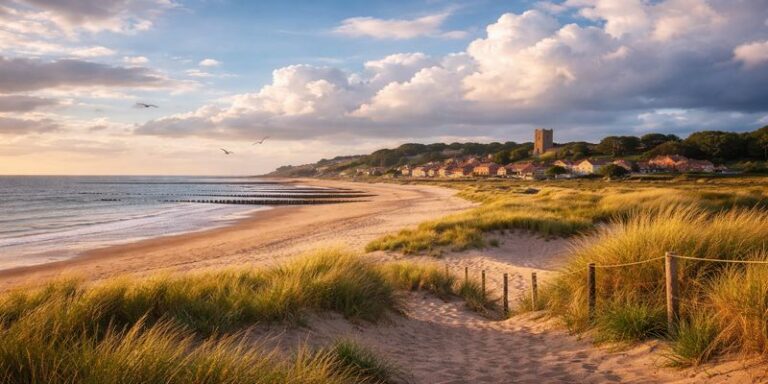
There is a particular quality of light in Norfolk. Locals call it the land of the “big skies”, where horizons stretch wide above salt marshes, golden beaches and gently rolling farmland. Stand on the dunes at Holkham Beach at sunset, wander the medieval lanes of Norwich, or drift quietly along the reed-lined waterways of the Norfolk Broads, and you will quickly understand why this eastern county has long captured the British imagination.
Tourism scholars argue that destinations thrive when they combine natural landscapes, cultural heritage and authentic local experience (Cooper, 2005; Holloway and Humphreys, 2019). Norfolk offers precisely this blend. It is a place where heritage and hospitality, food and farming, and coast and countryside come together in a way that feels both restorative and quietly exhilarating.
1.0 Brief Background / History
Norfolk’s tourism story is rooted in both history and geography. In the Middle Ages, Norwich was England’s second city, a centre of trade and ecclesiastical power. The county’s coastline and rivers supported fishing and maritime industries, while inland estates such as Holkham Hall and Sandringham symbolised aristocratic wealth.
The development of tourism in Norfolk accelerated during the nineteenth century railway expansion, which made seaside towns such as Great Yarmouth, Cromer and Hunstanton accessible to urban visitors (Holloway and Humphreys, 2019). As Page (2011) notes, improved transport infrastructure is a key driver of destination growth.
The creation of the Norfolk Broads—a unique network of navigable rivers and lakes formed from medieval peat diggings—further shaped the county’s identity as a leisure destination. Today, the Broads are recognised as a protected landscape, balancing recreation with environmental management in line with sustainable tourism principles (Murphy, 2014; Gössling, Hall and Weaver, 2009).
Modern Norfolk tourism reflects broader UK trends towards experiential travel, rural escapes and sustainable practices (Morrison and Buhalis, 2024). Visitors increasingly seek slower, meaningful experiences: cycling quiet lanes, sampling local produce, and connecting with landscape and heritage.
2.0 Accommodation
Norfolk’s accommodation offer reflects the diversity of its landscape. From boutique city hotels in Norwich to thatched cottages in rural villages, seafront guesthouses, luxury lodges, and eco-friendly barn conversions, there is something for every preference and budget.
The county exemplifies the range of the tourism accommodation sector described by Medlik (2012), encompassing hotels, self-catering units, campsites and heritage properties. In coastal towns, traditional guesthouses continue the Victorian seaside legacy, while inland, farm stays and converted granaries align with the growth of rural tourism (Roberts and Hall, 2001).
Sustainability is increasingly visible. Many providers emphasise local sourcing, energy efficiency and conservation, reflecting broader industry shifts towards environmentally responsible hospitality (Harris, Williams and Griffin, 2012). On the Broads, waterside lodges and houseboats allow visitors to immerse themselves directly in nature—though operators must carefully manage environmental impact (Caffyn, 2024).
3.0 Food & Drink
Norfolk’s culinary scene is deeply tied to its agricultural heritage. Fertile soils and coastal waters yield Cromer crab, Brancaster mussels, artisan cheeses, asparagus, samphire and locally reared meats. Food has become a central element of destination appeal, as gastronomy increasingly shapes travel motivation (Robinson, 2012; Sloan, Legrand and Hindley, 2015).
In Norwich, independent cafés, bakeries and fine-dining restaurants celebrate seasonal ingredients. Coastal pubs serve fresh seafood with views of tidal creeks. Farm shops and food festivals highlight the county’s field-to-fork ethos.
Food tourism literature highlights how cuisine reinforces place identity and visitor satisfaction (Cleave, 2020). In Norfolk, food is not simply sustenance—it is storytelling. Sampling local produce connects visitors to farming traditions, maritime culture and regional pride.
4.0 Things to Do
Norfolk offers a rich spectrum of experiences:
4.1 Coastal Exploration
The county boasts over 90 miles of coastline. The Norfolk Coast Area of Outstanding Natural Beauty provides dunes, salt marshes and bird reserves. Walking the Norfolk Coast Path combines physical activity with ecological appreciation.
4.2 The Broads National Park
Boating, kayaking and wildlife watching define the Broads experience. Sustainable management is crucial here, as increased visitor numbers require careful balancing of conservation and recreation (Murphy, 2014).
4.3 Historic Norwich
With its Norman cathedral, medieval streets and vibrant arts scene, Norwich blends past and present. Cultural heritage tourism remains a major motivator for UK domestic travel (Chhabra, 2010).
4.4 Country Estates and Gardens
Holkham Hall, Blickling Estate and Sandringham offer architecture, landscaped gardens and seasonal events.
4.5 Wildlife and Nature
Norfolk is a haven for birdwatchers, particularly at Cley Marshes and Snettisham. Rural landscapes also support cycling and walking tourism, aligned with low-impact travel trends (Gössling, Hall and Weaver, 2009).
5.0 Sample Itinerary (Three Days)
This enhanced itinerary blends heritage, coastline, waterways and traditional seaside culture, offering a rounded experience of Norfolk’s diversity.
Day One: Norwich & The East Coast (Great Yarmouth and Hemsby)
Morning – Norwich
- Explore Norwich Cathedral, one of England’s finest Romanesque buildings.
- Wander the cobbled streets of Elm Hill, rich in medieval character.
Afternoon – Great Yarmouth
- Travel east to Great Yarmouth, one of Britain’s classic seaside resorts.
- Stroll along the historic Golden Mile promenade.
- Visit the Time and Tide Museum or enjoy traditional fish and chips by the sea.
Late Afternoon – Hemsby
- Continue north to Hemsby Beach, known for its wide sandy shoreline and dunes.
- Enjoy a peaceful coastal walk away from busier resort areas.
Evening
- Return to Norwich or stay in a coastal guesthouse.
- Dine at a locally sourced, farm-to-table restaurant, reflecting Norfolk’s strong agricultural heritage.
Day Two: The Broads & Cromer
Morning – The Norfolk Broads (Wroxham)
- Hire a day boat in Wroxham, often called the “capital of the Broads”.
- Cruise through reed-lined waterways, observing wildlife and tranquil riverside villages.
Afternoon – Cromer
- Travel to Cromer, famed for its Victorian pier and renowned Cromer crab.
- Walk along the clifftop paths for panoramic coastal views.
- Sample fresh seafood at a traditional seaside café.
Evening
- Watch sunset from Cromer Pier, particularly atmospheric as the sun dips into the North Sea.
- Stay overnight in a seaside hotel or countryside inn nearby.
Day Three: Hunstanton & The North Norfolk Coast
Morning – Hunstanton
- Visit Hunstanton, unique for being Norfolk’s only west-facing resort.
- Admire its distinctive striped cliffs and enjoy sea views across The Wash.
Afternoon – Holkham & Wells-next-the-Sea
- Walk along Holkham Beach, celebrated for its vast sands and dunes.
- Visit Wells-next-the-Sea harbour and sample fresh seafood or local ice cream.
Evening – Blakeney or Coastal Villages
- End the day with a sunset walk at Blakeney Point, known for wildlife and expansive skies.
- Alternatively, enjoy a relaxed dinner in a coastal village pub.
This itinerary blends heritage, landscape and gastronomy, reflecting integrated tourism planning principles (Cooper, 2005).
6.0 When to Visit
Spring (April–June) brings wildflowers and migratory birds.
Summer (July–August) offers beach weather and festivals but higher visitor numbers.
Autumn (September–October) provides dramatic coastal light and quieter trails.
Winter delivers atmospheric seascapes and festive markets in Norwich.
Seasonality remains a structural feature of UK coastal tourism (Stabler, Papatheodorou and Sinclair, 2009). Visiting in shoulder seasons supports local businesses while avoiding peak congestion.
7.0 Travel Tips
- Transport: A car offers flexibility, though trains connect Norwich to London and Cambridge (Page, 2005).
- Book Early: Coastal accommodation fills quickly in summer.
- Respect Nature: Follow countryside codes, especially in protected areas.
- Support Local: Choose independent cafés and farm shops.
- Check Tides: Coastal walks may be tide-dependent.
Sustainable tourism frameworks emphasise responsible visitor behaviour as essential to long-term destination resilience (Harris, Williams and Griffin, 2012).
8.0 Why It’s Worth Visiting
Norfolk’s appeal lies not in spectacle but in subtle richness. It offers space to breathe beneath expansive skies, moments of stillness on tidal marshes, and the warmth of village pubs after windswept walks.
In tourism theory, successful destinations combine place identity, accessibility and authentic experience (Cooper, 2005; Holloway and Humphreys, 2019). Norfolk achieves this with quiet confidence. Whether you seek coastal adventure, cultural discovery or culinary exploration, the county rewards curiosity.
To visit Norfolk is to rediscover the simple pleasure of landscape, history and hospitality working in harmony.
References
Caffyn, A. (2024) ‘Contested rural landscapes: Contemporary entanglements of tourism and farming’, Journal of Sustainable Tourism. Available at: https://www.tandfonline.com/doi/abs/10.1080/09669582.2022.2134399.
Chhabra, D. (2010) Sustainable marketing of cultural and heritage tourism. London: Routledge.
Cooper, C. (2005) Tourism: Principles and practice. Harlow: Pearson Education.
Cleave, P. (2020) ‘Food as a leisure pursuit, a United Kingdom perspective’, Annals of Leisure Research. Available at: https://www.tandfonline.com/doi/abs/10.1080/11745398.2019.1613669.
Gössling, S., Hall, C.M. and Weaver, D. (2009) Sustainable tourism futures. London: Routledge.
Harris, R., Williams, P. and Griffin, T. (2012) Sustainable tourism. Oxford: Butterworth-Heinemann.
Holloway, J.C. and Humphreys, C. (2019) The business of tourism. London: Sage.
Medlik, S. (2012) Dictionary of travel, tourism and hospitality. Oxford: Butterworth-Heinemann.
Morrison, A.M. and Buhalis, D. (2024) Routledge handbook of trends and issues in tourism sustainability. London: Routledge.
Murphy, S.A. (2014) Sustainable tourism development in UK National Parks. York: York St John University. Available at: https://etheses.whiterose.ac.uk/id/eprint/6815/.
Page, S. (2005) Transport and tourism: Global perspectives. Harlow: Pearson Education.
Roberts, L. and Hall, D. (2001) Rural tourism and recreation: Principles to practice. Wallingford: CABI.
Robinson, P. (2012) Tourism: The key concepts. London: Routledge.
Stabler, M.J., Papatheodorou, A. and Sinclair, M.T. (2009) The economics of tourism. London: Routledge.