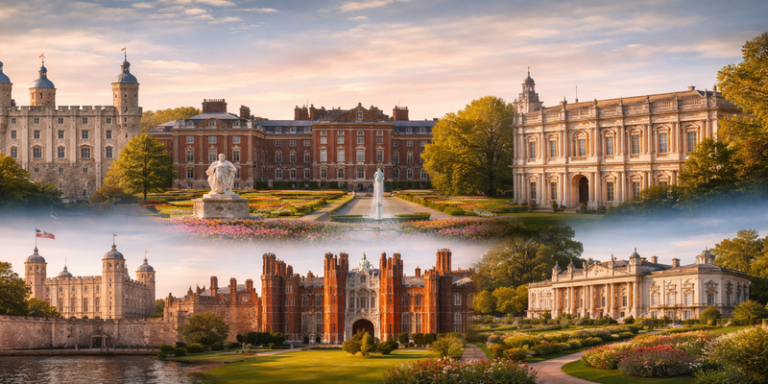
The United Kingdom’s Historic Royal Palaces (HRP) are more than architectural relics—they are living monuments that preserve, interpret and celebrate over 1,000 years of British royal history. Alongside closely associated royal landmarks such as Buckingham Palace and Windsor Castle, these sites collectively embody the evolution of monarchy, governance, and national identity.
Together, the Tower of London, Hampton Court Palace, Kensington Palace, Banqueting House, Kew Palace, Hillsborough Castle, Buckingham Palace, and Windsor Castle serve as guardians of national memory, hosting millions of visitors each year while playing vital roles in education, identity, diplomacy, and heritage-led regeneration.
1.0 A Palace-by-Palace Glimpse into Britain’s Soul and Story
1.1 Buckingham Palace
Buckingham Palace has served as the official London residence of the British monarch since Queen Victoria’s reign in 1837. Originally built as Buckingham House in the early 18th century, it evolved into a symbol of constitutional monarchy and state authority. The palace is the focal point of national ceremonies, including Changing of the Guard, state banquets, and royal celebrations. While not managed by HRP, it is inseparable from Britain’s royal narrative and global image.
1.2 Windsor Castle
Founded by William the Conqueror in the 11th century, Windsor Castle is the oldest and largest occupied castle in the world. It has served as a royal residence for over 900 years, reflecting architectural developments from medieval fortifications to Gothic revival splendour. Closely associated with Queen Elizabeth II, Windsor Castle represents continuity, stability, and the enduring presence of monarchy in British life.
1.3 Tower of London
Constructed by William the Conqueror in the 11th century following his victory at the Battle of Hastings, the Tower of London was initially a symbol of Norman power over a newly conquered England. Throughout history, it served as a royal palace, fortress, mint, menagerie, prison, and execution ground. It was here that Anne Boleyn, Thomas More, and Lady Jane Grey met their fates. Today, the Tower is best known for housing the Crown Jewels, watched over by the iconic Yeoman Warders (Impey & Parnell, 2000).
1.4 Hampton Court Palace
Initially built by Cardinal Thomas Wolsey in the early 16th century, Hampton Court Palace was seized by King Henry VIII after Wolsey fell from royal favour. The palace became the epicentre of Tudor court life, witnessing lavish banquets, royal marriages, and intense political intrigue. Later expanded by William III and Mary II in the late 17th century, its Baroque additions sit alongside original Tudor structures, making it a rare example of two contrasting architectural eras under one roof (Thurley, 2003).
1.5 Kensington Palace
Originally a modest Jacobean mansion known as Nottingham House, Kensington Palace was acquired in 1689 by William III and Mary II, who sought a residence away from polluted central London. It later became the childhood home of Queen Victoria and was closely associated with Diana, Princess of Wales, in the late 20th century. Today, it remains an official royal residence while also housing exhibitions that explore the private and public lives of royalty (Strong, 1999).
1.6 Banqueting House
The Banqueting House is the sole surviving fragment of the once-vast Whitehall Palace, the principal residence of English monarchs from 1530 to 1698. Designed by Inigo Jones and completed in 1622, it introduced Palladian architecture to England, signalling a shift towards Renaissance ideals. Most famously, it was the site of King Charles I’s execution in 1649, a defining moment in British constitutional history. The Rubens ceiling, celebrating the divine right of kings, adds a poignant historical irony (Summerson, 1993).
1.7 Kew Palace
The smallest of the royal palaces, Kew Palace originated in the 17th century as a merchant’s house before becoming a royal residence in the 18th century. It was used extensively by King George III and offers rare insight into royal domestic life and the monarch’s struggles with mental illness. Located within the UNESCO-listed Royal Botanic Gardens, Kew Palace uniquely connects royal, scientific, and botanical heritage (Porter, 2004).
1.8 Hillsborough Castle and Gardens
Located in Northern Ireland, Hillsborough Castle was built in the 18th century as a Georgian country house before becoming a royal residence in the 1920s. It serves as the official residence of the Secretary of State for Northern Ireland and has played a significant role in political diplomacy, particularly during the Northern Ireland peace process. Today, it symbolises the monarchy’s role in reconciliation and governance (Historic Royal Palaces, 2024).
2.0 Cultural Relevance Beyond Bricks and Mortar
These historic sites preserve not only stone and stories, but also play vital roles in education, economic renewal, and cultural diplomacy.
2.1 Educational Impact
Historic Royal Palaces facilitates learning for over half a million students annually, offering curriculum-aligned programmes that transform history into lived experience (HRP, 2023). From analysing Henry VIII’s marriages at Hampton Court to understanding the English Civil War through Banqueting House, students are invited to walk in the footsteps of history.
Falk and Dierking (2013) argue that heritage learning environments enhance memory retention and emotional engagement, particularly when learners experience history in situ.
2.2 Economic Revitalisation and Regeneration
The Tower of London alone welcomed over 2.8 million visitors in 2019, contributing substantially to London’s cultural economy (VisitBritain, 2020). Conservation projects across royal sites, including Kensington Palace and Hillsborough Castle, demonstrate how heritage-led regeneration can revitalise urban and regional spaces while maintaining historical integrity (Jones & Evans, 2012; Pendlebury, 2013).
2.3 Soft Power and Global Cultural Identity
Royal palaces function as powerful instruments of soft power, attracting global audiences through tourism, diplomacy, and popular culture (Nye, 2004). International interest in series such as The Crown reinforces the global fascination with Britain’s royal past and present (Hall, 2020). Sites such as Hillsborough Castle further illustrate how royal spaces can support political dialogue and reconciliation within a multinational UK.
3.0 Living Symbols of Heritage and Hope
Britain’s royal palaces are not static relics; they are active participants in shaping how society understands its past and imagines its future. From the Tudor splendour of Hampton Court to the ceremonial authority of Buckingham Palace and the enduring continuity of Windsor Castle, each site contributes to a shared cultural soul.
As historian David Cannadine observes, “Heritage is not just about the past; it is also about the present’s use of the past to shape the future” (Cannadine, 2001). Britain’s royal palaces exemplify this principle daily—educating, inspiring, and connecting millions of people across generations and borders.
References
Cannadine, D. (2001). Ornamentalism: How the British Saw Their Empire. Oxford University Press.
Falk, J.H. & Dierking, L.D. (2013). The Museum Experience Revisited. Walnut Creek: Left Coast Press.
Glendinning, M. (2013). The Conservation Movement: A History of Architectural Preservation. Routledge.
Hall, S. (2020). ‘Netflix’s The Crown and Cultural Diplomacy’, Journal of Media & Cultural Studies, 34(6), pp. 899–915.
Historic Royal Palaces. (2023). Learning and Engagement Report. Available at: https://www.hrp.org.uk.
Historic Royal Palaces. (2024). About Our Palaces. Available at: https://www.hrp.org.uk.
Impey, E. & Parnell, G. (2000). The Tower of London: The Official Illustrated History. Merrell.
Jones, P. & Evans, J. (2012). Urban Regeneration in the UK: Theory and Practice. SAGE.
Nye, J.S. (2004). Soft Power: The Means to Success in World Politics. Public Affairs.
Pendlebury, J. (2013). ‘Conservation Values and the Authorised Heritage Discourse’, International Journal of Heritage Studies, 19(7), pp. 709–727.
Porter, R. (2004). Madness: A Brief History. Oxford University Press.
Strong, R. (1999). Kensington Palace: The Official Illustrated History. Merrell Holberton.
Summerson, J. (1993). Architecture in Britain: 1530–1830. Penguin Books.
Thurley, S. (2003). Hampton Court Palace: The Official Guidebook. Historic Royal Palaces.
VisitBritain. (2020). Inbound Tourism Statistics. Available at: https://www.visitbritain.org.