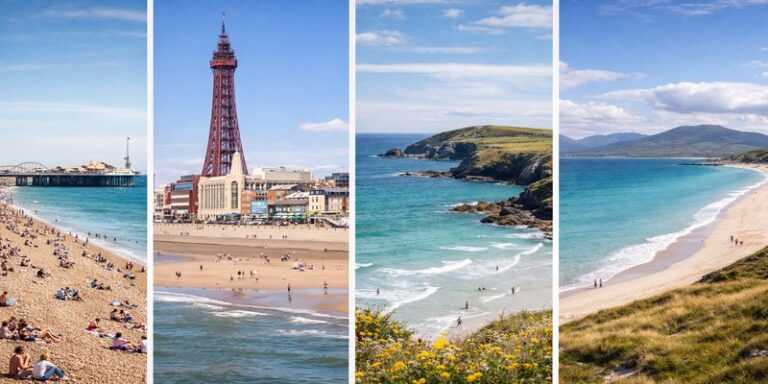
For generations, the British seaside has held a special place in the nation’s holiday imagination. Long before cheap flights and overseas package tours, families packed trunks, boarded trains, and headed for the coast in search of sea air, sandy shores, and simple pleasures. Today, the United Kingdom’s beaches and coastal resorts remain central to domestic tourism, offering a rich mix of heritage, natural beauty, nostalgia, and modern leisure experiences.
Despite the unpredictability of the weather, Britain’s beaches and coastal resorts continues to attract millions of visitors each year, proving that seaside holidays are about far more than sunshine alone.
1.0 A Seaside Tradition Rooted in History
The popularity of coastal tourism in the UK dates back to the eighteenth and nineteenth centuries, when medical professionals promoted sea bathing as beneficial to health (Hassan, 2016). Resorts such as Brighton, Scarborough, and Blackpool flourished as railways made travel accessible to the growing middle and working classes.
According to Walton (2000), the seaside holiday became one of the earliest forms of mass tourism, shaping leisure habits that still influence travel behaviour today. Although overseas travel reduced long-stay domestic holidays from the 1960s onwards, recent decades have seen a revival driven by short breaks, staycations, and experiential travel (Agarwal & Shaw, 2007).
2.0 Brighton: Where Culture Meets the Coast
Few places capture the spirit of the modern British seaside better than Brighton. Set against the Sussex coastline, its pebble beach, historic pier, and Regency architecture attract visitors seeking a blend of relaxation and urban energy.
Brighton has successfully reinvented itself as a centre for arts, nightlife, food tourism, and LGBTQ+ travel, illustrating how coastal resorts can diversify beyond traditional beach tourism (Maitland, 2007). Visitors may spend the afternoon by the sea, explore independent shops in The Lanes, and enjoy live music or theatre by night—making Brighton ideal for weekend breaks and city-coast hybrids.
3.0 Blackpool: The Classic British Seaside Experience
If Brighton represents reinvention, Blackpool embodies tradition. Often described as the archetypal British seaside resort, Blackpool rose to prominence during the industrial era as a holiday escape for working-class families (Walton, 2009).
Its famous attractions—the Blackpool Tower, Pleasure Beach, Golden Mile, and Illuminations—highlight the enduring importance of entertainment, spectacle, and fun in seaside tourism. Research by Hughes and Allen (2008) shows that live entertainment remains a key motivator for visitors to traditional resorts.
While Blackpool has faced social and economic challenges, regeneration efforts demonstrate how heritage and popular culture can support tourism resilience and renewal.
4.0 Bournemouth: Sandy Beaches and Family Appeal
On England’s south coast, Bournemouth offers a different seaside atmosphere. Known for its wide sandy beaches, mild climate, and landscaped gardens, it consistently ranks among the UK’s most popular beach destinations.
Bournemouth’s frequent Blue Flag awards underline the importance of environmental quality in coastal tourism decision-making (Phillips & House, 2009). The resort appeals particularly to families, older visitors, and international students, demonstrating how coastal destinations can serve multiple markets simultaneously (Morgan & Pritchard, 1999).
5.0 Cornwall: Nature, Surf and Coastal Escapes
For travellers seeking dramatic scenery and outdoor experiences, Cornwall stands apart. Its coastline is dotted with celebrated beaches such as Fistral Beach (Newquay), Porthcurno, and St Ives, each offering a distinctive sense of place.
Cornwall’s popularity reflects a broader shift towards experiential and nature-based tourism, where visitors value walking, surfing, local food, and cultural authenticity (Jennings, 2004). The region has also become a leader in sustainable coastal tourism, balancing visitor demand with environmental protection.
6.0 Devon and the English Riviera
The English Riviera, encompassing Torquay, Paignton, and Brixham, combines gentle beaches with maritime heritage and elegant promenades. Historically associated with refined seaside holidays, the area continues to attract multi-generational families and short-break visitors.
Morgan and Pritchard (1999) argue that Devon’s resorts demonstrate how regional branding and identity influence visitor perceptions, reinforcing the emotional pull of familiar seaside landscapes.
7.0 Wilder Shores: Wales and Scotland
Beyond England, some of the UK’s most spectacular beaches are found in Wales and Scotland. Rhossili Bay on the Gower Peninsula and Luskentyre Beach in the Outer Hebrides are frequently ranked among the world’s most beautiful beaches.
Research suggests that visitors to these areas are motivated by tranquillity, scenery, and a sense of escape, rather than traditional resort entertainment (Tunstall & Penning-Rowsell, 1998). These destinations appeal strongly to walkers, photographers, and eco-tourists, highlighting the diversity of Britain’s coastal offer.
8.0 The Future of Britain’s Coastal Holidays
The future of UK seaside tourism depends on sustainability, regeneration, and adaptability. Coastal erosion, climate change, and social inequality present ongoing challenges, while changing visitor expectations demand innovation (Jennings, 2004).
Yet the enduring popularity of staycations, combined with renewed appreciation for local travel, suggests a positive outlook. As Walton (2011) observes, the British seaside has always evolved—absorbing change while retaining its distinctive character.
From lively promenades to windswept sands, Britain’s beaches and coastal resorts continue to offer something uniquely comforting and compelling: a holiday close to home, shaped by memory, landscape, and the timeless pull of the sea.
References
Agarwal, S. & Shaw, G. (2007) Managing Coastal Tourism Resorts: A Global Perspective. Clevedon: Channel View.
Hassan, J. (2016) The Seaside, Health and the Environment in England and Wales since 1800. London: Routledge.
Hughes, H.L. & Allen, D. (2008) Entertainment and its significance in the holiday experience at UK seaside resorts. Tourism Recreation Research, 33(2), pp. 173–181.
Jennings, S. (2004) Coastal tourism and shoreline management. Annals of Tourism Research, 31(4), pp. 899–922.
Maitland, R. (2007) Cultural tourism and the development of new tourism areas in London. In: Cultural Tourism: Global and Local Perspectives. London: Routledge.
Morgan, N. & Pritchard, A. (1999) Power and Politics at the Seaside: The Development of Devon’s Resorts. Exeter: University of Exeter Press.
Phillips, M.R. & House, C. (2009) An evaluation of priorities for beach tourism. Tourism Management, 30(1), pp. 20–29.
Tunstall, S. & Penning-Rowsell, E. (1998) The English beach: experiences and values. Geographical Journal, 164(3), pp. 292–305.
Walton, J.K. (2000) The British Seaside: Holidays and Resorts in the Twentieth Century. Manchester: Manchester University Press.
Walton, J.K. (2009) Seaside tourism on a global stage. Journal of Tourism History, 1(1), pp. 1–15.
VisitBritain (2024) Seaside and Coastal Holidays in the UK. Available at: https://www.visitbritain.com.