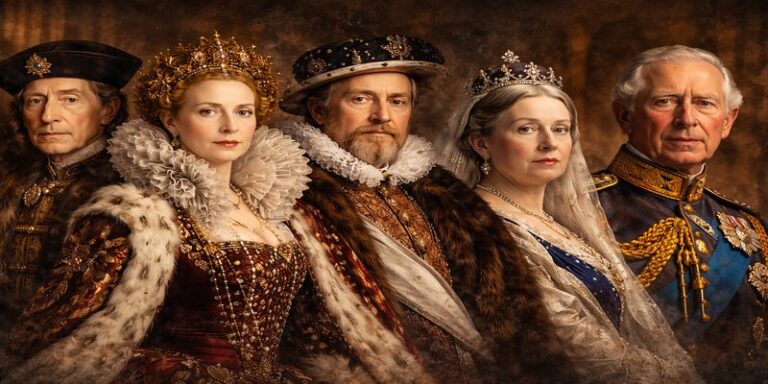
It is a question that often arises in discussions of British history: are today’s royal family descended from the Tudors? At first glance, the answer may appear to be no. The Tudor dynasty ended in 1603 with the death of Elizabeth I, who left no children. The current royal house is the House of Windsor, a name adopted in 1917. Between these two points lie several dynastic changes — Stuart, Hanoverian and Saxe-Coburg and Gotha.
Yet genealogy tells a more intricate story. Although the Tudor surname disappeared, the Tudor bloodline did not vanish. Through intermarriage and succession, it continued — and it flows today in the veins of the modern monarchy. To understand how, we must trace the path of inheritance across four centuries.
1.0 The End of the Tudor Dynasty
The Tudor dynasty began in 1485, when Henry VII defeated Richard III at the Battle of Bosworth Field, ending the Wars of the Roses (Carpenter, 1997). Henry’s marriage to Elizabeth of York united the rival houses of Lancaster and York and strengthened the legitimacy of his line.
The Tudors ruled England through:
- Henry VII
- Henry VIII
- Edward VI
- Mary I
- Elizabeth I
However, Elizabeth I never married and had no children. When she died in 1603, the direct Tudor royal line ended (Guy, 1988). Yet the succession did not break from Tudor ancestry entirely.
2.0 The Scottish Link: Margaret Tudor
The key to Tudor survival lies not in Elizabeth I, but in her aunt: Margaret Tudor, the eldest daughter of Henry VII.
In 1503, Margaret married James IV of Scotland, forging an Anglo-Scottish alliance. Their descendants inherited the Scottish throne. When Elizabeth I died, her closest Protestant relative was Margaret Tudor’s great-grandson, James VI of Scotland, who became James I of England in 1603 (Morrill, 2005).
Thus, although England moved from the Tudor dynasty to the Stuart dynasty, the new king was still a great-great-grandson of Henry VII. The Tudor bloodline continued through the female line.
3.0 The Stuarts: Tudor Blood in a New Dynasty
The Stuart monarchs — including Charles I, Charles II, and James II — were therefore direct descendants of the Tudors. Even dramatic events such as the English Civil War and the execution of Charles I in 1649 did not alter this genealogical reality.
After the Glorious Revolution of 1688, James II was deposed and replaced by his Protestant daughter Mary II and her husband William III. Mary II, like her father, descended from Margaret Tudor. The line remained intact.
When Mary’s sister Queen Anne died childless in 1714, Parliament invoked the Act of Settlement (1701), which restricted succession to Protestant heirs (Bogdanor, 1995). The crown passed to a distant relative — George I of Hanover — but even this apparent shift did not sever Tudor ancestry.
4.0 The Hanoverians: German by Name, Tudor by Blood
George I’s claim derived from his mother, Sophia of Hanover, who was the granddaughter of James I of England. Since James I descended from Margaret Tudor, George I — and all subsequent Hanoverians — also carried Tudor ancestry (Cannadine, 2020).
The Hanoverian dynasty included:
- George III
- George IV
- William IV
- Queen Victoria
Queen Victoria’s long reign (1837–1901) reshaped the monarchy’s public image, but genealogically she remained part of the same extended family tree reaching back to Henry VII — and ultimately to earlier medieval monarchs such as Edward III and William the Conqueror.
5.0 From Saxe-Coburg to Windsor
Queen Victoria married Prince Albert of Saxe-Coburg and Gotha, introducing a new dynastic name. Their descendants ruled under that house name until 1917, when George V changed it to Windsor during the First World War to avoid anti-German sentiment (Cannadine, 2020).
Despite these changes in title and branding, the hereditary line remained continuous. Elizabeth II, who reigned for seventy years, descended directly from Victoria, and therefore from the Hanoverians, Stuarts and Tudors.
Her son, King Charles III, continues that lineage.
6.0 How Direct Is the Descent?
Genealogically, the connection is not symbolic but demonstrable. A simplified line of descent runs as follows:
Henry VII
→ Margaret Tudor
→ James V of Scotland
→ Mary, Queen of Scots
→ James I of England
→ Sophia of Hanover
→ George I
→ Queen Victoria
→ Elizabeth II
→ Charles III
This chain illustrates the continuity of Tudor ancestry in the modern monarchy.
Because European royal families intermarried extensively, today’s monarch is descended from the Tudors through multiple lines. As historians of genealogy often observe, royal bloodlines are interwoven networks rather than simple linear successions.
7.0 Why the Confusion?
The confusion arises because people often equate dynasty with bloodline. A dynasty refers to the ruling house name — Tudor, Stuart, Hanoverian, Windsor — whereas a bloodline traces biological descent.
The Tudor dynasty ended in 1603, but Tudor ancestry persisted. In fact, the present royal family can trace descent not only to the Tudors but also to:
- The Plantagenets
- The Norman kings
- And even pre-Conquest Anglo-Saxon monarchs (via intermarriage)
As Bartlett (2000) notes, medieval European royal families were deeply interconnected. Political marriages were tools of diplomacy, alliance and legitimacy.
8.0 The Meaning of Continuity
The fact that today’s royal family descends from the Tudors underscores the remarkable continuity of Britain’s monarchy. Although the political powers of the Crown have diminished significantly since the sixteenth century, the hereditary principle remains intact.
The monarchy has transformed from an institution of personal rule — as under Henry VIII — into a constitutional monarchy, where the sovereign reigns but does not govern (Bogdanor, 1995). Yet the genealogical link to Tudor England persists.
This continuity contributes to the monarchy’s symbolic authority. It represents a living connection to centuries of British history — from the Reformation and the Armada to empire and modern parliamentary democracy.
9.0 Final Thoughts
So, are today’s royals descended from the Tudors?
Yes — but not through the direct male Tudor line.
When Elizabeth I died childless in 1603, the Tudor dynasty ended. However, through Margaret Tudor’s marriage into the Scottish royal house, Tudor blood passed to the Stuarts, then to the Hanoverians, and ultimately to the modern House of Windsor.
King Charles III is therefore a descendant of Henry VII — and by extension, of a long chain of English monarchs stretching back nearly a millennium.
The names of royal houses may change, but the thread of ancestry remains unbroken.
References
Bartlett, R. (2000) England under the Norman and Angevin Kings 1075–1225. Oxford: Oxford University Press.
Bogdanor, V. (1995) The Monarchy and the Constitution. Oxford: Clarendon Press.
Cannadine, D. (2020) The Decline and Fall of the British Aristocracy. New Haven: Yale University Press.
Carpenter, C. (1997) The Wars of the Roses: Politics and the Constitution in England, c.1437–1509. Cambridge: Cambridge University Press.
Guy, J. (1988) Tudor England. Oxford: Oxford University Press.
Morrill, J. (2005) Stuart Britain: A Very Short Introduction. Oxford: Oxford University Press.