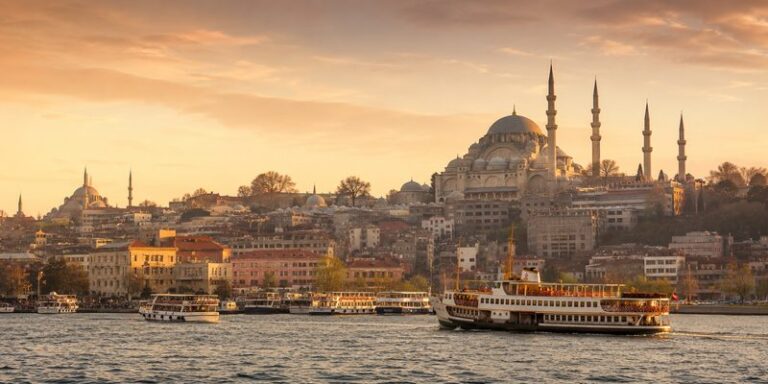
✧ The Ottoman Empire was one of history’s most remarkable imperial powers. At its height, it stretched across Europe, Asia and Africa, linking the Mediterranean, the Middle East, the Balkans and North Africa through trade, conquest, diplomacy and culture. Its capital, Istanbul, formerly Constantinople, became a city of palaces, mosques, markets and diplomatic intrigue.
The story of the Ottoman Empire is not simply a tale of sultans and battles. It is also a story of administration, religious diversity, urban life, artistic achievement, military innovation and reform. From its frontier origins in north-western Anatolia to its formal dissolution after the First World War, the empire shaped the modern histories of Turkey, the Arab world, south-eastern Europe and the wider Mediterranean.
1.0 The Origins of the Ottoman Empire
The Ottoman Empire began as a small principality in Anatolia in the late thirteenth and early fourteenth centuries. It was associated with Osman I, whose followers expanded into Byzantine frontier lands. The early Ottoman state benefited from flexible military organisation, frontier warfare and the ability to absorb different communities into its political structure (İnalcık and Quataert, 1994).
Expansion was not only military. The Ottomans also built alliances, offered protection to local elites and developed administrative systems that helped newly conquered regions remain productive. This combination of force, negotiation and governance helped the state grow rapidly.
2.0 List of Ottoman Sultans
The Ottoman dynasty ruled for more than six centuries, from Osman I in the early fourteenth century to Mehmed VI in the early twentieth century. The following list shows the Ottoman sultans in chronological order:
- Osman I (c. 1299–1324)
- Orhan (1324–1362)
- Murad I (1362–1389)
- Bayezid I (1389–1402)
- Mehmed I (1413–1421)
- Murad II (1421–1444; 1446–1451)
- Mehmed II — Mehmed the Conqueror (1444–1446; 1451–1481)
- Bayezid II (1481–1512)
- Selim I (1512–1520)
- Süleyman I — Süleyman the Magnificent (1520–1566)
- Selim II (1566–1574)
- Murad III (1574–1595)
- Mehmed III (1595–1603)
- Ahmed I (1603–1617)
- Mustafa I (1617–1618; 1622–1623)
- Osman II (1618–1622)
- Murad IV (1623–1640)
- Ibrahim (1640–1648)
- Mehmed IV (1648–1687)
- Süleyman II (1687–1691)
- Ahmed II (1691–1695)
- Mustafa II (1695–1703)
- Ahmed III (1703–1730)
- Mahmud I (1730–1754)
- Osman III (1754–1757)
- Mustafa III (1757–1774)
- Abdülhamid I (1774–1789)
- Selim III (1789–1807)
- Mustafa IV (1807–1808)
- Mahmud II (1808–1839)
- Abdülmecid I (1839–1861)
- Abdülaziz (1861–1876)
- Murad V (1876)
- Abdülhamid II (1876–1909)
- Mehmed V (1909–1918)
- Mehmed VI (1918–1922)
This long line of rulers shows the continuity of the Ottoman imperial dynasty, which helped transform a frontier principality into one of the most powerful empires in world history.
3.0 Territories of the Ottoman Empire at Its Greatest Extent
At its greatest extent, the Ottoman Empire was a vast transcontinental power stretching across south-eastern Europe, western Asia and North Africa. Its territory was not always controlled in the same way: some regions were ruled directly by Ottoman governors, while others were semi-autonomous provinces, tributary states or frontier zones owing allegiance to the sultan. Even so, by the late sixteenth and seventeenth centuries, the empire had become one of the largest and most strategically important states in the world (İnalcık and Quataert, 1994; Quataert, 2005).
In Europe, Ottoman rule covered much of the Balkans. This included territories corresponding broadly to modern Greece, Bulgaria, Albania, North Macedonia, Kosovo, Serbia, Bosnia and Herzegovina, Montenegro and parts of Croatia, Romania and Hungary. The empire also controlled Thrace, including its capital Istanbul, and held important frontier positions along the Danube. For a period, parts of central Hungary were under direct Ottoman administration, while Transylvania, Wallachia and Moldavia often functioned as tributary principalities rather than fully integrated provinces (Faroqhi, 2004).
In Asia, the Ottoman Empire ruled Anatolia, the heartland of modern Turkey, and extended across much of the Middle East. Its Asian territories included Syria, Lebanon, Palestine, Jordan, Iraq and parts of the Arabian Peninsula. After the conquests of Sultan Selim I in the early sixteenth century, the empire gained control of major Arab lands, including Greater Syria, Egypt and the holy cities of Mecca and Medina through the Hejaz. This gave the Ottoman sultan enormous religious prestige as protector of the Islamic holy places (Hathaway, 2019).
In North Africa, Ottoman authority extended along much of the southern Mediterranean coast. The empire ruled or strongly influenced Egypt, Libya, Tunisia and Algeria, though some of these provinces, especially in the western Mediterranean, developed considerable local autonomy. Egypt was particularly important because of its agricultural wealth, tax revenue and position between the Mediterranean, the Red Sea and the wider Indian Ocean trade networks (İslamoğlu-İnan, 2004).
The empire’s reach also touched the Red Sea, the Persian Gulf and the eastern Mediterranean islands. Ottoman power included important islands such as Cyprus, Crete and Rhodes, which strengthened control over sea routes and naval movement. Its influence reached into parts of Yemen and western Arabia, although control in these areas was often uneven and contested due to geography, local politics and distance from the imperial centre.
At its height, therefore, the Ottoman Empire connected three continents and controlled key routes between Europe, Asia and Africa. Its territories included major cities such as Istanbul, Cairo, Damascus, Aleppo, Baghdad, Jerusalem, Mecca, Medina, Sarajevo, Sofia, Thessaloniki and Belgrade. This vast geography made the empire a meeting point of languages, religions, cultures, trade routes and political traditions. It also explains why the Ottoman legacy remains visible today across the Balkans, Turkey, the Middle East and North Africa.
4.0 The Ottoman Empire and the Conquest of Constantinople
A defining moment came in 1453, when Sultan Mehmed II, later known as Fatih, or “the Conqueror”, captured Constantinople. This event transformed the Ottoman state into a major imperial power. Constantinople became Istanbul, the political and symbolic centre of the empire.
The conquest had deep historical significance. It ended the Byzantine Empire and gave the Ottomans control of a strategic city connecting the Black Sea, the Mediterranean and European trade routes. Mehmed II also encouraged the rebuilding of the city by bringing in Muslims, Christians and Jews, turning Istanbul into a vibrant imperial capital (Faroqhi, 1997).
5.0 Government and Power in the Ottoman Empire
The Ottoman Empire was ruled by a sultan, but its success depended on a complex administrative system. The central government included the Imperial Council, palace officials, judges, tax administrators and military commanders. The empire also relied on provincial governors to manage distant territories.
One important institution was the devşirme system, through which Christian boys from the Balkans were recruited, converted to Islam and trained for service in the army or administration. Some rose to become powerful statesmen. The elite Janissary corps became one of the empire’s most famous military forces, although it later became politically influential and resistant to reform (Imber, 2002).
Justice and legitimacy were important ideals. Ottoman rulers presented themselves as protectors of order, religion and prosperity. Tax collection, landholding and legal systems were designed to support both the state and local society, though experiences varied across regions and periods (Darling, 1996).
6.0 Society and Religion in the Ottoman Empire
The Ottoman Empire governed a diverse population, including Muslims, Christians, Jews, Arabs, Turks, Greeks, Armenians, Kurds, Slavs and many others. Religious communities often organised their own family law, education and charitable institutions. This did not mean complete equality by modern standards, but it did allow many groups to maintain communal identities within the imperial system (Faroqhi, 2005).
The empire’s cities were full of social and economic activity. Istanbul, Cairo, Damascus, Aleppo, Sarajevo and Thessaloniki contained markets, workshops, schools, mosques, churches, synagogues, bathhouses and caravanserais. Everyday life was shaped by trade, craft production, religious observance, family networks and neighbourhood communities.
7.0 Economy, Trade and Urban Life
The economy of the Ottoman Empire was closely connected to agriculture, taxation and long-distance trade. Grain, textiles, spices, coffee, silk and metal goods moved through imperial markets. Ottoman lands linked Europe with the Middle East and Indian Ocean trade routes, although global commercial shifts gradually changed these patterns (İslamoğlu-İnan, 2004).
Money and finance also mattered. The empire used a variety of coins and fiscal systems, while tax farming became increasingly important in later centuries. Economic historians have shown that the empire was not simply “declining” after the sixteenth century; rather, it was adapting to new pressures, including European commercial expansion, military costs and internal administrative challenges (Pamuk, 2000).
8.0 Culture, Architecture and Learning in the Ottoman Empire
The Ottoman Empire produced a rich cultural legacy. Ottoman architecture reached a high point under Mimar Sinan, the sixteenth-century architect responsible for masterpieces such as the Süleymaniye Mosque in Istanbul and the Selimiye Mosque in Edirne. These buildings expressed imperial power, religious devotion and artistic refinement.
Ottoman culture also included calligraphy, miniature painting, poetry, music, ceramics and manuscript production. Court culture was sophisticated, but artistic life was not limited to the palace. Guilds, religious foundations and urban patrons supported schools, fountains, libraries and public buildings.
Education was often linked to religious institutions, especially madrasas, but knowledge also circulated through bureaucratic training, translation, diplomacy and practical expertise. By the nineteenth century, new military, medical and administrative schools reflected the state’s desire to reform and compete with European powers (Davison, 2015).
9.0 Reform and Challenge in the Ottoman Empire
From the eighteenth century onwards, the Ottoman Empire faced serious challenges. Military defeats, territorial losses, nationalist movements, debt and European political pressure weakened imperial authority. However, the empire did not simply collapse overnight. It responded with major reforms.
The Tanzimat reforms of the nineteenth century aimed to modernise law, administration, taxation and citizenship. Reformers attempted to strengthen the state and create a broader sense of Ottoman belonging among different religious and ethnic groups (Köksal, 2019). New ministries, courts, schools and provincial councils were introduced.
These reforms produced important changes, but they also created tensions. Some groups wanted greater autonomy or independence, while others resisted centralisation. The empire’s final decades were marked by war, migration, constitutional politics and competing visions of identity.
10.0 The Fall and Legacy of the Ottoman Empire
The Ottoman Empire formally ended after the First World War. Its defeat led to occupation, partition plans and conflict. The Turkish War of Independence followed, and the Republic of Turkey was declared in 1923 under Mustafa Kemal Atatürk.
The empire’s legacy remains visible today. Borders, legal traditions, religious communities, architecture, cuisine, music and political debates across the Balkans, Middle East and North Africa still carry traces of Ottoman rule. The empire is remembered in different ways: as a period of order, conquest, coexistence, hierarchy, reform or imperial domination, depending on the perspective and region.
∎ The Ottoman Empire was a vast and adaptable civilisation that shaped world history for more than six centuries. Its power rested not only on armies and conquest, but also on administration, trade, religious management, urban culture and reform. Its history reveals how empires grow, govern diversity, respond to crisis and leave complex legacies.
Rather than being viewed only through the lens of rise and decline, the Ottoman story is best understood as one of transformation. Its influence continues to be felt in modern politics, culture, architecture and identity across a wide region of the world.
References
Darling, L.T. (1996). Revenue-Raising and Legitimacy: Tax Collection and Finance Administration in the Ottoman Empire, 1560–1660. Leiden: Brill.
Davison, R.H. (2015). Reform in the Ottoman Empire, 1856–1876. Princeton: Princeton University Press.
Faroqhi, S. (1997). An Economic and Social History of the Ottoman Empire. Cambridge: Cambridge University Press.
Faroqhi, S. (2004). The Ottoman Empire and the World Around It. London: I.B. Tauris.
Faroqhi, S. (2005). Subjects of the Sultan: Culture and Daily Life in the Ottoman Empire. London: I.B. Tauris.
Hathaway, J. (2019). The Arab Lands under Ottoman Rule: 1516–1800. London: Routledge.
İnalcık, H. and Quataert, D. (eds.) (1994). An Economic and Social History of the Ottoman Empire, 1300–1914. Cambridge: Cambridge University Press.
İslamoğlu-İnan, H. (ed.) (2004). The Ottoman Empire and the World-Economy. Cambridge: Cambridge University Press.
Imber, C. (2002). The Ottoman Empire, 1300–1650: The Structure of Power. Basingstoke: Palgrave Macmillan.
Köksal, Y. (2019). The Ottoman Empire in the Tanzimat Era: Provincial Perspectives from Ankara to Edirne. London: Routledge.
Pamuk, Ş. (2000). A Monetary History of the Ottoman Empire. Cambridge: Cambridge University Press.
Quataert, D. (2005). The Ottoman Empire, 1700–1922. Cambridge: Cambridge University Press.
Tezcan, B. (2010). The Second Ottoman Empire: Political and Social Transformation in the Early Modern World. Cambridge: Cambridge University Press.