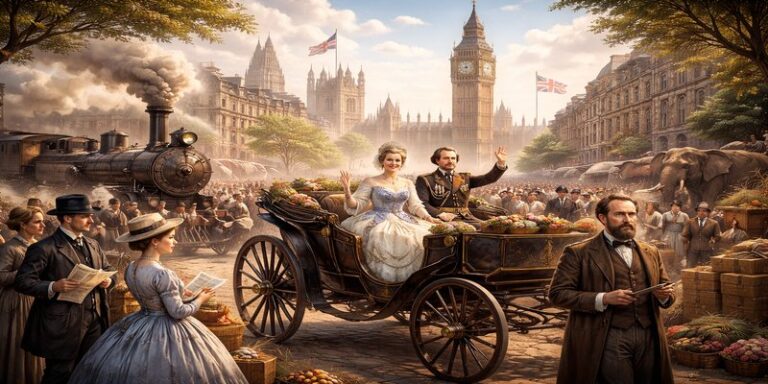
The Victorian era (1837–1901), defined by the reign of Queen Victoria, represents one of the most dynamic and transformative periods in British history. Marked by rapid industrial expansion, imperial growth, scientific innovation and profound social change, the era reshaped Britain’s domestic structures and its global position. By the late nineteenth century, Britain stood at the height of its economic and imperial power, often described as the “workshop of the world” (Darwin, 2009).
Yet beneath this image of progress and confidence lay deep social inequalities, political tensions and moral debates. The Victorian period was characterised by contrasts: wealth and poverty, faith and doubt, reform and repression. This article explores the defining features of the Victorian age, examining its political leadership, economic development, social reforms, cultural achievements and imperial ambitions.
1.0 Political Stability and Reform
1.1 Monarchy and Governance
Queen Victoria’s accession to the throne in 1837 followed a period of political uncertainty. Her long reign provided symbolic continuity during decades of change. Although constitutional monarchy limited her direct political authority, Victoria exercised significant influence, particularly in foreign affairs (Briggs, 1999).
The Victorian era also witnessed the maturation of Britain’s parliamentary democracy. The Reform Acts of 1832 (just prior to Victoria’s reign), 1867 and 1884 gradually extended the franchise, increasing male participation in elections. These reforms reflected growing recognition of the political voice of the urban working and middle classes (Evans, 2001).
1.2 Ireland and Political Tensions
Despite political stability in mainland Britain, tensions persisted in Ireland. The Great Famine (1845–1849) devastated the Irish population, causing mass starvation and emigration. British governmental responses were widely criticised, intensifying nationalist sentiment. Later demands for Home Rule highlighted unresolved constitutional questions within the United Kingdom.
2.0 Industrial Growth and Urban Society
2.1 Economic Expansion
Building upon earlier industrial developments, the Victorian era saw remarkable economic growth. Britain dominated global trade in textiles, coal, iron and manufactured goods. By the mid-nineteenth century, it produced more than half the world’s iron and cotton cloth (Allen, 2009).
The Great Exhibition of 1851, held in the Crystal Palace in London, celebrated British industrial achievement and technological innovation. Exhibits from across the empire reinforced Britain’s self-image as a global leader in industry and progress.
Railways expanded rapidly during this period, transforming travel, commerce and communication. By 1900, Britain had one of the densest railway networks in the world, connecting industrial centres to ports and markets.
2.2 Urbanisation and Social Conditions
Industrial prosperity was accompanied by dramatic urbanisation. Cities such as London, Manchester and Birmingham grew rapidly, attracting migrants seeking employment. However, overcrowding, poor sanitation and air pollution posed serious challenges.
Public health reforms gradually improved conditions. The Public Health Acts of 1848 and 1875 introduced sanitation standards and local health authorities. Urban improvements reflected growing awareness of the links between environment and wellbeing (Porter, 1999).
3.0 Social Reform and Moral Values
3.1 The ‘Victorian Values’ Debate
The Victorian era is often associated with so-called “Victorian values”—emphasis on morality, discipline, hard work and respectability. While this portrayal can oversimplify complex realities, it reflects prevailing middle-class ideals regarding family life, gender roles and social responsibility (Thompson, 1963).
Women’s roles were largely confined to domestic spheres, especially within the middle class. However, industrial employment offered working-class women economic participation, albeit often under harsh conditions.
3.2 Education and Social Improvement
Education reform expanded significantly. The Education Act of 1870 established elementary schooling for children, reflecting recognition of literacy as essential in an industrial society. By the end of the century, education had become compulsory and more widely accessible.
Philanthropic and reform movements addressed issues such as child labour, factory conditions and housing. The Factory Acts limited working hours and improved protections for women and children.
4.0 Science, Innovation and Intellectual Change
4.1 Scientific Breakthroughs
The Victorian era witnessed extraordinary scientific progress. Most notably, Charles Darwin’s On the Origin of Species (1859) challenged traditional religious understandings of creation, sparking intense debate about science and faith (Desmond and Moore, 1991).
Advances in engineering, medicine and communication transformed everyday life. The telegraph reduced communication times dramatically, while improvements in medicine, including antiseptic surgery introduced by Joseph Lister, enhanced survival rates.
4.2 Literature and Cultural Achievement
Victorian Britain produced a rich literary culture. Authors such as Charles Dickens, the Brontë sisters and Thomas Hardy explored themes of industrial hardship, morality and social injustice. Dickens’ novels, for example, vividly portrayed urban poverty and child exploitation.
Cultural institutions, museums and libraries expanded, reflecting growing public engagement with knowledge and leisure.
5.0 Empire at its Zenith
5.1 Imperial Expansion
The Victorian era marked the height of the British Empire. By the late nineteenth century, Britain controlled territories across Africa, Asia and the Pacific. The “Scramble for Africa” in the 1880s saw Britain acquire vast new colonies, including Egypt, Sudan and parts of southern Africa (Darwin, 2009).
India, described as the “jewel in the crown”, remained central to imperial strategy. Following the Indian Rebellion of 1857, governance shifted from the East India Company to direct Crown rule.
5.2 Economic and Cultural Impact
Empire strengthened Britain’s access to raw materials and global markets. It also shaped British identity, reinforcing narratives of civilising mission and racial hierarchy. However, imperial rule frequently involved coercion and resistance.
Conflicts such as the Boer War (1899–1902), which began during the final years of Victoria’s reign, exposed the costs and controversies of imperial expansion.
6.0 Contradictions and Criticisms
Despite its achievements, the Victorian era was marked by stark inequalities. Wealth generated by industry coexisted with slum poverty. Imperial confidence masked tensions within colonies and at home.
Historians such as Briggs (1999) emphasise that Victorian society was neither uniformly prosperous nor morally unified. Reform and resistance, progress and hardship existed side by side.
The Victorian era (1837–1901) was a period of extraordinary transformation. Britain experienced sustained industrial growth, urban expansion and scientific innovation while presiding over the largest empire in history. Political reforms gradually broadened participation, and social legislation improved living conditions for many.
Yet the era was also defined by inequality, imperial tension and cultural debate. Its legacy endures in Britain’s institutions, infrastructure and global connections. Understanding the Victorian period provides crucial insight into the foundations of modern Britain—its strengths, contradictions and enduring influence.
References
Allen, R.C. (2009) The British Industrial Revolution in Global Perspective. Cambridge: Cambridge University Press.
Briggs, A. (1999) Victorian People: A Reassessment of Persons and Themes 1851–1867. London: Penguin.
Darwin, J. (2009) The Empire Project: The Rise and Fall of the British World-System, 1830–1970. Cambridge: Cambridge University Press.
Desmond, A. and Moore, J. (1991) Darwin. London: Penguin.
Evans, E.J. (2001) The Forging of the Modern State: Early Industrial Britain 1783–1870. 3rd edn. Harlow: Pearson.
Porter, R. (1999) The Greatest Benefit to Mankind: A Medical History of Humanity. London: HarperCollins.
Thompson, E.P. (1963) The Making of the English Working Class. London: Victor Gollancz.