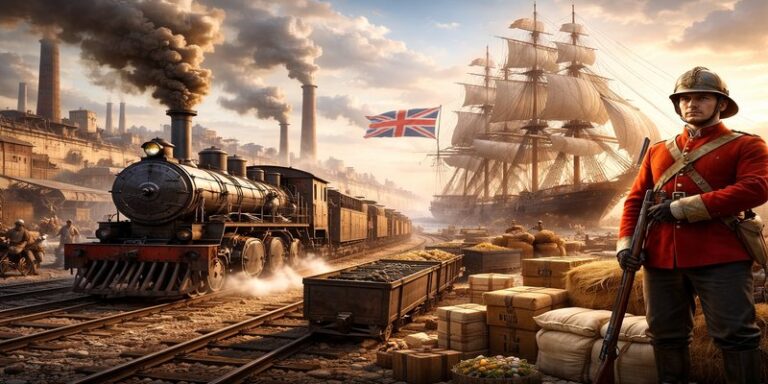
The eighteenth and nineteenth centuries were among the most transformative periods in British history, marked by profound economic, social and political change. During this era, Britain became the birthplace of the Industrial Revolution, a process that reshaped production, labour, technology and urban life. Simultaneously, Britain constructed the largest empire the world had yet seen, extending its influence across North America, the Caribbean, Africa, India and Australasia. Together, industrialisation and imperial expansion altered not only Britain’s domestic landscape but also the global balance of power.
As Colley (2009) observes, Britain’s rise was closely linked to its capacity for adaptation, innovation and overseas engagement. Meanwhile, O’Brien (2006) situates Britain’s imperial expansion within the broader processes of early globalisation, characterised by intensified trade, capital flows and migration. This article explores the interwoven developments of industrialisation and empire, highlighting their economic foundations, social consequences and lasting legacies.
1.0 The Industrial Revolution: Origins and Drivers
1.1 Technological Innovation
The Industrial Revolution, beginning in the mid-eighteenth century, was driven by remarkable technological advances. In textile manufacturing, inventions such as the spinning jenny, the water frame and the power loom revolutionised cloth production. James Watt’s improvements to the steam engine in the 1770s transformed energy use, enabling mechanised production and railway transport (Mokyr, 2009).
Coal and iron resources were crucial. Britain’s abundant coal reserves powered steam engines and ironworks, while its navigable rivers and expanding canal network facilitated internal trade. According to Allen (2009), Britain’s relatively high wages and cheap energy created strong incentives to mechanise production.
1.2 Agricultural and Financial Foundations
Industrialisation did not occur in isolation. The preceding Agricultural Revolution increased food production and freed labour for urban industries. Enclosure policies consolidated farmland, raising productivity but displacing rural populations.
Equally important were Britain’s financial institutions. The Bank of England, established in 1694, and a sophisticated banking system supported investment and credit. London’s position as a financial centre strengthened Britain’s capacity to fund industrial and imperial ventures.
2.0 Urbanisation and Social Transformation
2.1 The Growth of Industrial Cities
Industrialisation triggered rapid urbanisation. Cities such as Manchester, Birmingham and Liverpool expanded dramatically as people migrated from rural areas in search of work. Manchester, once a small market town, became synonymous with textile manufacturing and industrial capitalism.
However, rapid growth produced severe challenges. Overcrowded housing, poor sanitation and pollution characterised many industrial centres. Engels’ The Condition of the Working Class in England (1845) vividly described the harsh realities of urban life.
2.2 Labour and Class
The Industrial Revolution reshaped labour patterns and social structure. A new industrial working class emerged alongside an expanding middle class of factory owners, merchants and professionals. Factory work imposed regimented hours and mechanised discipline, replacing many traditional artisanal trades.
Reform movements responded to social pressures. The Factory Acts (beginning in 1833) sought to regulate child labour and working hours. Trade unions gradually gained legal recognition, advocating for improved wages and conditions (Thompson, 1963).
Thus, industrialisation generated both economic growth and profound social inequality.
3.0 Britain and the Expansion of Empire
3.1 Empire and Global Trade Networks
While Britain industrialised at home, it expanded overseas. By the nineteenth century, the British Empire spanned territories across every inhabited continent. This empire connected Britain to global markets, resources and labour.
Colonial possessions in India, parts of Africa, the Caribbean and Australasia supplied raw materials such as cotton, sugar, tea and rubber. Manufactured goods produced in British factories were exported worldwide. O’Brien (2006) argues that imperial trade networks integrated Britain into an emerging global economy, reinforcing its industrial strength.
India became particularly significant after the East India Company’s territorial expansion in the eighteenth century and the establishment of Crown rule in 1858. British policies restructured India’s economy to serve imperial interests, stimulating export agriculture and infrastructure development while provoking resistance.
3.2 The Atlantic World and Slavery
Earlier imperial wealth was closely linked to the Atlantic slave trade and plantation economies in the Caribbean. Profits from sugar and slave labour contributed to British commercial expansion (Walvin, 2011). Although Britain abolished the slave trade in 1807 and slavery in its colonies in 1833, the economic legacy of slavery continued to shape imperial relations.
4.0 The Victorian Era: Confidence and Contradiction
4.1 Imperial Confidence
The reign of Queen Victoria (1837–1901) symbolised Britain’s imperial and industrial dominance. The Great Exhibition of 1851, held in London’s Crystal Palace, showcased British technological achievements and global reach.
By the late nineteenth century, Britain controlled roughly a quarter of the world’s land surface and population. The Royal Navy protected trade routes, reinforcing Britain’s reputation as the world’s leading maritime power (Darwin, 2009).
4.2 Tensions and Resistance
Yet empire was not uncontested. In Ireland, demands for Home Rule intensified throughout the nineteenth century, reflecting political and cultural tensions within the United Kingdom. The Great Famine (1845–1849) exposed structural inequalities and exacerbated resentment towards British governance.
In India, the 1857 Rebellion—often termed the Indian Mutiny in British accounts—challenged Company rule and led to the transfer of authority to the Crown. Later nationalist movements, including the Indian National Congress (founded in 1885), signalled growing resistance.
Imperial rule thus combined economic opportunity with coercion, reform with repression.
5.0 Industrialisation and Empire: Interconnected Forces
Industrialisation and empire were deeply interconnected. Factories required raw materials, while empire provided both resources and markets. Conversely, imperial wealth helped finance industrial infrastructure and naval expansion.
This dynamic relationship exemplifies what historians describe as proto-globalisation—a period of expanding global trade, migration and communication before the twentieth century (O’Brien, 2006). Railways, telegraphs and steamships shortened distances, intensifying global integration.
However, Britain’s dominance was not permanent. By the late nineteenth century, Germany and the United States were industrialising rapidly, challenging Britain’s economic leadership.
The eighteenth and nineteenth centuries reshaped Britain and the wider world. The Industrial Revolution transformed production, urban life and social relations, establishing Britain as the world’s first industrial nation. Simultaneously, imperial expansion connected Britain to global trade networks, reinforcing its economic and political influence.
Yet these developments were marked by contradictions. Industrial growth brought prosperity but also inequality and hardship. Empire generated wealth and prestige but provoked resistance and exploitation. As Colley (2009) suggests, Britain’s identity during this period was forged through both domestic transformation and overseas engagement.
The legacy of industrialisation and empire continues to shape contemporary debates about economic development, globalisation and historical responsibility. Understanding this era is essential to comprehending Britain’s modern position in the world.
References
Allen, R.C. (2009) The British Industrial Revolution in Global Perspective. Cambridge: Cambridge University Press.
Colley, L. (2009) Britons: Forging the Nation 1707–1837. 3rd edn. New Haven: Yale University Press.
Darwin, J. (2009) The Empire Project: The Rise and Fall of the British World-System, 1830–1970. Cambridge: Cambridge University Press.
Engels, F. (1845) The Condition of the Working Class in England. Leipzig: Otto Wigand.
Mokyr, J. (2009) The Enlightened Economy: An Economic History of Britain 1700–1850. New Haven: Yale University Press.
O’Brien, P.K. (2006) ‘Historiographical traditions and modern imperatives for the restoration of global history’, Journal of Global History, 1(1), pp. 3–39.
Thompson, E.P. (1963) The Making of the English Working Class. London: Victor Gollancz.
Walvin, J. (2011) The Slave Trade. London: Robinson.