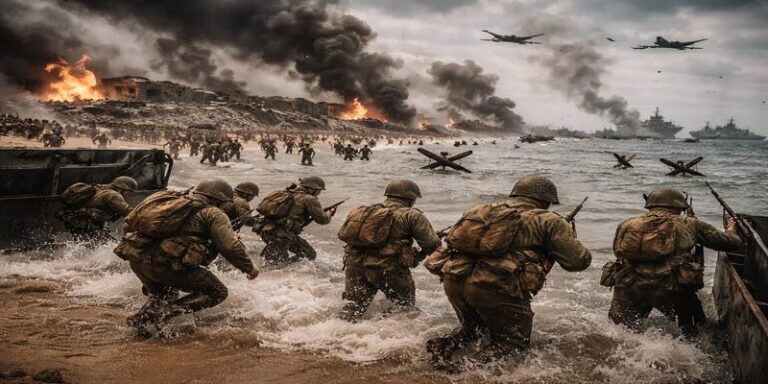
D-Day is one of the most important and widely remembered events of the Second World War. It refers to the Allied invasion of Nazi-occupied France on 6 June 1944, when British, American, Canadian and other Allied forces landed on the beaches of Normandy. Although the term “D-Day” can mean the launch day of any military operation, it is now most strongly associated with this historic invasion. The success of D-Day did not end the war immediately, but it marked the beginning of the liberation of Western Europe and placed Nazi Germany under growing pressure from both west and east. To understand D-Day properly, it is necessary to look at its planning, execution, human cost and long-term significance.
1.0 What Was D-Day?
1.1 D-Day and Operation Overlord
D-Day was the opening assault of Operation Overlord, the Allied campaign to establish a foothold in Normandy and push German forces out of France. The landings took place across five beaches: Utah, Omaha, Gold, Juno and Sword. Thousands of ships, landing craft and aircraft supported the invasion, making it one of the largest amphibious operations in history (Keegan, 1989).
The sheer scale of D-Day was astonishing. According to leading historians, the operation required detailed coordination between land, sea and air forces, as well as enormous logistical preparation in Britain before the crossing of the English Channel (Hastings, 1999). The invasion also depended on weather, timing and secrecy, all of which made it highly risky.
2.0 Why D-Day Was Necessary
2.1 The Strategic Importance of Opening a Western Front
By 1944, the Soviet Union had already inflicted major defeats on Germany in the east. However, the Western Allies needed to open a second major front in Europe to divide German resources and accelerate the defeat of Hitler’s regime. D-Day was designed to do exactly that.
The invasion also had political importance. Soviet leader Joseph Stalin had long demanded stronger action from Britain and the United States in Western Europe. A successful D-Day would therefore not only weaken Germany militarily but also demonstrate Allied unity (Beevor, 2009). In this sense, the operation mattered both on the battlefield and in the wider diplomacy of the wartime alliance.
3.0 Planning and Preparation for D-Day
3.1 Training, Deception and Logistics
The success of D-Day depended on months of careful planning. Troops trained intensively for amphibious warfare, while engineers prepared specialised equipment, including landing craft, artificial harbours and armoured vehicles. One of the most impressive achievements was the development of the Mulberry harbours, temporary portable harbours that allowed supplies to be landed even without capturing a major port immediately (Ford and Zaloga, 2009).
Another crucial element was deception. Through Operation Fortitude, the Allies convinced German commanders that the main invasion would occur at Pas-de-Calais, not Normandy. Fake armies, false radio traffic and dummy equipment helped mislead the enemy. This deception delayed the German response and gave the beachhead a better chance of survival (Ambrose, 1994).
3.2 Weather and Last-Minute Decisions
Weather conditions nearly forced a postponement. Rough seas and heavy cloud made the operation dangerous, especially for airborne troops and landing craft. General Dwight D. Eisenhower, the Supreme Allied Commander, made the final decision to go ahead after receiving a brief forecast of improved conditions. This decision became one of the most consequential military judgements of the war (Keegan, 1989).
4.0 How D-Day Unfolded
4.1 The Airborne Assault
Before the beach landings began, Allied airborne troops were dropped behind enemy lines during the night of 5–6 June. Their job was to seize bridges, disrupt communications and slow German reinforcements. Many paratroopers landed off target, yet they still caused confusion and made an important contribution to the success of D-Day (Beevor, 2009).
4.2 The Beach Landings
The main assault began in the early hours of 6 June. Conditions varied sharply from beach to beach. On Omaha Beach, American forces faced fierce German resistance and suffered especially heavy casualties. On Gold, Juno and Sword, British and Canadian forces also encountered strong opposition, but made steady progress inland. Utah Beach was comparatively less costly, partly because landings occurred in a slightly unexpected location.
Omaha remains the most famous example of the brutality of D-Day. Soldiers had to cross open sand under machine-gun fire, with many killed or wounded before reaching cover. Yet despite severe losses, Allied troops pushed forward, creating the foothold needed for further reinforcements (Hastings, 1999).
5.0 The Human Cost Of D-Day
5.1 Combat, Sacrifice and Civilians
D-Day is often remembered for courage and liberation, but it was also marked by fear, confusion and death. Thousands of Allied troops were killed, wounded or missing on 6 June alone. German forces also suffered serious casualties, and French civilians were caught in the destruction caused by bombing and ground fighting (Zetterling, 2000).
This human dimension is essential. The operation involved not just generals and grand strategy, but young soldiers facing chaos under fire. Oral histories and memoirs repeatedly show that many participants experienced D-Day as a mixture of terror, exhaustion and determination (Graff, 2024). Their individual experiences help explain why the event remains so powerful in public memory.
6.0 Why D-Day Matters in History
6.1 D-Day and the Liberation of Western Europe
The immediate result of D-Day was the establishment of an Allied beachhead in Normandy. Although fighting in Normandy continued for weeks, the invasion made it possible for Allied forces to break out, liberate Paris in August 1944 and continue advancing into Western Europe. Without D-Day, the defeat of Nazi Germany would probably have taken longer and may have unfolded very differently.
6.2 A Turning Point with Symbolic Power
Historians sometimes debate whether D-Day was the decisive turning point of the war, since Germany had already suffered catastrophic setbacks on the Eastern Front. Even so, few disagree that it was a decisive turning point in the liberation of Western Europe and in the final collapse of Hitler’s regime (Holland, 2019). It also became a symbol of multinational cooperation, planning and sacrifice.
Memory has shaped the meaning of D-Day as much as military history has. Museums, memorials and commemorations in Normandy, Britain and North America present it as both a strategic triumph and a moral struggle against tyranny (Dolski, Edwards and Buckley, 2014; Bird, Claxton and Reeves, 2016).
D-Day was far more than a dramatic military landing. It was the product of vast planning, international cooperation, deception, technological innovation and personal sacrifice. The Normandy landings did not end the Second World War in a single day, but they opened the way for the liberation of Western Europe and hastened the defeat of Nazi Germany. The story of D-Day still matters because it shows how strategy, courage and human cost intersect in moments of great historical change. Its legacy survives not only in textbooks and archives, but also in the beaches, cemeteries and memories that continue to remind later generations of what was at stake on 6 June 1944.
References
Ambrose, S.E. (1994) D-Day, June 6, 1944: The Climactic Battle of World War II. New York: Simon & Schuster.
Beevor, A. (2009) D-Day: The Battle for Normandy. London: Viking.
Bird, G., Claxton, S. and Reeves, K. (2016) Managing and Interpreting D-Day’s Sites of Memory: Guardians of Remembrance. Abingdon: Routledge.
Dolski, M., Edwards, S. and Buckley, J. (2014) D-Day in History and Memory: The Normandy Landings in International Remembrance and Commemoration. Denton, TX: University of North Texas Press.
Ford, K. and Zaloga, S.J. (2009) Overlord: The D-Day Landings. Oxford: Osprey Publishing.
Graff, G.M. (2024) When the Sea Came Alive: An Oral History of D-Day. New York: Avid Reader Press.
Hastings, M. (1999) Overlord: D-Day and the Battle for Normandy 1944. London: Pan Macmillan.
Holland, J. (2019) Normandy ’44: D-Day and the Epic 77-Day Battle for France. London: Bantam Press.
Imperial War Museums (2024) ‘What was D-Day?’, Imperial War Museums. Available at: https://www.iwm.org.uk/history/what-was-d-day (Accessed: 15 March 2026).
Keegan, J. (1989) The Second World War. London: Hutchinson.
The National WWII Museum (2024) ‘D-Day Invasion of Normandy’, The National WWII Museum. Available at: https://www.nationalww2museum.org/war/articles/d-day-invasion-normandy (Accessed: 15 March 2026).
Royal British Legion (2024) ‘What happened on D-Day?’, Royal British Legion. Available at: https://www.britishlegion.org.uk/stories/what-happened-on-d-day (Accessed: 15 March 2026).
Zetterling, N. (2000) Normandy 1944: German Military Organisation, Combat Power and Organisational Effectiveness. Winnipeg: J.J. Fedorowicz.