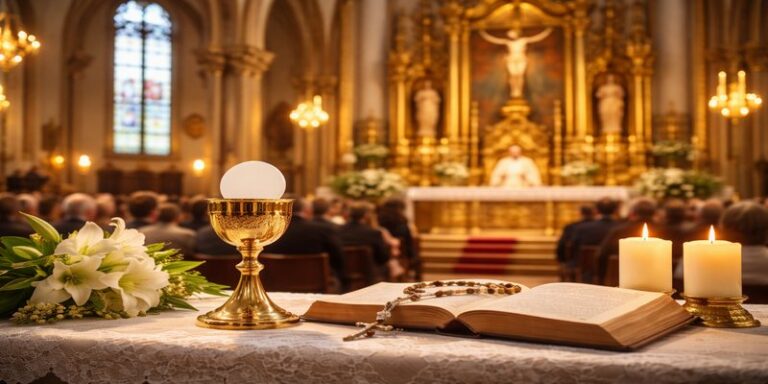
Catholicism is one of the oldest and most influential traditions within Christianity. It is not simply a set of religious rules or a single style of worship; rather, it is a broad and historically rich tradition that combines belief, ritual, community, moral teaching and a strong sense of continuity with the early Church. The word “Catholic” itself means universal, reflecting the Church’s claim to be a worldwide body of believers united in faith, sacrament and worship (O’Collins, 2017). Today, Catholics live on every continent and form one of the largest religious communities in the world, with local expressions that range from a village parish in rural Africa to a great cathedral in Rome or a school chapel in England. Although Catholicism is often associated with the Pope, Mass and the seven sacraments, it also includes a distinctive view of authority, tradition, morality and social responsibility (Catechism of the Catholic Church, 2012; Cunningham, 2009). This article explores what Catholicism is, what Catholics believe, how they worship and why the tradition continues to matter in the modern world.
1.0 The Meaning and History of Catholicism
1.1 A Historic Christian Tradition
At its heart, Catholicism is a branch of Christianity centred on the life, death and resurrection of Jesus Christ. Catholics believe that Christ entrusted the Church with a mission to preach the gospel, celebrate the sacraments and guide believers in faith and morals (Bauerschmidt and Buckley, 2016). The Catholic Church understands itself as standing in continuity with the early Christian community and with the leadership of the apostles, especially Saint Peter, whom Catholics regard as having a unique role that continues in the office of the Pope.
Historically, Catholicism developed over centuries through councils, theological debate, liturgical practice and institutional growth. Its story includes the early martyrs, the shaping of doctrine in the ancient world, the medieval papacy, the Reformation, the Counter-Reformation, missionary expansion and the reforms of the Second Vatican Council in the twentieth century (Bokenkotter, 2005; Küng, 2007). This long history helps explain why Catholicism often places strong emphasis on tradition as well as scripture.
1.2 A Global Church
One of the defining features of Catholicism is its global reach. A Catholic attending Mass in Poland, Nigeria, the Philippines or Brazil will find local differences in music, language and devotional style, yet the same essential structure of worship and the same basic creed. This balance of unity and diversity is central to Catholic identity (Marienberg, 2014). For example, a British Catholic may worship in a modest parish church with organ music, while a Catholic in Latin America may experience a more festive form of worship shaped by local culture. Both still belong to the same Church.
2.0 What Catholics believe
2.1 Scripture, Tradition and Authority
Catholics believe in the authority of the Bible, but they do not treat it in isolation. Catholic teaching holds that Scripture, Sacred Tradition and the teaching authority of the Church work together (Nichols, 2003). This means that the interpretation of Christian truth is not left solely to individual opinion. Instead, the Church, especially through bishops in communion with the Pope, is seen as having responsibility for preserving and teaching the faith.
This is one of the clearest differences between Catholicism and many Protestant traditions. A Catholic, for instance, might look not only to a biblical text but also to Church teaching and long-standing doctrine when considering issues such as the Eucharist, Mary or moral questions.
2.2 Core Doctrines
Catholics share the major Christian beliefs expressed in the Creed, including belief in one God, the Trinity, the divinity of Christ, the resurrection, and eternal life. In addition, Catholicism places distinctive emphasis on the Church, the communion of saints, and the sacramental presence of Christ in worship (O’Collins, 2017). Catholics also honour Mary, the mother of Jesus, in a special way, not as divine, but as the foremost saint and model of faith.
3.0 Worship and the Sacraments
3.1 The Centrality of the Mass
For most Catholics, the centre of worship is the Mass. This is the liturgical celebration in which scripture is read, prayers are offered, and the Eucharist is consecrated and received. Catholics believe that Christ is truly present in the Eucharist, which makes the Mass not just a memorial meal but a profound act of worship and participation in divine grace (Cessario, 2023).
A practical example is the Sunday obligation in many Catholic communities. Families gather for Mass not merely out of habit, but because it is seen as the high point of the week and the core expression of belonging to the Church.
3.2 The Seven Sacraments
Catholicism is deeply sacramental. The Church teaches that grace is communicated through seven sacraments: Baptism, Confirmation, Eucharist, Penance, Anointing of the Sick, Marriage and Holy Orders (Catechism of the Catholic Church, 2012). These sacraments mark key stages of life and faith.
For example, a Catholic child may be baptised in infancy, receive First Communion in primary school, and later be confirmed as a young person. A couple may marry in church, while a priest receives Holy Orders for ministry. In this way, Catholicism links spiritual life closely with ordinary human experience. Ganoczy (2008) notes that sacramental theology is central because it reflects the Catholic belief that material signs can become means of divine grace.
- Catholic Morality and Social Teaching
4.1 Personal and Communal Ethics
Catholicism is not only about worship; it also shapes how believers are expected to live. Catholic moral teaching addresses issues such as human dignity, marriage, family life, sexual ethics, poverty, war, and care for the vulnerable (Curran, 2002). The Church teaches that faith should be expressed in action, including charity, justice and service.
A good example is the Catholic tradition of schools, hospitals and charities. Many Catholic organisations serve people regardless of religion, showing that the Church’s mission is not limited to private devotion but extends into public life.
4.2 Catholic Social Teaching
A particularly important part of modern Catholicism is Catholic social teaching, which stresses the dignity of every person, the common good, solidarity and concern for the poor (Curran, 2002). This teaching has influenced debates on workers’ rights, migration, healthcare and economic justice. It helps explain why Catholicism has often played a role not only in parish worship, but also in education, welfare and social reform.
5.0 Catholicism in the Contemporary World
5.1 Continuity and Change
Modern Catholicism lives with a constant tension between continuity and change. The Church seeks to remain faithful to ancient beliefs while also responding to modern questions about science, democracy, gender, secularisation and global diversity. The reforms associated with the Second Vatican Council made worship more accessible in local languages and encouraged wider engagement with the modern world (Marienberg, 2014).
5.2 Why Catholicism Still Matters
Catholicism remains significant because it offers many believers a strong sense of identity, community, ritual continuity and moral purpose. In an age often marked by fragmentation, the Catholic Church presents a vision of a universal community united by shared worship and belief. For some, this is deeply attractive; for others, it is a subject of debate and criticism. Either way, Catholicism continues to shape culture, politics, education and social thought far beyond its church buildings.
Catholicism is best understood not as a single custom or doctrine, but as a living and complex Christian tradition. It combines ancient history, global community, sacramental worship, moral teaching and a strong commitment to continuity with the past. For Catholics, faith is expressed not only in belief but also in liturgy, sacraments, prayer, charity and communal life. From the celebration of the Mass to the work of Catholic schools and charities, the tradition reaches into both spiritual and public life. Its importance lies not only in its size, but in its enduring ability to shape how millions of people understand God, the Church, and their responsibilities to one another. Whether studied as a faith, a culture or a historical force, Catholicism remains one of the most powerful traditions in the modern world.
References
Bauerschmidt, F.C. and Buckley, J.J. (2016) Catholic Theology: An Introduction. Malden, MA: Wiley-Blackwell. Available at: https://books.google.com/books?id=KOQGCwAAQBAJ.
Bokenkotter, T. (2005) A Concise History of the Catholic Church. New York: Doubleday. Available at: https://books.google.com/books?id=Es9vDwAAQBAJ.
Catechism of the Catholic Church (2012) 2nd edn. Vatican City: Libreria Editrice Vaticana. Available at: https://books.google.com/books?id=vERbLEjcX8wC.
Cessario, R. (2023) The Seven Sacraments of the Catholic Church. Grand Rapids, MI: Baker Academic. Available at: https://books.google.com/books?id=X8B8EAAAQBAJ.
Cunningham, L. (2009) An Introduction to Catholicism. Cambridge: Cambridge University Press. Available at: https://books.google.com/books?id=lELDwEyIOagC.
Curran, C.E. (2002) Catholic Social Teaching, 1891–Present: A Historical, Theological, and Ethical Analysis. Washington, DC: Georgetown University Press. Available at: https://books.google.com/books?id=Xb6uGCcNlU8C.
Ganoczy, A. (2008) An Introduction to Catholic Sacramental Theology. Eugene, OR: Wipf and Stock. Available at: https://books.google.com/books?id=wSVKAwAAQBAJ.
Küng, H. (2007) The Catholic Church: A Short History. London: Phoenix. Available at: https://books.google.com/books?id=amtEJd_4Y9wC.
Marienberg, E. (2014) Catholicism Today: An Introduction to the Contemporary Catholic Church. London: Routledge. Available at: https://api.taylorfrancis.com/content/books/mono/download?identifierName=doi&identifierValue=10.4324/9781315867380&type=googlepdf.
Nichols, A. (2003) The Shape of Catholic Theology: An Introduction to its Sources, Principles, and History. Collegeville, MN: Liturgical Press. Available at: https://books.google.com/books?id=JXOvAwAAQBAJ.
O’Collins, G. (2017) Catholicism: A Very Short Introduction. Oxford: Oxford University Press. Available at: https://books.google.com/books?id=sDTADgAAQBAJ.