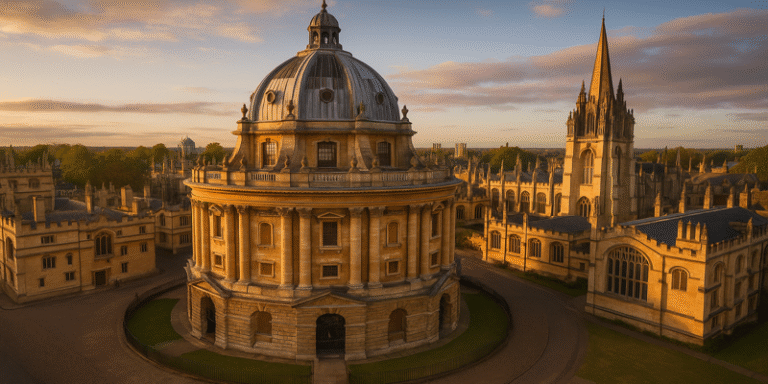
✧ Morning light falling across old quadrangles, the sound of bicycle wheels on cobbled streets, and the quiet concentration of libraries and seminar rooms all help explain the enduring fascination with the University of Oxford. Few institutions combine historical prestige and contemporary relevance so convincingly. Founded in the medieval period and still central to global intellectual life, Oxford represents an unusual union of tradition, academic rigour and modern innovation (Brockliss, 2016; Leedham-Green, 1996).
Yet the University of Oxford is not simply a monument to the past. It remains a dynamic research university whose influence extends across medicine, artificial intelligence, public policy, literature and the humanities. Its importance lies not only in age or reputation, but in its continued ability to shape ideas, solve problems and educate influential thinkers in a rapidly changing world (Tapper and Palfreyman, 2009; University of Oxford, n.d.-a).
1.0 What Makes the University of Oxford Distinctive
1.1 The University of Oxford and Its Medieval Origins
The origins of the University of Oxford stretch back to at least the late eleventh century, with teaching recorded in Oxford by 1096 (Brockliss, 2016). Its development accelerated after 1167, when Henry II restricted English students from attending the University of Paris, helping Oxford emerge as a major centre of learning in England (Leedham-Green, 1996). In its early form, the university was not a single campus in the modern sense, but a community of scholars teaching in halls and rented spaces.
Over time, this loose association became more structured through the founding of colleges. University College, Balliol and Merton are among the oldest foundations, and the collegiate pattern they established would become central to Oxford’s identity (Catto, 1984; University of Oxford, n.d.-a). By the later Middle Ages, Oxford had become a leading centre for theology, philosophy and scholastic debate, contributing to the intellectual life of Europe.
1.2 The University of Oxford and the Collegiate Model
One of the most distinctive features of the University of Oxford is its federal collegiate structure. According to current official information, Oxford consists of 36 colleges, three societies and four permanent private halls, each playing an important role in student life and undergraduate teaching (University of Oxford, n.d.-a). This structure sets Oxford apart from universities organised entirely through central departments.
The colleges are more than residential spaces. They provide accommodation, welfare, community and much of the university’s undergraduate tutorial teaching. This arrangement creates smaller academic and social communities within a large institution. It also helps explain why Oxford often feels both intimate and expansive at the same time. A student may belong to a college community while also participating in the wider intellectual life of faculties, libraries, museums and laboratories.
2.0 Teaching, Tutorials and Intellectual Culture
2.1 Why the University of Oxford Is Known for Tutorials
Perhaps the most famous element of the University of Oxford is its tutorial system. Unlike standard lecture-based teaching alone, tutorials involve intensive discussion in very small groups, often centred on essays, problems or close reading. Palfreyman (2008) describes the tutorial as one of Oxford’s defining pedagogical traditions, while Tapper and Palfreyman (2009) argue that it remains central to the Oxford educational ideal.
The strength of this model lies in its demand for independent thought. Students are expected not merely to absorb information, but to test arguments, defend interpretations and respond critically to expert feedback. This approach can be intellectually demanding, but it encourages habits of clarity, discipline and analytical confidence. In practical terms, it helps explain why Oxford graduates are often associated with strong verbal reasoning and academic independence.
2.2 Academic Breadth and Scholarly Standards
Oxford’s academic range is equally important. The institution spans humanities, social sciences, medical sciences, and mathematical, physical and life sciences, with substantial resources devoted to both specialist and interdisciplinary work (University of Oxford, n.d.-a). This breadth matters because it allows the university to preserve older strengths in classics, history and literature while also advancing newer areas such as data science, biomedical research and the ethics of AI.
3.0 Why the University of Oxford Matters Globally
3.1 Research Excellence And Scientific Impact
The global standing of the University of Oxford rests heavily on its research achievements. Its influence can be traced from the work of early natural philosophers to modern breakthroughs in medicine and technology. One of the clearest recent examples is Oxford’s role in the development of the Oxford–AstraZeneca COVID-19 vaccine, a major contribution to the global pandemic response (Voysey et al., 2021; Knoll and Wonodi, 2021).
That episode demonstrated more than scientific expertise alone. It showed how a university with deep research capacity can influence public health on a worldwide scale. Oxford’s wider research environment has also been important in areas such as infectious disease, public policy, climate-related scholarship and AI ethics. The institution’s significance, therefore, is not symbolic only; it is practical and international.
3.2 Libraries, Museums and Cultural Influence
The scholarly life of the University of Oxford is also sustained by its extraordinary cultural and intellectual resources. Its libraries, museums and collections form one of the richest university environments in the world, supporting teaching and research across disciplines (University of Oxford, n.d.-a). The Ashmolean Museum, for example, stands as a major cultural institution in its own right and reflects Oxford’s long-standing relationship between scholarship and public knowledge (MacGregor, 2012).
Oxford’s cultural influence extends further through its alumni and academic communities. Writers such as J.R.R. Tolkien, C.S. Lewis and Philip Pullman, alongside scientists such as Dorothy Hodgkin, are linked to Oxford’s wider intellectual legacy. The institution has also produced prominent political figures, diplomats, jurists and scholars, giving it an influence that reaches well beyond higher education itself.
4.0 Student Life, Tradition and Continuity
Despite its global role, Oxford remains recognisable for the traditions that shape everyday student experience. Ceremonies such as matriculation, formal hall and other long-established practices give continuity to university life. These customs can appear theatrical, yet they also serve a social purpose by linking present-day students with centuries of institutional memory.
At the same time, student life at Oxford is not confined to ritual. It includes clubs, societies, music, sport, theatre and debate, all of which help create a lively and diverse environment. This coexistence of continuity and change is one of Oxford’s defining characteristics. The university preserves ceremony, but it also adapts to contemporary academic and social realities.
5.0 Challenges Facing the University of Oxford
Like many elite institutions, the University of Oxford faces criticism as well as admiration. Questions of access, fairness and representation remain central to public debate. Research on higher-status universities in the UK suggests that social advantage continues to shape patterns of entry, even where formal admissions processes emphasise merit (Boliver, 2015).
Oxford has responded through outreach, admissions guidance and broader work on access and student support, as reflected in its current undergraduate admissions information (University of Oxford, n.d.-b). Nevertheless, the challenge remains substantial. The university must continue balancing excellence with broader inclusion if it is to sustain legitimacy in a more socially conscious higher education landscape.
∎ The University of Oxford endures because it is more than a historic institution. It is a living academic community that has repeatedly renewed itself without losing its identity. From medieval scholasticism to vaccine development, from tutorials to international research networks, Oxford has shown an unusual capacity to connect inherited tradition with pressing modern needs.
Its lasting importance lies in that balance. The University of Oxford represents continuity, but not stagnation; prestige, but also ongoing responsibility. As long as intellectual depth, research ambition and global engagement remain valued, Oxford is likely to remain one of the defining institutions of world higher education.
References
Boliver, V. (2015) ‘Are there distinctive clusters of higher and lower status universities in the UK?’, Oxford Review of Education, 41(5), pp. 608–627. https://doi.org/10.1080/03054985.2015.1082905.
Brockliss, L.W.B. (2016) The University of Oxford: A History. Oxford: Oxford University Press.
Catto, J.I. (ed.) (1984) The History of the University of Oxford, Vol. 1: The Early Oxford Schools. Oxford: Clarendon Press.
Knoll, M.D. and Wonodi, C. (2021) ‘Oxford–AstraZeneca COVID-19 vaccine efficacy’, The Lancet, 397(10269), pp. 72–74. https://doi.org/10.1016/S0140-6736(20)32623-4.
Leedham-Green, E.S. (1996) A Concise History of the University of Cambridge and the University of Oxford. Cambridge: Cambridge University Press.
MacGregor, A. (2012) The Ashmolean Museum: A Brief History of the Museum and its Collections. Oxford: Ashmolean Museum.
Palfreyman, D. (2008) ‘The Oxford Tutorial: Sacred Cow or Pedagogical Gem?’, Oxford Magazine, 271, pp. 12–15.
Tapper, T. and Palfreyman, D. (2009) Oxford, Cambridge, and the Changing Idea of the University: The Challenge to Donnish Dominion. London: Jessica Kingsley.
University of Oxford (n.d.-a) Organisation of the University. Available at: https://www.ox.ac.uk/about/organisation (Accessed: 11 April 2026).
University of Oxford (n.d.-b) Undergraduate admissions. Available at: https://www.ox.ac.uk/admissions/undergraduate (Accessed: 11 April 2026).
Voysey, M. et al. (2021) ‘Safety and efficacy of the ChAdOx1 nCoV-19 vaccine (AZD1222) against SARS-CoV-2’, The Lancet, 397(10269), pp. 99–111. https://doi.org/10.1016/S0140-6736(20)32661-1.