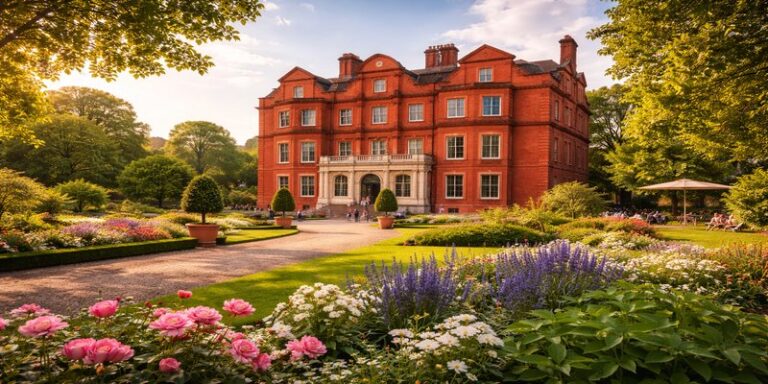
Tucked quietly within the sweeping landscapes of the Royal Botanic Gardens, Kew, stands a modest red-brick building that contrasts strikingly with the grandeur of Britain’s more famous royal residences. Kew Palace, the smallest of the royal palaces, offers something altogether different: not pomp or pageantry, but an intimate glimpse into royal domestic life, personal vulnerability and intellectual curiosity. Originating in the seventeenth century as a merchant’s house and later adopted as a royal residence in the eighteenth century, Kew Palace occupies a unique position at the intersection of monarchy, mental health history and botanical science (Porter, 2004).
For visitors seeking a reflective and enriching heritage experience, Kew Palace provides a rare opportunity to explore the human dimensions of royalty set within a UNESCO World Heritage landscape.
1.0 From Merchant’s House to Royal Retreat
Kew Palace began life in 1631 as a Dutch-style merchant’s residence built by Samuel Fortrey. Its distinctive brick façade, stepped gables and compact scale reflect the influence of northern European architecture. Unlike the expansive grandeur of Hampton Court or Windsor Castle, Kew Palace feels personal and domestic — almost suburban in character.
The house entered royal possession in 1728 when it was leased for use by the family of King George II, and it became closely associated with King George III and Queen Charlotte. According to Porter (2004), the Georgian monarchy often used Kew as a rural retreat, away from the formalities of court life. The palace’s modest size encouraged informality and family interaction, offering a stark contrast to the rigid ceremonial structures of larger royal residences.
In heritage tourism terms, this domestic scale enhances authenticity. Timothy and Boyd (2003) argue that visitors are often drawn to historic spaces that feel relatable rather than overwhelmingly monumental. Kew Palace’s charm lies precisely in its intimacy.
2.0 King George III and the Struggles of Mental Health
Perhaps the most compelling chapter in Kew Palace’s history relates to King George III, whose recurring episodes of mental illness profoundly shaped both his reign and British constitutional history. During severe bouts of illness in the late eighteenth century, the King was cared for at Kew, where he experienced periods of isolation and medical treatment.
Historians now widely recognise that George III likely suffered from a complex psychiatric condition, once attributed to porphyria but more recently reassessed through modern medical analysis (Porter, 2004). His illness led to the establishment of the Regency in 1811, transferring power to his son, the future George IV. This constitutional development demonstrated the monarchy’s capacity to adapt during crisis.
For visitors, exploring the King’s private rooms at Kew Palace offers a poignant insight into the vulnerability behind royal authority. Unlike the triumphant narratives often associated with monarchy, Kew Palace confronts the realities of human fragility. Heritage interpretation here fosters empathy, aligning with contemporary approaches that emphasise personal storytelling and emotional engagement (Waterton and Watson, 2015).
3.0 Royal Domestic Life in the Georgian Era
Beyond political drama, Kew Palace illuminates everyday eighteenth-century royal life. The preserved kitchens, dining rooms and modest bedchambers reveal how George III and Queen Charlotte raised their fifteen children in relatively informal surroundings. Queen Charlotte, in particular, cultivated a deep interest in botany and science, reflecting the intellectual currents of the Enlightenment.
This domestic focus aligns with broader shifts in the public perception of monarchy during the Georgian period. As Colley (1992) suggests, the royal family increasingly projected an image of moral respectability and family unity, strengthening national identity. Kew Palace embodies this transformation from distant sovereign to relatable household.
From a tourism perspective, such narratives enhance visitor connection. Cooper et al. (2018) note that attractions rooted in everyday life often resonate more strongly with contemporary audiences than purely ceremonial sites.
4.0 The Botanical Connection: Science and Sovereignty
What truly distinguishes Kew Palace from other royal residences is its location within the Royal Botanic Gardens, Kew, a UNESCO World Heritage Site recognised for its scientific significance. The gardens played a crucial role in Britain’s global botanical exploration during the eighteenth and nineteenth centuries.
Under the patronage of George III and Queen Charlotte, Kew became a centre for botanical research and plant collection. According to Brockway (1979), botanical institutions like Kew were instrumental in supporting imperial trade networks, facilitating the movement of crops such as tea, rubber and quinine across continents.
Today, visitors can seamlessly combine exploration of the palace with a walk through the world-renowned gardens, glasshouses and arboretums. This integration of royal heritage and scientific achievement creates a multidimensional visitor experience. Hall and Page (2014) emphasise that destinations offering layered narratives — cultural, educational and environmental — tend to sustain higher visitor satisfaction.
5.0 Architecture and Atmosphere
Architecturally, Kew Palace retains much of its original seventeenth-century structure. Its red brickwork and restrained decoration contrast sharply with the opulence of later Baroque and Victorian palaces. Inside, restored Georgian interiors reflect understated elegance rather than extravagance.
This modesty enhances its authenticity. As Ashworth and Tunbridge (2000) argue, heritage value often lies not in scale but in representativeness. Kew Palace exemplifies the lived-in reality of royal retreat rather than theatrical display.
Moreover, its riverside location along the Thames contributes to its tranquillity. Visitors frequently remark upon the peaceful atmosphere — a reminder that royal life, too, required moments of respite.
6.0 Modern Interpretation and Sustainable Tourism
Managed by Historic Royal Palaces, Kew Palace is presented with careful attention to conservation and interpretation. Interactive displays, costumed interpreters and educational workshops engage diverse audiences while preserving the site’s historical integrity (Historic Royal Palaces, 2024).
Sustainability is central to the broader management of Kew Gardens. As a UNESCO site, the Royal Botanic Gardens balance conservation, research and tourism, reflecting global commitments to environmental stewardship (UNESCO, 2023). The integration of palace and garden reinforces the importance of connecting cultural and natural heritage.
In the context of contemporary tourism trends, Kew Palace aligns with increasing demand for slow travel, reflective experiences and meaningful learning (Page, 2019). Rather than overwhelming visitors with spectacle, it invites quiet exploration.
7.0 An Intimate Jewel in Britain’s Royal Crown
Kew Palace may be the smallest of the royal residences, but its significance is immense. From its origins as a merchant’s house to its role in the personal and political life of King George III, it offers unparalleled insight into the domestic and emotional dimensions of monarchy. Situated within the scientifically renowned Royal Botanic Gardens, it uniquely unites royal history, Enlightenment thought and botanical innovation.
For holidaymakers exploring London, Kew Palace provides a refreshing alternative to more imposing landmarks. It is a place where history feels personal, gardens nurture reflection and the story of a nation unfolds quietly within modest walls. In its intimacy and authenticity, Kew Palace reminds us that even the grandest institutions are shaped by profoundly human experiences.
References
Ashworth, G.J. and Tunbridge, J.E. (2000) The Tourist-Historic City. London: Routledge.
Brockway, L.H. (1979) Science and Colonial Expansion: The Role of the British Royal Botanic Gardens. New York: Academic Press.
Colley, L. (1992) Britons: Forging the Nation 1707–1837. London: Pimlico.
Cooper, C., Fletcher, J., Fyall, A., Gilbert, D. and Wanhill, S. (2018) Tourism: Principles and Practice. 6th edn. Harlow: Pearson.
Hall, C.M. and Page, S.J. (2014) The Geography of Tourism and Recreation. 4th edn. London: Routledge.
Historic Royal Palaces (2024) Kew Palace. Available at: https://www.hrp.org.uk.
Page, S.J. (2019) Tourism Management. 6th edn. London: Routledge.
Porter, R. (2004) Madness: A Brief History. Oxford: Oxford University Press.
Timothy, D.J. and Boyd, S.W. (2003) Heritage Tourism. Harlow: Pearson Education.
UNESCO (2023) Royal Botanic Gardens, Kew. Available at: https://whc.unesco.org.
Waterton, E. and Watson, S. (2015) The Palgrave Handbook of Contemporary Heritage Research. London: Palgrave Macmillan.