The Summer Paralympics are one of the most powerful events in world sport. They bring together elite athletes with disabilities to compete at the highest level in disciplines such as athletics, swimming, wheelchair basketball and para-cycling. More than a companion event to the Olympics, the Summer Paralympics have become a major global showcase for athletic excellence, innovation and inclusion. For many viewers, the Games are thrilling because of the competition itself; for others, they also offer a chance to rethink old assumptions about disability and achievement (International Paralympic Committee, 2024).
What makes the Summer Paralympics especially important is the way they connect sport with wider social change. The Games celebrate performance, but they also raise questions about access, media representation and equality. A wheelchair racer crossing the finish line or a blind football team combining speed and precision can alter public perceptions more effectively than any slogan. This article explores the history, significance and cultural impact of the Summer Paralympics, using examples from sport, scholarship and official sources.
1.0 The History of the Summer Paralympics
1.1 How the Summer Paralympics Began
The roots of the Paralympic movement lie in post-war rehabilitation sport. In 1948, Sir Ludwig Guttmann organised the Stoke Mandeville Games in Britain for veterans with spinal injuries. These events gradually grew in scale and ambition. According to the International Paralympic Committee, the first official Summer Paralympics were held in Rome in 1960, with around 400 athletes from 23 countries (International Paralympic Committee, 2024).
This moment was important because it marked a shift away from seeing disabled sport only through a medical lens. Instead, competition, training and performance began to take centre stage. Legg and Steadward (2013) describe this development as part of a broader move from a medical model towards a sport-based model of disability competition. In simple terms, athletes were no longer being viewed mainly as patients in recovery, but as serious competitors.
1.2 Growth into a Global Sporting Event
Since Rome 1960, the Summer Paralympics have expanded dramatically. More sports have been added, more nations now participate and media attention has increased significantly. Historical research shows that the number of medal events and classification categories has evolved over time, reflecting both growth and attempts to improve fairness across a diverse range of impairments (Baumgart et al., 2022).
Today, the Summer Games are watched worldwide and feature some of the best-known names in disability sport. British athletes such as Tanni Grey-Thompson, Sarah Storey and Ellie Simmonds have helped turn Paralympic sport into part of mainstream sporting culture. Their popularity shows how the Summer Paralympics have moved from the margins to the centre of public attention.
2.0 Summer Paralympics Sports and Why They Matter
2.1 Athletics, Swimming and Cycling
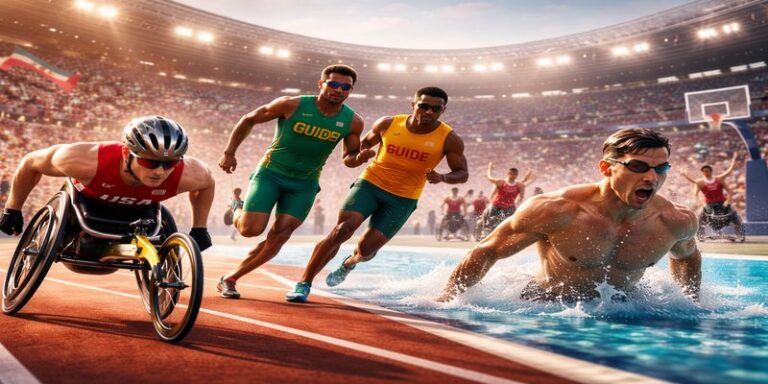
Some of the most iconic moments in the Summer Paralympics come from athletics and swimming. These are highly visible sports that showcase speed, strength, technique and tactical control. In para-athletics, events may include wheelchair racing, sprinting with running blades and field events for athletes with visual or limb impairments. In swimming, classification makes it possible for athletes with different impairments to compete in fair categories.
Para-cycling offers another striking example. Handcycles, tandems for visually impaired riders and adapted bicycles show how technology and skill can work together at elite level. These events remind audiences that the Summer Paralympics are not about symbolic participation. They are about winning, losing, preparation and performance.
2.2 Team Sports and Tactical Skill
Team events also play a major role. Wheelchair basketball, goalball and blind football combine strategy, communication and physical intensity. Goalball, played by visually impaired athletes using a ball with bells inside, is a particularly good example of how adapted sport can create a unique competitive environment. To a first-time viewer, it may seem unfamiliar. Within minutes, however, the tactics and tension become obvious.
These sports matter because they broaden the public image of disability sport. Rather than focusing only on individual triumph, they show collaboration, game intelligence and structured team play. That makes the Summer Paralympics feel familiar to mainstream audiences while still expanding their understanding of what sport can look like.
3.0 Why the Summer Paralympics Matter Beyond Sport
3.1 Changing Attitudes Towards Disability
One of the biggest contributions of the Summer Paralympics is their effect on public attitudes. When disabled athletes are seen performing on a world stage, stereotypes about weakness or dependence are challenged. Viewers see discipline, professionalism and competitive excellence instead. Blauwet and Willick (2012) argue that the Paralympic movement has helped promote health, rights and social integration for athletes with disabilities.
That impact can be very direct. A child watching a wheelchair basketball match may begin to see disability differently. A school or local club may become more open to inclusive sport after a Paralympic summer. These changes are not automatic, but the Games create moments that can shift public thinking in lasting ways.
3.2 Inclusion, But Not A Perfect Solution
At the same time, scholars caution against assuming that visibility equals equality. Ferez et al. (2020) argue that the legacy of Paralympic sport is often more complicated than official celebration suggests. A successful Summer Paralympics may improve awareness, but it does not guarantee accessible transport, equal funding or inclusive local facilities.
This tension is important. The Games are powerful, but they do not solve every barrier faced by disabled people in everyday life. In that sense, the Summer Paralympics are best understood as a catalyst rather than a complete solution. They can inspire action, but governments, schools, sports clubs and media organisations still have work to do.
4.0 Media, Representation and the Summer Paralympics
4.1 Greater Visibility in the Media
Media coverage has been crucial to the rise of the Summer Paralympics. Television, newspapers and digital platforms have helped bring para-sport into the mainstream. Research on broadcast and news coverage suggests that increased visibility can contribute to broader public engagement and greater awareness of disability sport (Kolotouchkina et al., 2021; Pullen, Jackson and Silk, 2022).
The London 2012 Games are often seen as a turning point in the UK. Coverage was wider, branding was stronger and athletes became household names. That helped reposition the Summer Paralympics as a major media event rather than a niche topic.
4.2 Problems with Storytelling
Yet representation remains uneven. Some coverage still leans too heavily on “inspirational” narratives and not enough on tactics, rankings or sporting context. Goggin and Newell (2000) and Jackson-Brown (2020) both note that media stories can sometimes oversimplify disability, turning athletes into symbols rather than professionals.
A better approach is to cover the sport seriously: discuss form, rivals, records and coaching, just as journalists do in Olympic coverage. When that happens, the Summer Paralympics are framed not as exceptional because disabled people are involved, but as exceptional because the sport is excellent.
The Summer Paralympics are far more than an international sporting event. They are a showcase for elite talent, a platform for innovation and a force that can reshape how society understands disability. From their beginnings in Rome in 1960 to their present status as a major global competition, they have grown in scale, professionalism and cultural significance.
Most importantly, the Summer Paralympics demonstrate that inclusion is strongest when it is visible and ambitious. The Games do not remove every barrier, but they make it harder to ignore those barriers and easier to imagine something better. Whether through wheelchair racing, goalball or para-swimming, the message is clear: excellence in sport comes in many forms, and the Summer Paralympics deserve their place at the heart of the sporting world.
References
Baumgart, J.K., Blaauw, E.R., Mulder, R. and colleagues (2022) ‘Changes in the number of medal events, sport events, and classes during the Paralympic Games: a historical overview’, Frontiers in Sports and Active Living, 3, 762206. Available at: https://www.frontiersin.org/journals/sports-and-active-living/articles/10.3389/fspor.2021.762206/full.
Blauwet, C. and Willick, S.E. (2012) ‘The Paralympic Movement: using sports to promote health, disability rights, and social integration for athletes with disabilities’, PM&R, 4(11), pp. 851–856. Available at: https://www.sciencedirect.com/science/article/pii/S1934148212004224.
Brittain, I. (2016) The Paralympic Games Explained. 2nd edn. Abingdon: Routledge. Available at: https://doi.org/10.4324/9781315682761.
Ferez, S., Ruffié, S., Joncheray, H. and Marcellini, A. (2020) ‘Inclusion through sport: A critical view on paralympic legacy from a historical perspective’, Social Inclusion, 8(3), pp. 224–235. Available at: https://www.ssoar.info/ssoar/handle/document/69787.
Goggin, G. and Newell, C. (2000) ‘Crippling paralympics? Media, disability and olympism’, Media International Australia, 97(1), pp. 71–83. Available at: .https://journals.sagepub.com/doi/abs/10.1177/1329878X0009700110.
International Paralympic Committee (2024) History of the Paralympic Movement. Available at: https://www.paralympic.org/ipc/history.
Jackson-Brown, C. (2020) Disability, the Media and the Paralympic Games. Abingdon: Routledge.
Kolotouchkina, O., Llorente-Barroso, C., García-Guardia, M.L. and Pavón, J. (2021) ‘Disability, sport, and television: Media visibility and representation of Paralympic Games in news programs’, Sustainability, 13(1), 256. Available at: https://www.mdpi.com/2071-1050/13/1/256.
Legg, D. and Steadward, R. (2013) ‘The Paralympic Games and 60 years of change (1948–2008): Unification and restructuring from a disability and medical model to sport-based competition’, in Disability in the Global Sport Arena. Abingdon: Routledge.
Pullen, E., Jackson, D. and Silk, M. (2022) ‘Paralympic broadcasting and social change: An integrated mixed method approach to understanding the Paralympic audience in the UK’, Television & New Media, 23(8), pp. 805–823. Available at: https://journals.sagepub.com/doi/10.1177/15274764211004407.