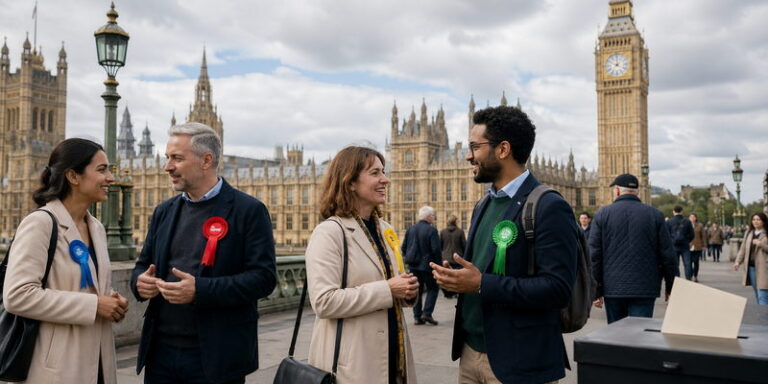
✧ On election night, the map of England often tells a powerful story: red cities, blue shires, orange university towns, green urban pockets and, increasingly, constituencies where voters no longer behave as predictably as they once did. Understanding Political Parties in England is therefore essential for understanding modern British democracy. Although England does not have its own separate parliament, most of the United Kingdom’s largest parties compete heavily in English constituencies, shaping decisions on taxation, public services, climate policy, immigration, housing and national identity.
The major Political Parties in England are usually best understood as UK-wide or England-and-Wales parties operating within English constituencies. The most important include the Conservative Party, Labour Party, Liberal Democrats, Green Party of England and Wales and Reform UK. Each has a distinctive history, political profile and voter base, although party identities have changed significantly over time (Webb, 2000; Bale, 2016).
Political Parties in England: A Brief Overview
The party system in England has traditionally been dominated by the Conservatives and Labour, creating a broadly two-party competition. However, smaller parties have become increasingly influential, especially in local government, by-elections, European elections before Brexit and closely contested parliamentary seats. Political scientists often describe Britain as having two-party dominance, but with growing multi-party pressures (Denver and Garnett, 2021).
In simple terms, the Conservatives are usually associated with the centre-right, Labour with the centre-left, the Liberal Democrats with liberal centrism, the Greens with ecological and social justice politics, and Reform UK with right-wing populism. These labels are useful starting points, but each party contains internal debates, regional differences and shifting priorities.
1.0 The Conservative Party: Tradition, Markets and National Identity
The Conservative Party is one of the oldest and most successful Political Parties in England. Its roots lie in the Tory tradition of the eighteenth and nineteenth centuries, with modern Conservatism developing around ideas of property, tradition, gradual reform, national unity and strong institutions (Bale, 2016).
Historically, the party has appealed to business owners, older voters, rural communities, suburban homeowners and voters favouring lower taxation. Under Margaret Thatcher in the 1980s, Conservatism became strongly associated with free markets, privatisation, trade union reform and individual responsibility (Gamble, 1994). Later Conservative governments combined market economics with different versions of social conservatism, localism and national sovereignty.
Brexit reshaped the party’s identity. The Conservatives became closely linked to the promise to “get Brexit done”, gaining support in many English towns that had previously voted Labour. This demonstrated how Political Parties in England can realign when questions of culture, sovereignty and economic insecurity become central (Ford and Goodwin, 2014).
2.0 The Labour Party: Equality, Public Services and Working-Class Roots
The Labour Party emerged in the early twentieth century from the trade union movement, socialist societies and working-class political organisation. Its traditional purpose was to represent workers in Parliament and challenge inequality produced by industrial capitalism (Thorpe, 2015).
Labour’s political beliefs centre on social justice, stronger public services, workers’ rights and a more active role for the state. The party created many of the institutions most associated with post-war Britain, including support for the welfare state and the National Health Service, established by the 1945 Labour government (Pugh, 2010).
However, Labour has never had a single fixed ideology. “Old Labour” was more closely linked with public ownership and trade unions, while “New Labour” under Tony Blair accepted much of the market economy while increasing investment in health, education and anti-poverty policies (Driver and Martell, 2006). More recently, Labour has sought to balance economic credibility, social reform and appeal to both metropolitan and post-industrial English constituencies. Among Political Parties in England, Labour remains the main centre-left alternative to Conservative rule.
3.0 The Liberal Democrats: Civil Liberties, Localism and Electoral Reform
The Liberal Democrats were formed in 1988 through a merger between the Liberal Party and the Social Democratic Party. Their deeper roots reach back to nineteenth-century liberalism, with its emphasis on individual freedom, constitutional reform, free expression and limits on state power (Cook, 2010).
Among Political Parties in England, the Liberal Democrats are especially associated with civil liberties, local government activism, environmental concern and proportional representation. They often perform well in university towns, affluent liberal areas and constituencies where local campaigning is highly organised.
The party’s profile changed after entering coalition government with the Conservatives from 2010 to 2015. This brought ministerial experience but damaged support, especially after controversy over university tuition fees (Quinn, 2012). Even so, the Liberal Democrats remain important because they can challenge both Conservatives and Labour in specific English constituencies, particularly where voters favour moderation, local representation and constitutional reform.
4.0 The Green Party of England and Wales: Climate, Equality and System Change
The Green Party of England and Wales is the clearest example of a party built around environmental politics. Its origins lie in the ecology movements of the 1970s, but its modern platform goes beyond conservation. The party links climate action with social equality, public transport, housing reform, democratic participation and opposition to excessive consumerism (Carter, 2018).
In the landscape of Political Parties in England, the Greens have traditionally been smaller at Westminster but increasingly visible in local councils and urban constituencies. Brighton Pavilion, first won by Caroline Lucas in 2010, became a symbolic breakthrough for Green politics in England.
The Greens argue that climate change requires structural change, not only minor adjustments. Their policies often include rapid decarbonisation, investment in renewable energy, stronger local democracy and wealth redistribution. Their appeal is strongest among younger voters, environmentally concerned citizens and progressive urban communities.
5.0 Reform UK: Populism, Brexit and Anti-Establishment Politics
Reform UK developed from the Brexit Party, which itself grew out of the political energy surrounding Euroscepticism. While not as historically rooted as the Conservatives or Labour, it has become one of the most discussed Political Parties in England because it speaks to voters frustrated with mainstream politics.
Its political profile combines anti-establishment rhetoric, lower-tax economics, strict immigration control, criticism of net zero policies and strong emphasis on national sovereignty. Reform UK’s rise reflects wider European trends in right-wing populism, where parties challenge established elites and claim to speak for “ordinary people” against political insiders (Mudde, 2007).
The party’s support has been especially relevant in English seats where voters feel economically neglected, culturally ignored or dissatisfied with established parties. Whether Reform UK becomes a lasting force depends on electoral organisation, leadership, policy credibility and the behaviour of the Conservative Party.
Political Parties in England and Voter Realignment
A major recent trend is voter realignment. Class voting has weakened, while age, education, geography, housing status and cultural values have become more important (Evans and Tilley, 2017). For example, Labour tends to perform strongly in large cities, diverse communities and among younger graduates, while Conservatives have often appealed to older homeowners and rural or suburban voters. The Liberal Democrats benefit from local campaigning in middle-class constituencies, while the Greens attract environmentally minded progressives. Reform UK appeals to voters who prioritise immigration, sovereignty and protest against established parties.
This means Political Parties in England no longer compete only over left and right economics. They also compete over identity, place, trust, competence and the meaning of national belonging.
∎ The story of Political Parties in England is not simply a contest between red and blue. It is a changing landscape shaped by history, class, Brexit, climate change, public services, local identity and distrust of political elites. The Conservatives represent a broad centre-right tradition rooted in markets, national identity and institutional continuity. Labour remains the main centre-left party, shaped by equality, public services and labour movement history. The Liberal Democrats promote liberalism, localism and constitutional reform. The Greens place climate and social justice at the centre of politics. Reform UK channels populist, Eurosceptic and anti-establishment pressures.
Together, these parties reveal a country whose politics is both historically familiar and increasingly fluid. Understanding Political Parties in England therefore offers a clearer view of how power is won, challenged and reshaped in modern Britain.
References
Bale, T. (2016) The Conservative Party: From Thatcher to Cameron. 2nd edn. Cambridge: Polity Press.
Carter, N. (2018) The Politics of the Environment: Ideas, Activism, Policy. 3rd edn. Cambridge: Cambridge University Press.
Cook, C. (2010) A Short History of the Liberal Party: The Road Back to Power. Basingstoke: Palgrave Macmillan.
Denver, D. and Garnett, M. (2021) British General Elections Since 1964: Diversity, Dealignment, and Disillusion. Oxford: Oxford University Press.
Driver, S. and Martell, L. (2006) New Labour. 2nd edn. Cambridge: Polity Press.
Evans, G. and Tilley, J. (2017) The New Politics of Class: The Political Exclusion of the British Working Class. Oxford: Oxford University Press.
Ford, R. and Goodwin, M. (2014) Revolt on the Right: Explaining Support for the Radical Right in Britain. London: Routledge.
Gamble, A. (1994) The Free Economy and the Strong State: The Politics of Thatcherism. 2nd edn. Basingstoke: Palgrave Macmillan.
Mudde, C. (2007) Populist Radical Right Parties in Europe. Cambridge: Cambridge University Press.
Pugh, M. (2010) Speak for Britain! A New History of the Labour Party. London: Vintage.
Quinn, T. (2012) ‘The Liberal Democrats in coalition: A new politics or a new betrayal?’, Political Quarterly, 83(2), pp. 377–386.
Thorpe, A. (2015) A History of the British Labour Party. 4th edn. Basingstoke: Palgrave Macmillan.
Webb, P. (2000) The Modern British Party System. London: SAGE.