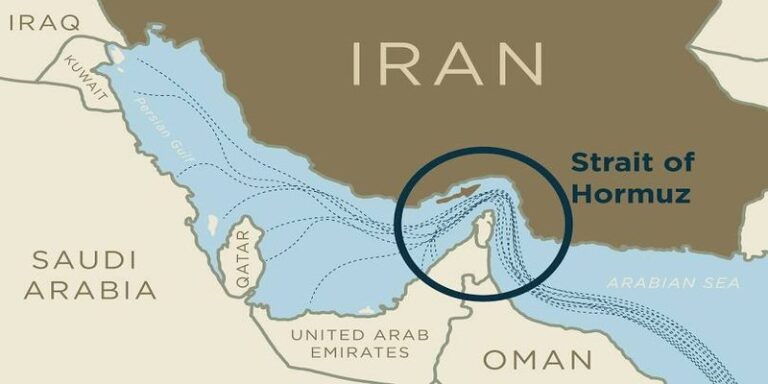
The Strait of Hormuz is one of the most strategically important maritime passages in the world. Located between Iran to the north and Oman and the United Arab Emirates to the south, it links the Persian Gulf with the Gulf of Oman and the Arabian Sea. Although relatively narrow, the strait carries a substantial share of the world’s seaborne oil and liquefied natural gas (LNG) exports, making it essential to the global economy. Its significance is not only commercial but also geopolitical, because tensions among regional and external powers frequently centre on this chokepoint. This discussion explains the economic, military and political importance of the Strait of Hormuz, examines the major threats to security there, and considers the implications of any disruption for energy markets and international stability.
1.0 Geographical and Strategic Significance
1.1 A Vital Maritime Chokepoint
A chokepoint is a narrow route through which a large volume of traffic must pass. The Strait of Hormuz is one of the clearest examples. At its narrowest, it is only a few dozen miles wide, yet it serves as the main export route for major Gulf producers such as Saudi Arabia, Iraq, Kuwait, Qatar and the United Arab Emirates. Because these states hold some of the world’s largest hydrocarbon reserves, the strait has global significance far beyond its physical size.
The strait’s importance can be illustrated by comparison with the Suez Canal and the Strait of Malacca, which are also major trade arteries. However, Hormuz is especially sensitive because so much of the world’s energy supply depends upon it. If tankers cannot pass safely, the impact is felt not only in the Middle East but also in Europe, Asia and North America through higher prices, uncertainty and market volatility.
1.2 Why Location Matters
The geography of the strait gives nearby states, especially Iran, considerable strategic leverage. Iran’s coastline and islands near the passage allow it to monitor and potentially threaten shipping. This does not mean that closure is easy or sustainable, but it does mean that even limited incidents can raise insurance costs, unsettle markets and provoke international naval responses. In this sense, the Strait of Hormuz is both a commercial lifeline and a security flashpoint.
2.0 Economic Importance
2.1 Energy Security and World Markets
The most important reason for the Strait of Hormuz’s global relevance is energy security. A large proportion of internationally traded crude oil passes through it, along with significant volumes of LNG, particularly from Qatar. Countries in Asia, including China, India, Japan and South Korea, are especially dependent on Gulf energy supplies, so any interruption in Hormuz can have immediate worldwide effects.
For example, when tensions rise between Iran and the United States, or when tankers are attacked or seized, oil prices often increase because traders fear supply disruption. Even if exports continue, the mere possibility of conflict can affect shipping insurance, freight costs and investment decisions. This shows that the strait’s economic importance lies not only in the physical flow of oil and gas but also in the confidence required to keep global markets stable.
2.2 Limited Alternatives
Some Gulf states have developed pipelines and alternative export routes to reduce dependence on Hormuz. For instance, Saudi Arabia and the UAE have infrastructure that can bypass the strait to some extent. However, these alternatives are limited in capacity and cannot fully replace normal seaborne exports through Hormuz. As a result, the strait remains indispensable.
3.0 Geopolitical and Military Importance
3.1 Iran and Regional Power Politics
The Strait of Hormuz is central to Iran’s strategic doctrine. Iranian leaders have repeatedly used rhetoric about the strait in response to sanctions, military pressure or diplomatic confrontation. By signalling that it could threaten shipping, Iran seeks both deterrence and bargaining power. This does not necessarily imply a full closure, which would also damage Iran’s own interests, but it reflects how geography can be used as a political instrument.
At the same time, Arab Gulf states and their Western partners see free navigation through the strait as essential. This has led to a strong United States naval presence in the region, supported at times by the United Kingdom and other allies. Consequently, Hormuz has become an arena in which local rivalries intersect with great-power competition.
3.2 Naval Security and Incident Risks
The heavy military presence in and around the strait creates both protection and danger. Naval patrols help deter piracy, sabotage and attacks on shipping. Yet the close proximity of rival forces also increases the possibility of miscalculation. A small confrontation, such as the boarding of a vessel or the downing of a drone, can quickly escalate into a larger crisis.
A good example is the series of tanker incidents in 2019, when several ships were attacked or detained amid heightened Iran–US tensions. These events demonstrated that the strait can become unstable even without formal war. They also highlighted the vulnerability of global trade to regional disputes.
4.0 Threats to the Strait of Hormuz
4.1 State Conflict and Coercion
The most serious threat to the strait is confrontation involving Iran, the US, or Gulf Arab states. Iran has capabilities such as fast attack craft, naval mines, anti-ship missiles and drones that could threaten vessels or complicate passage. While most analysts argue that a complete closure would be difficult to maintain because of overwhelming international opposition, even temporary disruption would be highly consequential.
4.2 Non-State and Hybrid Threats
Although state conflict receives most attention, hybrid threats also matter. These include sabotage, cyber interference, proxy actions and attacks on energy infrastructure linked to maritime trade. In modern security studies, the risk is not simply invasion or blockade but a wider pattern of grey-zone conflict, where pressure is exerted below the threshold of open war.
5.0 Global Consequences of Disruption
5.1 Oil Prices, Inflation and Political Pressure
If the Strait of Hormuz were seriously disrupted, the most immediate effect would likely be a sharp rise in oil and gas prices. This would feed into inflation, transport costs and industrial production in importing states. Governments could then face domestic political pressure due to rising energy bills and economic uncertainty.
5.2 Wider Strategic Instability
Disruption would also affect diplomacy and military planning. Import-dependent countries might seek emergency stock releases, diversify suppliers or increase naval cooperation. In the longer term, repeated crises in Hormuz strengthen arguments for energy diversification, renewable investment and reduced dependence on vulnerable chokepoints.
In conclusion, the Strait of Hormuz is one of the most important and sensitive waterways in the world. Its importance stems from its role as a global energy artery, its position at the centre of Middle Eastern geopolitics, and its vulnerability to conflict, coercion and disruption. While alternative routes exist, none can fully replace it, which is why tensions in the strait have consequences far beyond the Gulf region. Ultimately, the Strait of Hormuz demonstrates how a narrow stretch of water can shape international trade, security policy and the wider global economy.
References
Britannica (2024) Strait of Hormuz. Available at: https://www.britannica.com/place/Strait-of-Hormuz (Accessed: 10 March 2026).
Cordesman, A.H. (2007) Iran, Oil, and the Strait of Hormuz. Washington, DC: Center for Strategic and International Studies.
Energy Information Administration (2023) The Strait of Hormuz is the world’s most important oil transit chokepoint. Available at: https://www.eia.gov/todayinenergy/detail.php?id=61062 (Accessed: 10 March 2026).
Friedman, G. (2008) The Next 100 Years. New York: Doubleday.
Kaplan, R.D. (2010) Monsoon: The Indian Ocean and the Future of American Power. New York: Random House.
O’Rourke, R. (2022) Iran’s Threat to the Strait of Hormuz. Congressional Research Service.
Oxford Analytica (2019) ‘Tensions in Hormuz raise global energy security concerns’, Expert Briefings.
Rodhan, N.R.F. (2007) The Geopolitics of Energy in the Middle East. Geneva: Geneva Centre for Security Policy.
Till, G. (2018) Seapower: A Guide for the Twenty-First Century. 4th edn. Abingdon: Routledge.
United States Naval Institute (2020) ‘Maritime security in the Persian Gulf and Strait of Hormuz’, Proceedings, 146(6).
Yergin, D. (2020) The New Map: Energy, Climate, and the Clash of Nations. New York: Penguin Press.