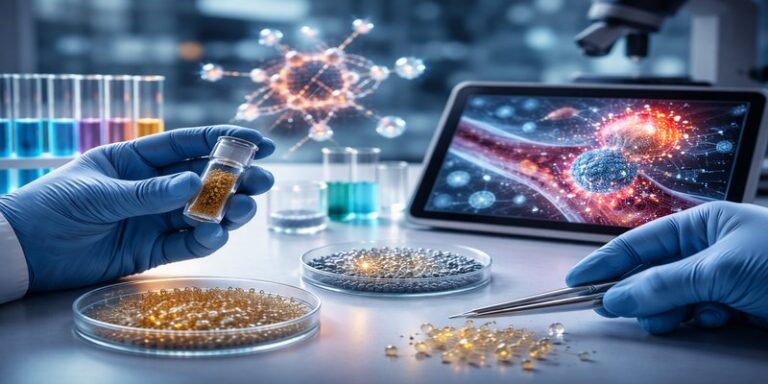
In recent decades, nanotechnology has transformed multiple scientific disciplines, but perhaps nowhere is its impact more profound than in nanomedicine. By manipulating materials at the scale of 1–100 nanometres, scientists are developing highly precise diagnostic tools and targeted therapies that were once unimaginable. At this scale, materials exhibit unique properties—such as enhanced reactivity, improved solubility and altered optical behaviour—that can be harnessed to improve healthcare outcomes (Hornyak et al., 2018).
Nanomedicine represents the convergence of biology, chemistry, physics and engineering, offering innovative approaches to disease detection, drug delivery and regenerative medicine. While its potential is immense, it also raises important ethical and regulatory questions regarding safety, accessibility and long-term societal impact (Meetoo, 2009). This article explores the major applications of nanomedicine, supported by academic research and real-world examples, and examines the ethical considerations associated with its development
1.0 Nanotechnology to Nanomedicine
Nanomedicine refers to the application of nanotechnology in healthcare for the purposes of diagnosis, treatment and prevention of disease. According to Ebbesen and Jensen (2006), nanomedicine involves the use of nanoscale materials—such as nanoparticles, nanocapsules and nanosensors—to interact directly with biological systems at the molecular level.
At the nanoscale, particles can cross biological barriers more effectively than conventional drug formulations. Their small size allows them to circulate within the bloodstream, enter cells and deliver therapeutic agents with high precision. This capacity for targeted interaction distinguishes nanomedicine from traditional pharmaceutical approaches.
Hornyak et al. (2018) emphasise that nanomedicine is built upon the principle that materials behave differently at reduced dimensions. Increased surface area-to-volume ratios and quantum effects enhance reactivity and enable customisation of medical treatments.
2.0 Applications of Nanomedicine
2.1 Targeted Drug Delivery – Precision in Cancer Treatment
One of the most significant applications of nanomedicine is targeted drug delivery, particularly in cancer therapy. Traditional chemotherapy often damages both cancerous and healthy cells, resulting in severe side effects such as hair loss, nausea and immune suppression. Nanotechnology offers a more refined alternative.
Ebbesen and Jensen (2006) explain that nanoscale drug carriers can be engineered to recognise and bind specifically to cancer cells. For example, liposomal drug formulations encapsulate anticancer drugs within lipid-based nanoparticles. These carriers enhance solubility, protect the drug from premature degradation and concentrate the medication at the tumour site.
A well-known example is Doxil, a liposomal formulation of doxorubicin used in cancer treatment. By encapsulating the drug within nanoscale liposomes, Doxil reduces toxicity to healthy tissues while maintaining therapeutic effectiveness.
This targeted approach improves patient outcomes by reducing harmful side effects and increasing drug efficiency. According to the National Cancer Institute (2023), nanoparticle-based therapies are increasingly incorporated into modern oncology treatment protocols.
2.2 Controlled and Sustained Release
Nanotechnology also enables controlled drug release, ensuring that medication is delivered gradually over time rather than in a single large dose. Polymeric nanoparticles can be designed to release drugs in response to specific biological triggers, such as changes in pH or temperature.
For instance, in the treatment of chronic inflammatory diseases, nanoscale carriers can release anti-inflammatory agents only when inflammation is detected. This reduces systemic exposure and minimises adverse reactions (Hornyak et al., 2018).
Such innovations demonstrate how nanomedicine enhances both precision and personalisation in healthcare.
2.3 Advanced Diagnostics and Imaging – Early Disease Detection
Another major contribution of nanomedicine lies in early diagnosis. Nanosensors are capable of detecting extremely small concentrations of biomarkers—molecular indicators of disease—within blood or tissue samples.
Ebbesen and Jensen (2006) highlight the development of nanoparticle-based imaging agents that improve the visibility of tumours in medical scans. For example, quantum dots, which are semiconductor nanoparticles, emit bright and stable fluorescence. When attached to specific antibodies, they can illuminate cancer cells during imaging procedures.
Early detection significantly improves survival rates in diseases such as breast and prostate cancer. By identifying molecular changes before symptoms appear, nanomedicine enhances preventive care and reduces healthcare costs in the long term.
2.4 Personalised Medicine
Nanotechnology supports the growth of personalised medicine, in which treatments are tailored to an individual’s genetic profile. Nanodevices can analyse genetic markers and assist clinicians in selecting the most effective therapy.
According to the European Medicines Agency (EMA, 2022), nanotechnology-based diagnostic tools are increasingly integrated into personalised therapeutic strategies. This shift reflects a broader transformation from generalised treatment models to precision healthcare.
2.5 Regenerative Medicine and Tissue Engineering
Beyond diagnostics and drug delivery, nanomedicine contributes to tissue engineering and regenerative medicine. Nanostructured scaffolds can mimic the natural extracellular matrix, supporting cell growth and tissue repair.
For example, researchers have developed nanofibrous scaffolds that promote bone regeneration in patients with fractures or degenerative conditions. These materials encourage stem cell attachment and differentiation, accelerating healing processes (Hornyak et al., 2018).
Similarly, nanotechnology is being explored in the development of artificial skin and cardiovascular implants, demonstrating its transformative potential in surgical and restorative medicine.
3.0 Ethical and Safety Considerations
3.1 Long-Term Toxicity and Risk Assessment
Despite its promise, nanomedicine raises significant ethical and safety concerns. Due to their small size, nanoparticles may accumulate in organs or cross biological barriers such as the blood–brain barrier. The long-term health effects of such accumulation remain uncertain.
Meetoo (2009) argues that comprehensive risk assessment and ethical oversight are essential before widespread clinical adoption. Regulatory agencies must evaluate potential toxicity, environmental impact and manufacturing standards.
3.2 Equity and Access
Another pressing issue concerns equitable access. Advanced nanomedical treatments can be expensive, potentially widening health inequalities between high-income and low-income populations. Ethical frameworks must address questions of fairness and distribution (Meetoo, 2009).
Ebbesen and Jensen (2006) emphasise that respect for autonomy, beneficence and justice—core principles of biomedical ethics—should guide nanomedical research and implementation.
3.3 Governance and Public Trust
Public confidence plays a crucial role in technological acceptance. Transparent communication regarding benefits and risks is necessary to maintain trust. As Hornyak et al. (2018) suggest, responsible innovation requires collaboration between scientists, policymakers and society.
Effective governance ensures that nanomedicine develops in alignment with societal values rather than purely commercial interests.
Nanomedicine stands at the forefront of modern healthcare innovation. Through targeted drug delivery, advanced diagnostics, personalised medicine and regenerative therapies, it offers unprecedented opportunities to improve patient outcomes and transform clinical practice. Real-world examples such as liposomal chemotherapy and quantum dot imaging demonstrate how nanoscale engineering enhances precision and effectiveness.
However, alongside these remarkable benefits come important ethical and regulatory challenges. Issues of long-term toxicity, equitable access and responsible governance must be carefully addressed to ensure safe and fair implementation.
Ultimately, nanomedicine illustrates how nano technology, when guided by ethical reflection and scientific rigour, can serve as a powerful force for societal good. By balancing innovation with responsibility, it has the potential to reshape the future of healthcare in profound and lasting ways.
References
Ebbesen, M. and Jensen, T.G. (2006) ‘Nanomedicine: techniques, potentials, and ethical implications’, BioMed Research International, Article ID 51516.
European Medicines Agency (EMA) (2022) Reflection paper on nanotechnology-based medicinal products. Available at: https://www.ema.europa.eu (Accessed: 28 February 2026).
Hornyak, G.L., Moore, J.J., Tibbals, H.F. and Dutta, J. (2018) Fundamentals of nanotechnology. Boca Raton: CRC Press.
Meetoo, D. (2009) ‘Nanotechnology: is there a need for ethical principles?’, British Journal of Nursing, 18(20), pp. 1234–1237.
National Cancer Institute (2023) Nanotechnology in cancer treatment. Available at: https://www.cancer.gov (Accessed: 28 February 2026).