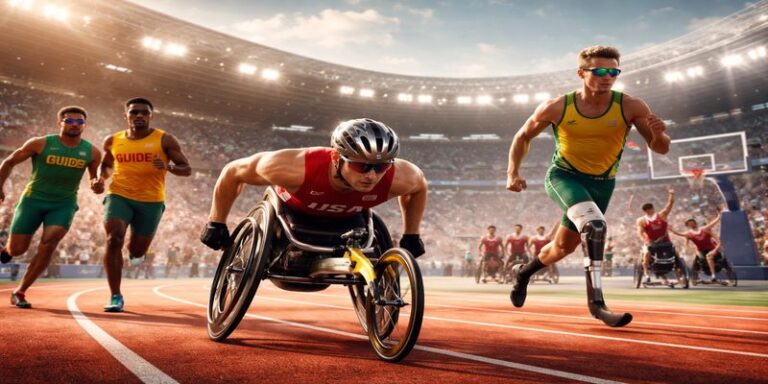
The Paralympics are one of the most significant events in global sport. Bringing together elite athletes with disabilities from around the world, the Paralympics showcase excellence, determination and competitive skill at the highest level. They are not simply a companion event to the Olympics; they are a major sporting platform in their own right, with growing influence on culture, media and public attitudes towards disability (International Paralympic Committee, 2024).
Over time, the Paralympics have developed into far more than a sporting competition. They have become a symbol of inclusion, visibility and social change. For many people, watching the Games is an opportunity to rethink assumptions about disability and human potential. At the same time, scholars note that the impact of the Paralympics depends on how societies respond after the closing ceremony, especially in areas such as access, participation and representation (Ferez et al., 2020). This article explores the history, meaning and wider significance of the Paralympics in a clear and engaging way.
1.0 The History of the Paralympics –
1.1 How the Paralympics Began
The story of the Paralympics began in Britain after the Second World War. In 1948, Sir Ludwig Guttmann organised the Stoke Mandeville Games for injured war veterans with spinal cord injuries. What started as part of a rehabilitation programme soon evolved into competitive sport with international ambition (Brittain, 2016). The first official Paralympic Games were held in Rome in 1960, laying the foundation for the modern Paralympics (Legg and Steadward, 2013).
This development marked an important shift in how disability sport was understood. Earlier approaches were shaped mainly by medicine and recovery, but the growth of the Paralympics moved the emphasis towards performance, training and elite competition. That change helped transform disability sport from a marginal activity into a respected international movement (Blauwet and Willick, 2012).
1.2 The Growth of The Paralympics Worldwide
Since those early years, the Paralympics have expanded dramatically. More countries now take part, more sports are included and audiences are larger than ever. Summer and Winter editions attract millions of viewers, while digital platforms have widened global access to the Games. As a result, the Paralympics have become one of the most visible expressions of disability sport in the world.
This growth can be seen in the professional standards of competition. Athletes now benefit from specialised coaching, sports science, nutrition support and advanced equipment. Events such as wheelchair racing, para-swimming and para-cycling demonstrate that the Paralympics are defined by precision, tactics and athletic excellence, not by sympathy or tokenism.
2.0 Why the Paralympics Matter
2.1 The Paralympics and Changing Attitudes
One of the most powerful contributions of the Paralympics is their ability to challenge stereotypes. For decades, disabled people were often represented through narratives of dependence or limitation. The Paralympics offer a very different image: one built around achievement, discipline and high performance. This shift can affect how the public thinks about disability in everyday life, including in education, employment and public policy (Kolotouchkina et al., 2021).
A useful example is blind football, where communication, spatial awareness and teamwork are essential. Another example is wheelchair basketball, where speed, physical contact and tactical decision-making are central to success. Through such sports, the Paralympics show that disability does not reduce athletic value. Instead, they broaden the public understanding of what sporting excellence looks like.
2.2 The Paralympics and inclusion in sport
The Paralympics also matter because they can inspire wider participation. Seeing disabled athletes compete on the world stage may encourage children, young people and adults to take part in sport themselves. This is especially important in communities where disabled people still face barriers such as inaccessible facilities, limited coaching and low expectations (Kirakosyan, 2019).
Even so, the Paralympics should not be treated as proof that inclusion has already been achieved. Researchers warn that high-profile events can create a strong image of progress while everyday inequalities remain in place (Mauerberg-deCastro et al., 2016). In other words, the Paralympics can open minds, but real inclusion depends on sustained action in schools, clubs, transport systems and public spaces.
3.0 Media and the Paralympics
3.1 How Media Has Shaped the Paralympics
Media coverage has played a central role in the rise of the Paralympics. Television, news platforms and social media have helped bring para-sport into mainstream culture. This visibility matters because what people regularly see in the media often influences what they view as normal, important or admirable. The growing media profile of the Paralympics has therefore helped disabled athletes gain recognition as serious competitors (Misener, Bodin and Quinn, 2018).
In Britain, broadcasters have helped make Paralympic athletes more familiar to general audiences. Figures such as Tanni Grey-Thompson, Ellie Simmonds, Jonnie Peacock and Sarah Storey have become widely recognised, showing how the Paralympics can shape national sporting identity as well as public awareness.
3.2 Challenges in Paralympics Representation
Although coverage has improved, some reporting still frames the Paralympics too heavily through emotional or inspirational storytelling. While personal stories can be meaningful, they can also overshadow the sport itself. Scholars argue that athletes should be represented not only as inspirational individuals but also as skilled professionals competing at elite level (McNamee, 2017).
A stronger media approach focuses on rankings, records, tactics, rivalries and sporting achievement. When this happens, the Paralympics are presented in a way that respects both the athlete and the competition.
4.0 The Social Impact of the Paralympics
The wider importance of the Paralympics goes beyond medals. The Games have become a platform for discussion about rights, accessibility, visibility and belonging. They encourage societies to think more seriously about who gets opportunities, who gets represented and who gets left out. In this sense, the Paralympics are both a sporting event and a cultural force (Wolbring, Legg and Stahnisch, 2010).
At the same time, there are limits to what the Paralympics can achieve on their own. Elite sport can raise awareness, but awareness does not always lead to structural change. Purdue and Howe (2015) describe this tension as the Paralympic paradox: the success of the Games may increase visibility while wider exclusion still persists. This means the legacy of the Paralympics depends on whether governments, organisations and communities turn symbolic progress into practical action.
The Paralympics have grown from a rehabilitation-centred initiative into one of the world’s most important sporting events. They celebrate elite competition, challenge narrow assumptions about disability and create space for more inclusive public conversations. Through sport, the Paralympics demonstrate skill, ambition and achievement on a global stage.
Yet the true meaning of the Paralympics lies not only in records and medals, but also in their ability to influence how society thinks and acts. They remind us that inclusion must be visible, practical and ongoing. When understood in this broader way, the Paralympics are not just a sporting event. They are an important force for cultural change.
References
Blauwet, C. and Willick, S.E. (2012) ‘The Paralympic Movement: using sports to promote health, disability rights, and social integration for athletes with disabilities’, PM&R, 4(11), pp. 851–856. Available at: https://www.sciencedirect.com/science/article/pii/S1934148212004224.
Brittain, I. (2016) The Paralympic Games Explained. 2nd edn. Abingdon: Routledge. Available at: https://doi.org/10.4324/9781315682761.
Ferez, S., Ruffié, S., Joncheray, H. and Marcellini, A. (2020) ‘Inclusion through sport: A critical view on Paralympic legacy from a historical perspective’, Social Inclusion, 8(3), pp. 224–235. Available at: https://www.ssoar.info/ssoar/handle/document/69787.
International Paralympic Committee (2024) History of the Paralympic Movement. Available at: https://www.paralympic.org/ipc/history.
Kirakosyan, L. (2019) ‘Sport for all and social inclusion of individuals with impairments: a case study from Brazil’, Societies, 9(2), 44. Available at: https://www.mdpi.com/2075-4698/9/2/44.
Kolotouchkina, O., Llorente-Barroso, C., Garcia-Guardia, M.L. and Pavón, J. (2021) ‘Disability, sport, and television: Media visibility and representation of Paralympic Games in news programs’, Sustainability, 13(1), 256. Available at: https://www.mdpi.com/2071-1050/13/1/256.
Legg, D. and Steadward, R. (2013) ‘The Paralympic Games and 60 years of change (1948–2008): Unification and restructuring from a disability and medical model to sport-based competition’, in Disability in the Global Sport Arena. Abingdon: Routledge.
Mauerberg-deCastro, E., Campbell, D.F. and Tavares, C.P. (2016) ‘The global reality of the Paralympic Movement: Challenges and opportunities in disability sports’, Motriz: Revista de Educação Física, 22(3), pp. 111–123. Available at: https://www.scielo.br/j/motriz/a/csCyzztNpz7vZQjXk9KpdkN/.
McNamee, M.J. (2017) ‘Paralympism, Paralympic values and disability sport: a conceptual and ethical critique’, Disability and Rehabilitation, 39(2), pp. 178–184. Available at: https://doi.org/10.3109/09638288.2015.1095247.
Misener, L., Bodin, K. and Quinn, N. (2018) ‘Paralympics, para-sport bodies, and legacies of media representation’, in The Routledge Handbook of Disability in Sport. Abingdon: Routledge.
Purdue, D.E.J. and Howe, P.D. (2015) ‘See the sport, not the disability: Exploring the Paralympic paradox’, Qualitative Research in Sport, Exercise and Health, 7(2), pp. 189–205. Available at: https://doi.org/10.1080/2159676X.2014.918575.
Wolbring, G., Legg, D. and Stahnisch, F. (2010) ‘Meaning of inclusion throughout the history of the Paralympic Games and movement’, Sport in Society, 13(9), pp. 1389–1402.