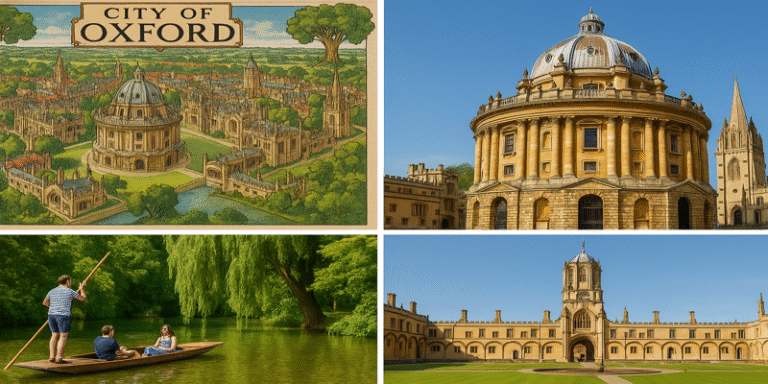
There are cities you visit, and then there are cities you inhabit with your imagination. Oxford belongs firmly to the latter. As morning mist drifts over honey-coloured stone and the bells of college chapels ripple through narrow lanes, you feel as though you’ve stepped into a living manuscript. Nicknamed the “City of Dreaming Spires”, Oxford is at once scholarly and soulful, grand yet intimate. Its cobbled streets echo with centuries of debate, discovery and quiet contemplation. Yet beyond its academic prestige lies a vibrant, welcoming destination brimming with heritage, gastronomy and cultural energy.
Oxford is not simply a university city. It is a heritage tourism icon, a place where past and present converse in every courtyard and café.
1.0 Brief Background/History
Oxford’s origins trace back to the Anglo-Saxon period, when it developed as a fortified settlement at a river crossing (Walton, 2009). The University of Oxford, established in the late twelfth century, is one of the oldest universities in the English-speaking world (University of Oxford, 2024). Over time, its colleges—such as Christ Church, Magdalen and Balliol—shaped the city’s architectural and cultural landscape.
From a tourism perspective, Oxford exemplifies heritage-led urban development, where historic assets function as primary visitor attractions (Smith and Richards, 2013; Park, 2013). Its colleges, libraries and museums form a concentrated cultural cluster that aligns with theories of cultural and heritage tourism (Robinson, 2012). According to VisitBritain (2023), heritage cities like Oxford remain among the UK’s most visited destinations, reflecting the enduring appeal of authentic built environments.
Oxford’s tourism identity also connects with broader scholarship on the evolution of hospitality and travel (O’Gorman, 2010; O’Gorman, 2009). As tourism historians note, cities with strong intellectual and architectural legacies often become symbolic landscapes of national identity (Zuelow and James, 2025).
2.0 Accommodation
Oxford’s accommodation offering mirrors its layered personality. Visitors can sleep within college walls, in boutique townhouses, or in riverside hotels overlooking the Thames (locally known as the Isis).
Staying in a university college—available outside term time—offers a uniquely immersive experience. These rooms, sometimes centuries old, align with the concept of experiential heritage tourism, where visitors engage directly with historical settings (Palmer and Tivers, 2018). Meanwhile, luxury hotels such as The Randolph Hotel combine Victorian grandeur with modern amenities, illustrating the adaptive reuse of historic buildings in hospitality (MacKenzie, Pittaki and Wong, 2020).
For budget-conscious travellers, guesthouses and serviced apartments provide practical alternatives. The diversity reflects contemporary hospitality trends emphasising authenticity, comfort and location (Dredge, Airey and Gross, 2015).
3.0 Food & Drink
Oxford’s culinary landscape extends well beyond student fare. Traditional pubs such as The Eagle and Child—once frequented by J.R.R. Tolkien and C.S. Lewis—offer hearty British classics beneath dark wooden beams. Historic pubs function as both gastronomic and cultural heritage sites, reinforcing identity through food traditions (Timothy and Ron, 2013).
The Covered Market, established in 1774, remains a vibrant hub for artisan produce, bakeries and global street food. Contemporary research highlights how food enhances the tourism experience by creating memorable, place-specific encounters (Richards, 2012; Everett, 2019). Oxford’s restaurant scene reflects broader trends in gastronomic tourism, blending local produce with international influences (Hall and Sharples, 2004; Dixit, 2019).
Afternoon tea in a riverside café or fine dining in a Michelin-starred establishment illustrates how food tourism contributes to regional economic development (Hall and Gössling, 2016).
4.0 Things to Do
Oxford’s attractions are compact yet rich:
- Bodleian Library: One of Europe’s oldest libraries, offering guided tours through medieval reading rooms.
- Ashmolean Museum: Britain’s oldest public museum, housing art and artefacts from across civilisations.
- College Visits: Explore cloisters, chapels and quadrangles that inspired literature and film.
- Punting on the River Cherwell: A quintessential Oxford pastime.
- Oxford Botanic Garden: Founded in 1621, a tranquil botanical sanctuary.
Such experiences align with the “tourist gaze” theory, where visitors seek symbolic landscapes shaped by cultural expectation (Urry, 1990). Oxford delivers these landscapes abundantly—stone façades, ivy-covered walls and quiet gardens all contributing to its romanticised yet authentic image.
5.0 Sample Itinerary (Three Days)
Day 1: Historic Foundations
Morning: Guided tour of the Bodleian Library and Radcliffe Camera.
Afternoon: Explore Christ Church College and meadow walks.
Evening: Dinner in a historic pub.
Day 2: Culture & Collections
Morning: Ashmolean Museum.
Afternoon: Covered Market browsing and café stop.
Evening: Theatre performance or riverside dining.
Day 3: Relaxed Oxford
Morning: Punting on the Cherwell.
Afternoon: Botanic Garden and independent bookshops.
Evening: Sunset stroll along the Thames Path.
These itinerary balances structured heritage engagement with leisurely exploration, reflecting best practices in cultural tourism planning (Smith and Richards, 2013).
6.0 When to Visit
Oxford shines in late spring and early autumn, when the weather is mild and the gardens are in bloom. Summer brings lively street scenes and festivals but also peak visitor numbers. Winter, though quieter, offers atmospheric charm—mist rising from the river and Christmas markets in historic squares.
Seasonality is a recognised feature of European city tourism (Walton, 2009). Travelling outside peak periods allows for a more contemplative experience and often better accommodation rates.
7.0 Travel Tips
- Arrive by train: Oxford is well connected to London (approx. one hour).
- Book college visits in advance, particularly in summer.
- Wear comfortable shoes—streets are often cobbled.
- Consider weekday visits to avoid weekend crowds.
- Respect college regulations, as many remain working academic institutions.
Sustainable tourism principles encourage visitors to respect local communities and preserve heritage sites (Hall and Gössling, 2016).
8.0 Why It’s Worth Visiting
Oxford is more than an academic symbol; it is a living cultural landscape. Its spires, libraries and rivers create an atmosphere that feels both intellectually stirring and deeply human. Whether you are drawn by literature, architecture, gastronomy or quiet reflection, Oxford offers an experience layered with meaning.
As heritage scholars note, places endure when they successfully connect memory, identity and experience (Park, 2013). Oxford achieves this with grace. It invites you not merely to observe history—but to walk within it.
References
Dixit, S.K. (2019) The Routledge handbook of gastronomic tourism. London: Routledge.
Dredge, D., Airey, D. and Gross, M.J. (2015) The Routledge handbook of tourism and hospitality education. London: Routledge.
Everett, S. (2019) ‘Theoretical turns through tourism taste-scapes’, Research in Hospitality Management, 9(2), pp. 115–122.
Hall, C.M. and Gössling, S. (2016) Food tourism and regional development. London: Routledge.
Hall, C.M. and Sharples, L. (2004) Food tourism around the world. Oxford: Butterworth-Heinemann.
MacKenzie, N.G., Pittaki, Z. and Wong, N. (2020) ‘Historical approaches for hospitality and tourism research’, International Journal of Contemporary Hospitality Management, 32(4), pp. 1469–1488.
O’Gorman, K.D. (2009) ‘Origins of the commercial hospitality industry’, International Journal of Contemporary Hospitality Management, 21(7), pp. 777–790.
O’Gorman, K.D. (2010) The origins of hospitality and tourism. Oxford: Goodfellow Publishers.
Park, H.Y. (2013) Heritage tourism. London: Routledge.
Richards, G. (2012) ‘An overview of food and tourism trends and policies’, OECD. Available at: https://www.oecd.org (Accessed: 24 February 2026).
Robinson, P. (2012) Tourism: The key concepts. London: Routledge.
Smith, M.K. and Richards, G. (2013) The Routledge handbook of cultural tourism. London: Routledge.
Timothy, D.J. and Ron, A.S. (2013) ‘Understanding heritage cuisines and tourism’, Journal of Heritage Tourism, 8(2–3), pp. 99–104.
University of Oxford (2024) History of the University. Available at: https://www.ox.ac.uk. (Accessed: 24 February 2026).
VisitBritain (2023) Inbound tourism statistics. Available at: https://www.visitbritain.org. (Accessed: 24 February 2026).
Walton, J.K. (2009) ‘Histories of tourism’, in Jamal, T. and Robinson, M. (eds.) The SAGE handbook of tourism studies. London: SAGE.
Zuelow, E.G.E. and James, K.J. (2025) The Oxford handbook of tourism history. Oxford: Oxford University Press.