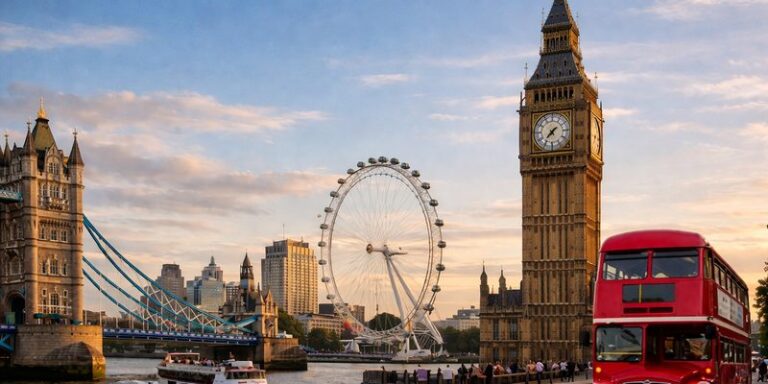
There is a certain magic to London at dawn. The mist rises gently from the River Thames, brushing against the spires of Westminster and the steel arcs of Tower Bridge. Red buses hum into life, café doors swing open, and somewhere a church bell reminds you that this city has been telling stories for nearly two millennia.
Few capitals balance tradition and trend quite like London. One moment you are standing inside the ancient walls of the Tower of London, the next you are sipping ethically sourced coffee in Shoreditch surrounded by street art. It is a city of contrasts – regal yet rebellious, historic yet experimental – and that is precisely why it continues to draw millions of visitors each year (VisitBritain, 2023).
1.0 Brief Background and History
London’s origins trace back to Roman Londinium, founded around AD 43. Its strategic river location fostered trade and expansion. By the medieval period, London had become England’s commercial heart, surviving plague, fire and political upheaval, most notably the Great Fire of 1666.
The Victorian era marked rapid industrial and imperial expansion, shaping many landmarks still admired today, including the Houses of Parliament and major railway termini. As urban tourism developed in the nineteenth and early twentieth centuries, London emerged as a cultural capital drawing international visitors (Steward, 2008; Cocks, 2001).
Today, London stands as a global hub for finance, fashion, theatre and higher education. Scholars identify it as a leading world tourism city, combining cultural heritage with business and event tourism (Morrison & Maxim, 2021).
2.0 Accommodation: From Royal Luxury to Boutique Cool
London’s accommodation landscape reflects its diversity. According to tourism research, successful cities provide a range of lodging options clustered near attractions and transport links (Fyall et al., 2022). London delivers this effortlessly.
- Luxury icons: The Savoy, The Ritz and Claridge’s offer refined elegance and historic prestige.
- Boutique hotels: Areas like Covent Garden and Soho showcase stylish, design-led stays.
- Budget-friendly chains and hostels: Ideal for students and backpackers.
- Serviced apartments: Increasingly popular among families and longer-stay visitors.
The growth of varied accommodation types reflects broader trends in urban tourism and regeneration (Law, 1992; García-Hernández & De la Calle-Vaquero, 2017). Wherever you choose to stay, efficient public transport ensures the city is within easy reach.
3.0 Food & Drink: A Culinary Capital
London’s food scene is a powerful tourism draw in its own right. Scholars describe food tourism as a key component of urban visitor experiences (Hall et al., 2004; Robinson, 2012).
Traditional British fare – think Sunday roast, fish and chips, and afternoon tea – remains popular. Yet London’s culinary identity is profoundly multicultural. Brick Lane’s Bangladeshi curries, Chinatown’s dim sum, Borough Market’s artisan produce and Brixton’s Caribbean kitchens reflect the city’s global influences.
Research highlights how gastronomy enhances destination image and visitor satisfaction (Cleave, 2020). London’s Michelin-starred restaurants coexist with vibrant street food markets, ensuring something for every budget and taste.
And let us not forget the pubs. A pint of ale in a centuries-old tavern offers a uniquely British pleasure.
4.0 Things to Do: Icons and Hidden Corners
London’s attractions blend heritage, culture and creativity. Urban tourism studies emphasise the importance of diverse visitor attractions in sustaining repeat visits (Fyall et al., 2022).
4.1 Must-See Landmarks
- The British Museum (free entry) – One of the world’s greatest museums, housing the Rosetta Stone, Egyptian mummies and treasures from across human civilisation.
- Buckingham Palace – The official London residence of the King. Watch the Changing of the Guard and tour the State Rooms in summer.
- The London Eye – A 135-metre observation wheel offering panoramic views over the Thames and London skyline.
- Madame Tussauds – The world-famous wax museum featuring celebrities, royalty and historical figures.
- St Paul’s Cathedral – Sir Christopher Wren’s masterpiece, known for its grand dome and Whispering Gallery.
- Tower Bridge – London’s iconic Victorian bridge with a glass walkway and historic engine rooms.
- The Tower of London (Historic Royal Palace) – Nearly 1,000 years of history and home to the Crown Jewels.
4.2 Iconic Government & Historic Sites
- Houses of Parliament & Big Ben (Elizabeth Tower) – The political heart of the UK and one of the world’s most recognisable landmarks.
- Westminster Abbey – Coronation church of British monarchs and UNESCO World Heritage Site.
- Trafalgar Square & Nelson’s Column – A central London gathering place surrounded by historic buildings.
4.3 Skyline & Unique Viewing Experiences
- IFS Cloud Cable Car (London Cable Car) – A scenic cable car crossing the River Thames between Greenwich Peninsula and the Royal Docks, offering impressive aerial views.
- The Shard – The View from The Shard – Western Europe’s tallest building with breathtaking 360-degree views.
- Sky Garden (free entry, booking required) – A landscaped public garden with panoramic city views.
4.4 River & Waterfront Experiences
- Thames River Cruise – A relaxing way to see London’s landmarks from the water, passing the Houses of Parliament, Tower Bridge and Canary Wharf.
- Uber Boat by Thames Clippers – A commuter-style river service that doubles as a scenic transport option.
- Greenwich (Royal Borough of Greenwich) – Home to the Royal Observatory, the Prime Meridian Line and the historic Cutty Sark.
4.5 Museums & Galleries (Many Free Entry)
- The National Gallery – Masterpieces by Van Gogh, da Vinci and Turner.
- Tate Modern – Contemporary art in a converted power station.
- The Natural History Museum – Famous for its dinosaur skeletons and grand architecture.
- The Victoria and Albert Museum (V&A) – Art, design and fashion collections.
4.5 Markets, Parks & Cultural Hotspots
- Covent Garden – Street performers, boutique shops and the historic market hall.
- Camden Market – Alternative fashion, street food and music culture.
- Hyde Park & Kensington Gardens – Royal parks perfect for walking and relaxation.
- Harrods (Knightsbridge) – The iconic luxury department store.
4.6 Cultural Experiences & Events
- West End Theatre Performances – World-class musicals, dramas and long-running productions in London’s historic theatre district.
- Seasonal Exhibitions at Tate Modern and the National Gallery – Rotating international exhibitions alongside permanent collections of modern and classical masterpieces.
- Notting Hill Carnival – Europe’s largest street festival, celebrating Caribbean culture through music, dance and vibrant costumes.
- Camden’s Alternative Markets and Live Music Scene – A hub of counterculture, independent fashion, street food and emerging music talent.
- Changing of the Guard Ceremony – A ceremonial display of British pageantry at Buckingham Palace.
- Royal Albert Hall Concerts – Prestigious performances ranging from classical music and the BBC Proms to contemporary artists.
4.7 Green Spaces & Creative Districts
- Hyde Park – One of London’s largest Royal Parks, offering open lawns, Serpentine Lake, walking trails and seasonal events.
- Regent’s Park – Known for its formal gardens, Regent’s Canal and the world-famous ZSL London Zoo.
- Greenwich Park – A historic Royal Park with sweeping views across Canary Wharf and the Thames.
- Hampstead Heath – Expansive natural parkland with woodland trails and panoramic views from Parliament Hill.
- Shoreditch – A contemporary creative district celebrated for street art, independent galleries, technology start-ups and innovative dining.
- South Bank – A vibrant riverside area blending green walkways with cultural institutions such as the Southbank Centre and the National Theatre.
5.0 When to Visit
London is a year-round destination, yet each season offers a distinct charm:
- Spring (March–May): Mild weather and blooming parks.
- Summer (June–August): Festivals, outdoor events and long daylight hours.
- Autumn (September–November): Fewer crowds and golden foliage.
- Winter (December–February): Festive markets and Christmas lights along Oxford Street.
Peak international arrivals typically occur in summer (VisitBritain, 2023). Shoulder seasons often provide better accommodation rates and shorter queues at major attractions.
6.0 Sample Three-Day Itinerary
Day 1: Royal and Historic London
Morning at Westminster Abbey and Big Ben. Afternoon exploring the Tower of London. Evening stroll along the South Bank.
Day 2: Culture and Cuisine
Morning at the British Museum. Lunch at Borough Market. Afternoon shopping in Covent Garden. West End show in the evening.
Day 3: Modern and Local London
Explore Shoreditch street art. Visit Tate Modern. Relax in Hyde Park before dining in Soho.
This balance reflects tourism principles advocating a mix of iconic sights and authentic local experiences (Holloway & Humphreys, 2019).
7.0 Travel Tips
- Purchase an Oyster card or use contactless payment for public transport.
- Book major attractions in advance during peak periods.
- Walk where possible – many landmarks are closer than they appear.
- Carry a light waterproof jacket: London weather can be unpredictable.
- Take advantage of free museums to balance your budget.
London’s transport infrastructure and tourism services are widely recognised as strengths supporting its global appeal (Morrison & Coca-Stefaniak, 2020).
8.0 Why London Is Worth Visiting
London is more than a checklist of landmarks. It is a living narrative – a city where Roman ruins stand beside glass skyscrapers, where centuries-old pubs neighbour vegan bakeries, and where tradition and innovation intertwine effortlessly.
Academic research consistently identifies London as a leading example of successful urban tourism development, blending heritage, gastronomy, cultural vibrancy and infrastructure (Law, 1992; Richards, 2022).
Whether you are drawn by royal pageantry, world-class museums, diverse cuisine or simply the pleasure of wandering historic streets, London rewards curiosity. It is not merely a place to visit – it is a city to experience.
References
Cleave, P. (2020) ‘Food as a leisure pursuit, a United Kingdom perspective’, Annals of Leisure Research.
Cocks, C. (2001) Doing the Town: The Rise of Urban Tourism in the United States, 1850–1915. Berkeley: University of California Press.
Fyall, A., Garrod, B., Leask, A. and Wanhill, S. (2022) Managing Visitor Attractions. London: Routledge.
García-Hernández, M. and De la Calle-Vaquero, M. (2017) ‘Cultural heritage and urban tourism: Historic city centres under pressure’, Sustainability, 9(8), 1346. Available at: https://www.mdpi.com/2071-1050/9/8/1346.
Hall, C.M., Sharples, L., Mitchell, R. and Macionis, N. (2004) Food Tourism Around the World. Oxford: Butterworth-Heinemann.
Holloway, J.C. and Humphreys, C. (2019) The Business of Tourism. London: Sage.
Law, C.M. (1992) ‘Urban tourism and its contribution to economic regeneration’, Urban Studies, 29(3–4), pp. 599–618.
Morrison, A.M. and Coca-Stefaniak, J.A. (2020) Routledge Handbook of Tourism Cities. London: Routledge.
Morrison, A.M. and Maxim, C. (2021) World Tourism Cities: A Systematic Approach to Urban Tourism. London: Routledge.
Richards, G. (2022) ‘Urban tourism as a special type of cultural tourism’, in A Research Agenda for Urban Tourism. Cheltenham: Edward Elgar.
Robinson, P. (2012) Tourism: The Key Concepts. London: Routledge.
Selby, M. (2003) Understanding Urban Tourism: Image, Culture and Experience. London: I.B. Tauris.
Steward, J. (2008) ‘The Attractions of Place: The Making of Urban Tourism, 1860–1914’, in The Making of Urban Tourism.
VisitBritain (2023) Inbound tourism statistics. Available at: https://www.visitbritain.org.