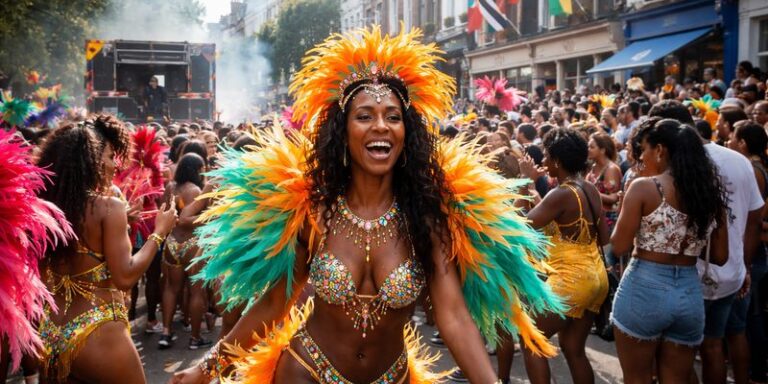
Notting Hill Carnival arrives like a burst of colour, bass and sunshine in the heart of west London. One moment, ordinary streets are lined with houses and cafés; the next, they are alive with steelpan rhythms, towering, feathered costumes, irresistible aromas of jerk chicken and fried plantain, and crowds moving together to the pulse of soca, calypso and reggae. It is loud, joyful, layered and impossible to ignore. Yet Notting Hill Carnival is much more than a spectacular summer event. Beneath the glitter and sound lies a powerful story about migration, identity, community and cultural resistance.
For first-time visitors, the festival can feel like a giant open-air party. For those who know its roots, it is also a living expression of Caribbean heritage in Britain, shaped by the experiences of the Windrush generation and later Black British communities. Scholars have long argued that carnival is not merely entertainment, but a way of claiming visibility, memory and public space (Cohen, 1982; Jackson, 1988). That is exactly why Notting Hill Carnival still matters. It offers pleasure, yes, but also pride, history and belonging.
1.0 Brief Background and History
The story of Notting Hill Carnival begins with Caribbean carnival traditions, especially those associated with Trinidad. These festivals grew from a complex history of European pre-Lenten masquerade, African cultural survival, and the struggle for dignity after slavery and emancipation (Cowley, 1996; La Rose, 2019). Music, masquerade and satire became ways to celebrate freedom and comment on society.
In Britain, the festival’s origins are closely tied to the racial tensions of post-war London. In the late 1950s, Notting Hill was a site of hostility towards Black migrants, culminating in the 1958 Notting Hill riots. In response, Trinidad-born activist Claudia Jones organised an indoor Caribbean carnival in 1959 as an act of cultural affirmation and communal healing. More street-based celebrations followed during the 1960s, gradually evolving into the annual event recognised today (Forbes-Erickson, 2025).
Over the decades, Notting Hill Carnival expanded from a local community gathering into one of Europe’s largest street festivals. Even so, its historic connection to anti-racism and Caribbean self-expression remains central to its identity (Ferdinand and Williams, 2018).
2.0 Cultural Significance of Notting Hill Carnival
2.1 A Celebration of Heritage and Belonging
At its core, Notting Hill Carnival is a public celebration of Caribbean culture in Britain. It gives space to traditions that were once pushed to the margins and places them at the centre of London life. This is significant because public festivals shape who is visible in the city and whose stories are valued (Taylor and Kneafsey, 2016).
For many Black Britons, the event is not simply something to attend, but something to inherit. Parents introduce children to mas bands, steel bands and carnival foods; grandparents recognise echoes of island traditions; younger people connect those traditions with present-day London identity. In that way, Carnival becomes both a festival and a bridge between generations.
2.2 More Than A Party
Academic work on Carnival repeatedly shows that it is also a form of cultural politics. Cohen (1982) and Jackson (1988) describe it as a contested performance in which identity, authority and urban space meet. That helps explain why Notting Hill Carnival carries such symbolic force. It is festive, but it is also meaningful. It shows that joy itself can be political when communities who have faced exclusion choose to celebrate openly and visibly.
3.0 Music, Costume and Parade Highlights
Music is the heartbeat of Notting Hill Carnival. Without it, the event would lose much of its energy and meaning. Steel bands bring bright, melodic sounds rooted in Trinidadian innovation, while sound systems reflect the deep influence of Jamaican musical culture on Black Britain. Soca pushes the tempo up; reggae and dub deepen the groove; calypso carries humour and social commentary (Henriques and Ferrara, 2016).
Costume is equally important. Masquerade, or mas, transforms the street into a moving gallery of sequins, feathers, flags and storytelling. Some costumes are grand and theatrical, others playful and modern, but all contribute to the sense that Carnival is both art and performance. Kimura (2006) notes that mas bands are not random displays but organised creative groups that shape the visual identity of the event.
For visitors, one of the most memorable experiences is simply watching a parade pass: dancers glittering in the sunlight, music rolling from a truck, children copying the steps of older masqueraders, and spectators becoming participants as they fall into rhythm. It is one of London’s rare events where the boundary between audience and performer almost disappears.
4.0 Food and Drink
Food is one of the great pleasures of Notting Hill Carnival. The festival’s stalls and street vendors reflect the richness of Caribbean cooking, and the role food plays in cultural memory. You are likely to find jerk chicken, curried goat, rice and peas, roti, doubles, fried dumplings and plantain, often served in busy, aromatic queues that are part of the experience themselves.
This matters beyond appetite. Food at Carnival is tied to identity, migration and shared celebration. Taylor and Kneafsey (2016) note that festivals often communicate heritage through music, dress and cuisine together. At Carnival, that mix is unmistakable. Even someone arriving with little prior knowledge quickly senses that flavour is part of the storytelling.
A practical example is the way food stalls create mini social hubs. Friends stop for a drink, families regroup over takeaway boxes, and first-time visitors often discover a dish they later seek out elsewhere in London. The food, like the music, travels beyond the event.
5.0 Things to Do and See
There is no single way to experience Notting Hill Carnival, which is part of its appeal. Some people come for the main parade and mas bands. Others follow particular sound systems, seeking reggae, dancehall, dub or soca. Many visitors make time for steelpan performances, which offer a slightly different atmosphere from the louder mobile processions.
One of the highlights is the Children’s Day parade, which showcases young performers and reminds visitors that Carnival is deeply rooted in family and community life. Elsewhere, simply wandering the route can be rewarding: the decoration, dancing, fashion and street-level atmosphere provide constant moments of interest.
For photographers, culture lovers and music fans, Notting Hill Carnival offers a rich sensory experience. For general visitors, it offers something simpler but no less valuable: the chance to feel part of a city celebrating its diversity in public.
6.0 When to Attend
Notting Hill Carnival traditionally takes place over the August Bank Holiday weekend. Sunday is usually associated with family-friendly programming and Children’s Day activities, while Monday often draws even larger crowds and a stronger focus on the main parade and party atmosphere.
In practical terms, the best day depends on what you want. Families and those who prefer a slightly calmer environment may enjoy Sunday. Visitors seeking maximum scale, sound and spectacle may prefer Monday. Either way, arriving early usually makes movement easier and helps you enjoy the festival before peak congestion.
7.0 Travel Tips
A little planning can make Notting Hill Carnival much more enjoyable. Wear comfortable shoes, dress for warm weather, and keep belongings secure. Because roads close and stations can become very busy, it is wise to check official travel guidance in advance through Transport for London and the event organisers.
Bring water, carry some card payment options, and agree a meeting point if travelling with friends, as mobile signals can become patchy in dense crowds. It is also worth approaching Carnival with patience. Big crowds are part of the experience, and the best moments often come when you stop rushing and simply take in the atmosphere.
Most importantly, come with respect. This is a visitor event, but it is also a community tradition with deep historical roots.
8.0 Why It’s Worth Experiencing
What makes Notting Hill Carnival worth experiencing is not only its size or energy, but its depth. It combines celebration, heritage, music, food and public memory in a way few events manage. It is a festival where London feels global and local at once.
Researchers describe Carnival as a space where politics, creativity and belonging intersect (Raj, 2015; Ferdinand and Williams, 2018). For visitors, that means the day can be fun and thought-provoking at the same time. You may arrive for the costumes and sound systems, but you leave with a stronger sense of the city’s cultural history.
In a time when public life can feel fragmented, Notting Hill Carnival offers a rare collective experience built on joy, artistry and resilience.
Notting Hill Carnival is one of London’s most powerful cultural events because it does more than entertain. It tells a story of Caribbean migration, Black British creativity, and the determination to turn difficult histories into visible, communal celebration. Its music fills the streets, its costumes dazzle the eye, and its food draws people together, but its deeper strength lies in what it represents: belonging, resistance and pride.
For tourists, it is an unforgettable day out. For London, it is a vital expression of multicultural life. And for the communities that built it, Notting Hill Carnival remains a living tradition that continues to transform the city, one beat, one costume and one street at a time.
References
Cohen, A. (1982) ‘A polyethnic London carnival as a contested cultural performance’, Ethnic and Racial Studies, 5(1), pp. 23–41.
Cowley, J. (1996) Carnival, Canboulay and Calypso: Traditions in the Making. Cambridge: Cambridge University Press.
Ferdinand, N. and Williams, N.L. (2018) ‘The making of the London Notting Hill carnival festivalscape: Politics and power and the Notting Hill carnival’, Tourism Management Perspectives, 27, pp. 33–46.
Forbes-Erickson, A.R. (2025) ‘The imperative of “human happiness”. Claudia Jones, the Windrush Generation, and the emergence of Notting Hill Carnival in 1959, London, England’, Angles: New Perspectives on the Anglophone World, 20.
Henriques, J. and Ferrara, B. (2016) ‘The sounding of the Notting Hill Carnival: Music as space, place and territory’, in Black Popular Music in Britain Since 1945. Farnham: Ashgate, pp. 143–158.
Jackson, P. (1988) ‘Street life: the politics of carnival’, Environment and Planning D: Society and Space, 6(2), pp. 213–227.
Kimura, Y. (2006) ‘The Notting Hill Carnival in London: A study on masbands, masquerading groups of an urban festival’, Japanese Review of Cultural Anthropology, 7, pp. 47–66.
La Rose, M. (2019) ‘“The City Could Burn Down, We Jammin’ Still!” The history and tradition of cultural resistance in the art, music, masquerade and politics of the Caribbean carnival’, Caribbean Quarterly, 65(4), pp. 579–593.
Raj, R. (2015) ‘Carnival: Community cohesion, neighbourhood identity or political challenge’, Journal of Hospitality and Tourism, 3, pp. 37–45.
Taylor, E. and Kneafsey, M. (2016) ‘The place of urban cultural heritage festivals: The case of London’s Notting Hill Carnival’, in Albert, M.T., Richon, M. and Vinals, M.J. (eds.) Cultural Heritage in a Changing World. Cham: Springer, pp. 181–197.
Transport for London (n.d.) Travel advice for Notting Hill Carnival. Available at: https://tfl.gov.uk/ (Accessed: 27 March 2026).
Notting Hill Carnival Ltd (n.d.) Official Notting Hill Carnival information. Available at: https://nhcarnival.org/ (Accessed: 27 March 2026).