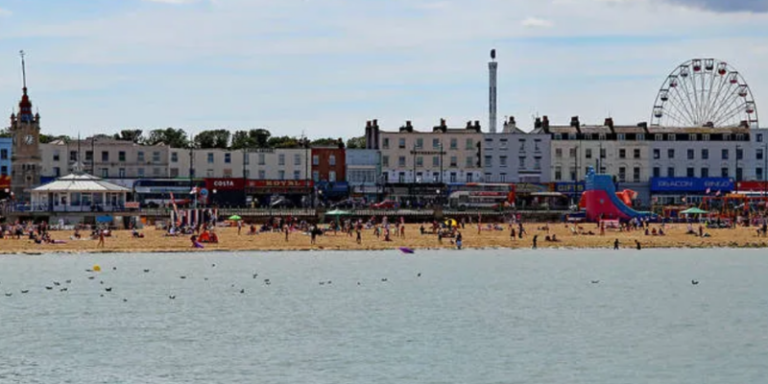
Stand on Margate’s Main Sands at low tide and you will see why this Kentish town has captivated visitors for centuries. The sky stretches wide above the North Sea, the sand glows golden beneath shifting light, and the distant curve of the harbour frames the horizon. Children chase waves along the shoreline, while just a short walk away, contemporary art lovers gather beneath the clean lines of the Turner Contemporary gallery. Margate is a seaside town where nostalgia and innovation exist side by side — a place that honours its past while embracing a vibrant cultural present.
Located on the north-east coast of Kent, Margate is one of Britain’s original seaside resorts. Its appeal lies in its ability to balance traditional seaside charm with artistic reinvention, offering visitors everything from sandy beaches and amusement arcades to contemporary galleries and independent cafés.
1.0 Brief Background and History
Margate’s rise began in the eighteenth century, when sea bathing was promoted as a therapeutic cure. As Hassan (2016) explains, coastal towns across Britain flourished during this period due to changing medical beliefs about health and fresh air. Londoners, seeking respite from industrial pollution, travelled to Margate for restorative holidays.
The construction of the Margate Harbour Arm in 1815 significantly improved access for visitors arriving by boat (Hassan, 2016). Later, railway expansion enabled mass tourism, transforming Margate into one of the first British resorts to welcome working- and middle-class holidaymakers (Jarratt, 2017). Georgian terraces and Victorian guesthouses still line the streets, echoing this golden era.
Throughout the twentieth century, Margate became synonymous with deckchairs, donkey rides and seaside amusements. Though it faced economic challenges in the late twentieth century, it has since undergone a powerful cultural revival.
2.0 Accommodation: Character by the Coast
Margate offers a range of accommodation that reflects both its heritage and modern transformation. Boutique hotels housed in restored Georgian buildings provide stylish interiors with sea views. Charming bed-and-breakfasts in Cliftonville and the Old Town combine comfort with character.
Self-catering apartments are popular among families and creative visitors seeking longer stays. According to Cooper et al. (2018), diverse accommodation strengthens destination resilience by appealing to varied market segments. Margate’s blend of historic and contemporary lodging supports this adaptability.
TripAdvisor (2023) highlights the growing number of independent, design-led stays that reinforce the town’s artistic identity.
3.0 Food and Drink: From Fish and Chips to Farmers’ Markets
Margate’s culinary scene mirrors its balance of tradition and innovation. Classic seaside staples — fish and chips enjoyed on the harbour wall — remain essential. Yet beyond nostalgia, Margate boasts a flourishing food culture centred on locally sourced and seasonal ingredients.
The Margate Farmers’ Market showcases Kentish produce, artisan breads and craft beverages (Margate Farmers’ Market, 2023). Independent cafés in the Old Town serve creative brunches and specialty coffee, reflecting evolving consumer tastes in food tourism (Ellis et al., 2018).
Evenings bring relaxed coastal dining and vibrant pub culture, with sea views providing the perfect backdrop.
4.0 Things to Do: Beach, Art and Heritage
Golden Sands and Seaside Fun
Margate’s Main Sands remains its star attraction. The beach’s soft sand and gently sloping waters make it ideal for families (UK Beach Guide, 2023). Deckchair rentals, ice cream kiosks and traditional arcades sustain its nostalgic charm.
Dreamland: Retro Thrills
Opened in 1920, Dreamland is one of Britain’s most iconic amusement parks. Its historic wooden roller coaster, the Scenic Railway, remains a treasured attraction (Dreamland Margate, 2022). The park’s recent restoration blends vintage rides with modern entertainment, exemplifying how heritage attractions can evolve without losing authenticity (Jarratt, 2017).
Turner Contemporary and the Artistic Revival
Margate’s cultural renaissance accelerated with the opening of Turner Contemporary in 2011. Named after J.M.W. Turner — who praised Margate’s luminous skies — the gallery honours his legacy while presenting international exhibitions (Warrell, 2014; Turner Contemporary, 2023).
Thompson (2019) argues that the gallery has catalysed Margate’s creative economy, attracting artists, entrepreneurs and visitors alike. Independent studios and galleries now populate the Old Town, reinforcing Margate’s identity as a cultural hub.
Historical Curiosities
The mysterious Shell Grotto, discovered in 1835, features walls covered with millions of shells arranged in intricate patterns (Morris, 2015). Its origins remain debated, adding intrigue to the visitor experience.
Literary enthusiasts may also visit Bleak House, associated with Charles Dickens, whose time in Kent influenced his writing (Keen, 2019).
5.0 When to Visit
Summer is peak season, when beaches bustle and festivals animate the streets. However, spring and early autumn offer milder temperatures and fewer crowds, ideal for gallery visits and coastal walks.
Winter reveals a quieter Margate, where dramatic skies and windswept sands evoke Turner’s atmospheric seascapes. Butler’s (1980) Tourism Area Life Cycle suggests that destinations sustaining year-round cultural programming maintain greater resilience. Margate’s event calendar — from art exhibitions to music festivals — ensures continuous appeal.
6.0 Sample Three-Day Itinerary
Day One – Seaside Classics
Morning: Relax on Main Sands.
Afternoon: Explore Dreamland’s vintage rides.
Evening: Harbour-side fish and chips at sunset.
Day Two – Art and Culture
Morning: Visit Turner Contemporary.
Afternoon: Wander the Old Town’s independent shops.
Evening: Live music at a local venue.
Day Three – History and Mystery
Morning: Tour the Shell Grotto.
Afternoon: Visit Bleak House and coastal viewpoints.
Evening: Dinner featuring Kentish produce.
This itinerary captures Margate’s blend of nostalgia, creativity and discovery.
7.0 Travel Tips
- Getting There: Direct trains from London St Pancras take approximately 90 minutes.
- Beach Conditions: Check tide times for optimal beach space.
- Event Planning: Book accommodation early during festival periods.
- Support Local: Explore independent shops to sustain the creative economy.
Responsible travel practices help preserve Margate’s distinctive atmosphere (Hall and Page, 2014).
8.0 Why Margate Is Worth Visiting
Margate’s enduring charm lies in its balance. It offers golden sands without stagnation, heritage without rigidity and culture without pretension. From Dreamland’s nostalgic thrills to Turner Contemporary’s artistic innovation, the town demonstrates how seaside resorts can reinvent themselves while retaining identity.
As Jarratt (2017) observes, British seaside towns flourish when they embrace both memory and modernity. Margate achieves precisely this synthesis. Whether drawn by the shimmer of its beach, the intrigue of its history or the energy of its creative scene, visitors find in Margate a timeless coastal escape.
References
Butler, R.W. (1980) ‘The concept of a tourist area cycle of evolution’, Canadian Geographer, 24(1), pp. 5–12.
Cooper, C., Fletcher, J., Fyall, A., Gilbert, D. and Wanhill, S. (2018) Tourism: Principles and Practice. 6th edn. Harlow: Pearson.
Dreamland Margate (2022) Dreamland Amusement Park. Available at: https://www.dreamland.co.uk.
Ellis, A., Park, E., Kim, S. and Yeoman, I. (2018) ‘What is food tourism?’, Tourism Management, 68, pp. 250–263.
Hall, C.M. and Page, S.J. (2014) The Geography of Tourism and Recreation. 4th edn. London: Routledge.
Hassan, J. (2016) The Seaside, Health and the Environment in England and Wales Since 1800. London: Routledge.
Jarratt, D. (2017) ‘Seaside towns and coastal tourism’, Journal of Tourism and Cultural Change, 15(4), pp. 352–367.
Keen, R. (2019) ‘Charles Dickens and the Kent Coast’, Journal of English Literature, 34(2), pp. 112–130.
Margate Farmers’ Market (2023) Fresh Produce and Artisanal Goods. Available at: https://www.margatefarmersmarket.co.uk.
Morris, L. (2015) ‘The mystery of Margate’s Shell Grotto’, Archaeology Journal, 72(3), pp. 184–195.
Thompson, A. (2019) ‘The rise of Margate’, British Art Journal, 16(2), pp. 89–101.
Turner Contemporary (2023) About Turner and the Gallery. Available at: https://www.turnercontemporary.org.
UK Beach Guide (2023) Margate Main Beach. Available at: https://www.ukbeaches.guide/margate-beach.
Visit Thanet (2023) Margate Events and Entertainment. Available at: https://www.visitthanet.co.uk/margate-events.
Warrell, I. (2014) Turner and the Sea. London: Tate Publishing.