Nestled within the tranquil expanse of Kensington Gardens, just west of London’s bustling centre, Kensington Palace offers visitors a rare glimpse into the personal lives behind the British monarchy’s public façade. Unlike the imposing grandeur of Buckingham Palace or the medieval drama of the Tower of London, Kensington Palace feels at once regal and intimate — a royal residence shaped as much by domestic life as by state ceremony. From its origins as a modest Jacobean mansion known as Nottingham House to its association with Queen Victoria and Diana, Princess of Wales, the palace reflects the evolving nature of monarchy itself (Strong, 1999).
Today, Kensington Palace stands as both an official royal residence and a major heritage attraction managed by Historic Royal Palaces. Through exhibitions, restored state apartments and immersive storytelling, it invites visitors to explore the complex interplay between private emotion and public duty that has defined Britain’s royal family for more than three centuries.
1.0 From Nottingham House to Royal Residence
Kensington Palace began life in the early seventeenth century as Nottingham House, a suburban retreat built in the Jacobean style. Its transformation began in 1689, when William III and Mary II purchased the property, seeking refuge from the polluted air and overcrowded streets of central London. According to architectural historian Roy Strong (1999), the monarchs desired a residence that combined accessibility to Parliament with healthier surroundings.
Sir Christopher Wren was commissioned to expand the house, creating elegant state apartments and formal gardens. The resulting design reflected the growing influence of Baroque aesthetics, though it retained the domestic scale of its Jacobean core. This architectural layering — modest beginnings enhanced by royal ambition — remains central to the palace’s charm.
In tourism studies, such architectural hybridity enhances visitor interest, as sites that embody multiple historical phases offer richer interpretative potential (Ashworth and Tunbridge, 2000). Kensington Palace thus appeals not only to admirers of royal history but also to enthusiasts of architectural evolution.
2.0 The Birthplace of a Queen
Perhaps Kensington Palace’s most compelling historical association is with Queen Victoria, who was born there in 1819. Raised within its walls under the restrictive “Kensington System” devised by her mother and Sir John Conroy, Victoria experienced a sheltered and closely supervised childhood. According to Hibbert (2000), her early years at Kensington profoundly shaped her later independence and resilience as monarch.
Visitors today can explore the Victoria: A Royal Childhood exhibition, which recreates the rooms where the young princess lived and studied. Personal objects, letters and artwork bring to life the emotional world of a future queen. This focus on individual narrative aligns with contemporary heritage interpretation strategies that emphasise human-centred storytelling (Timothy and Boyd, 2003).
By presenting Victoria not merely as a sovereign but as a child navigating complex familial dynamics, the palace deepens emotional engagement. Scholars note that heritage tourism thrives when visitors can form empathetic connections with historical figures (Pine and Gilmore, 2011).
3.0 A Modern Icon: Diana, Princess of Wales
In the late twentieth century, Kensington Palace once again entered the global spotlight through its association with Diana, Princess of Wales. Diana resided in Apartment 8 after her marriage to Prince Charles and remained there following their separation. Following her tragic death in 1997, the palace gates became a sea of flowers, symbolising public grief and affection.
Exhibitions dedicated to Diana’s life and fashion have drawn international visitors, illustrating the enduring fascination with modern royalty. The blending of contemporary memory with historical narrative demonstrates how heritage sites adapt to evolving cultural identities (Waterton and Watson, 2015). Kensington Palace thus serves not only as a repository of the distant past but as a living symbol of the monarchy’s continuing relevance.
4.0 The King’s and Queen’s State Apartments
Architecturally, the palace’s King’s State Apartments and Queen’s State Apartments are among its most striking features. The King’s Staircase, adorned with vivid murals by William Kent, depicts members of George I’s court in theatrical poses. These rooms once hosted receptions, musical performances and diplomatic gatherings.
By contrast, the Queen’s Apartments offer a more intimate perspective, reflecting the daily rhythms of court life. The juxtaposition of ceremonial grandeur and domestic comfort underscores the duality of monarchy — both public institution and private household.
From a tourism management perspective, such contrasts enhance visitor satisfaction. Cooper et al. (2018) argue that successful attractions balance spectacle with relatability, offering layered experiences that cater to diverse interests.
5.0 Gardens and Green Spaces
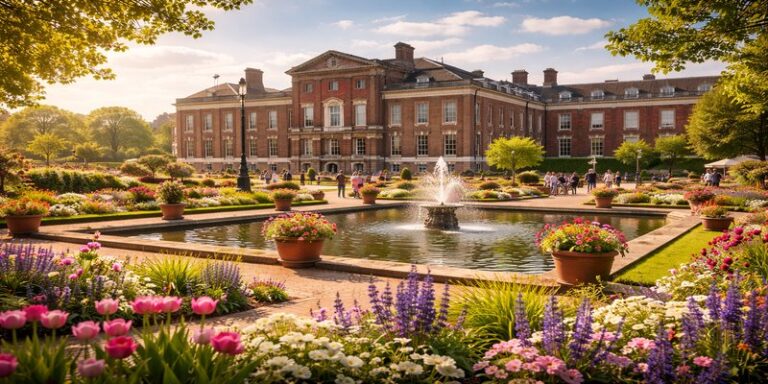
Beyond its interiors, Kensington Palace is enveloped by the landscaped beauty of Kensington Gardens. The Sunken Garden, redesigned in recent years as a tribute to Diana, features seasonal floral displays that attract photographers and families alike. Green spaces play a vital role in urban tourism, providing restorative environments within metropolitan settings (Hall and Page, 2014).
The palace’s location within a Royal Park also enhances its accessibility and appeal. Visitors can combine a palace tour with boating on the Serpentine or a stroll through Hyde Park, creating a multifaceted leisure experience.
6.0 Heritage, Education and the Experience Economy
Managed by Historic Royal Palaces, Kensington Palace exemplifies contemporary heritage practice. As an independent charity, the organisation prioritises conservation while embracing innovative interpretation. Interactive exhibitions, digital installations and thematic displays transform static artefacts into dynamic narratives (Historic Royal Palaces, 2024).
Pine and Gilmore’s (2011) concept of the Experience Economy is evident here. Rather than merely presenting historical facts, the palace curates immersive encounters that engage visitors intellectually and emotionally. Temporary exhibitions exploring royal fashion or court politics ensure repeat visitation and sustained relevance.
Moreover, Kensington Palace contributes significantly to London’s tourism economy. According to VisitBritain (2023), heritage attractions remain a primary motivator for inbound travel to the UK. Royal residences, in particular, hold strong international appeal due to the global visibility of Britain’s monarchy.
7.0 Symbolism and Soft Power
Beyond tourism, Kensington Palace embodies Britain’s cultural diplomacy. Monarchical heritage functions as a form of soft power, projecting continuity, tradition and national identity (Nye, 2004). By opening its doors to the public, the palace balances exclusivity with accessibility, reinforcing the monarchy’s symbolic connection to the people.
This dual function — residence and museum — makes Kensington Palace unique. Few historic sites maintain active royal occupancy while simultaneously welcoming millions of visitors annually. The palace thus represents a living institution rather than a frozen relic.
8.0 An Intimate Window into Royal Life
Kensington Palace stands as a testament to the evolving nature of British monarchy. From its origins as Nottingham House to its transformation under William III and Mary II, from the sheltered childhood of Queen Victoria to the global resonance of Diana, Princess of Wales, it encapsulates centuries of political change and personal drama.
For holidaymakers exploring London, Kensington Palace offers an experience that is both grand and deeply human. Its blend of architectural elegance, emotional storytelling and tranquil gardens provides a welcome contrast to the city’s frenetic pace. More than a tourist attraction, it is a space where the boundaries between private life and public history blur — reminding visitors that behind every crown lies a story of ambition, vulnerability and resilience.
References
Ashworth, G.J. and Tunbridge, J.E. (2000) The Tourist-Historic City. London: Routledge.
Cooper, C., Fletcher, J., Fyall, A., Gilbert, D. and Wanhill, S. (2018) Tourism: Principles and Practice. 6th edn. Harlow: Pearson.
Hall, C.M. and Page, S.J. (2014) The Geography of Tourism and Recreation. 4th edn. London: Routledge.
Hibbert, C. (2000) Queen Victoria: A Personal History. London: HarperCollins.
Historic Royal Palaces (2024) Kensington Palace. Available at: https://www.hrp.org.uk.
Nye, J.S. (2004) Soft Power: The Means to Success in World Politics. New York: PublicAffairs.
Pine, B.J. and Gilmore, J.H. (2011) The Experience Economy. Boston: Harvard Business Review Press.
Strong, R. (1999) The Spirit of Britain: A Narrative History of the Arts. London: Pimlico.
Timothy, D.J. and Boyd, S.W. (2003) Heritage Tourism. Harlow: Pearson Education.
VisitBritain (2023) Inbound Tourism Performance Report. Available at: https://www.visitbritain.org.
Waterton, E. and Watson, S. (2015) The Palgrave Handbook of Contemporary Heritage Research. London: Palgrave Macmillan.