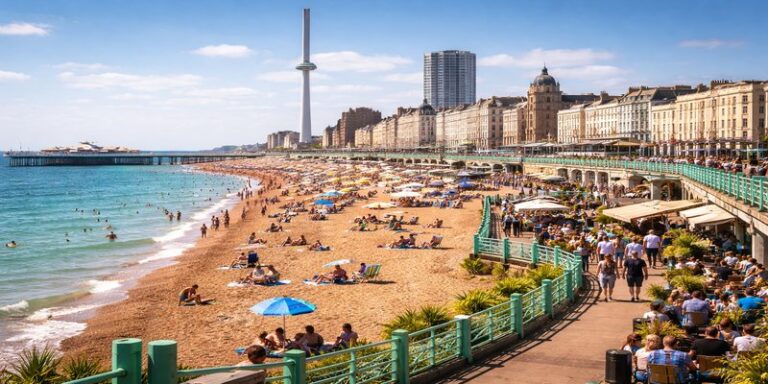
There is a certain energy in Brighton that sets it apart from Britain’s other coastal resorts. The moment you step onto its pebble beach, with the skeletal elegance of Brighton Palace Pier stretching into the Channel and the white façade of Regency terraces gleaming in the sunlight, you sense that this is no ordinary seaside town. Brighton is a place where bohemian culture, historic architecture and seaside nostalgia intertwine. Street performers animate the promenade, independent cafés spill onto narrow lanes, and the sea breeze carries both salt and creativity.
Unlike purely family-focused resorts or tranquil coastal villages, Brighton thrives on contrast. It is simultaneously relaxed and restless — a destination that embodies cultural vibrancy and coastal charm. In an era where travellers increasingly seek authentic, experience-driven destinations, Brighton offers an urban seaside escape with unmistakable personality (VisitBritain, 2023).
1.0 Brief Background and History
Brighton’s rise to prominence began in the eighteenth century, when it transformed from a modest fishing village into a fashionable spa resort. Its fortunes changed dramatically after Dr Richard Russell promoted sea bathing as a health cure, attracting wealthy visitors from London. However, it was the patronage of the Prince Regent (later King George IV) that truly elevated Brighton’s status. The construction of the extravagant Royal Pavilion, with its Indo-Saracenic domes and ornate interiors, cemented Brighton’s reputation as a playground for royalty and high society.
The arrival of the railway in 1841 further accelerated its popularity, making Brighton accessible to day-trippers and holidaymakers (Walton, 2000). As with many British seaside resorts, improved transport reshaped visitor demographics, broadening appeal across social classes.
Today, Brighton’s identity blends Regency elegance with modern diversity. Its reputation as one of the UK’s most inclusive and progressive cities reinforces its cultural magnetism.
2.0 Accommodation: From Regency Grandeur to Boutique Chic
Brighton’s accommodation reflects its layered history and creative spirit. Along the seafront, restored Regency hotels provide sea views framed by wrought-iron balconies. Boutique guesthouses in Kemptown offer individually styled rooms, often decorated with local art.
For budget-conscious travellers, hostels and serviced apartments near the station cater to weekend visitors and festival-goers. According to Cooper et al. (2018), destinations that provide a range of accommodation types are better positioned to attract diverse market segments. Brighton exemplifies this adaptability.
Eco-conscious travellers will also find sustainable options, including hotels that prioritise renewable energy and locally sourced products, reflecting growing environmental awareness in tourism (Hall and Page, 2014).
4.0 Food and Drink: Independent Flavours and Coastal Classics
Brighton’s culinary scene is as eclectic as its streets. Traditional fish and chips remain a seaside staple, best enjoyed along the promenade at sunset. Yet beyond this classic fare, Brighton’s reputation for independent restaurants and global cuisine shines.
The North Laine district is a haven for vegetarian cafés, vegan bakeries and artisan coffee houses. Brighton has one of the highest concentrations of vegetarian restaurants in the UK, reflecting evolving consumer values (Ellis et al., 2018). Seafood remains prominent, with local catches featured in harbour-front eateries.
Evenings bring lively pub culture and music venues, from intimate jazz bars to larger performance spaces. The city’s nightlife reinforces its image as both a cultural and coastal destination.
4.0 Things to Do: Art, Adventure and Atmosphere
Brighton’s appeal extends far beyond its pebble beach. The Royal Pavilion offers a glimpse into Regency extravagance, while the Brighton Museum & Art Gallery explores local and global artistic traditions.
The iconic Brighton Palace Pier provides nostalgic amusements, arcade games and panoramic sea views. For a contemporary perspective, visitors can ascend the British Airways i360, a glass observation tower offering sweeping coastal vistas.
Outdoor enthusiasts can explore the nearby South Downs National Park, where chalk cliffs and rolling hills contrast beautifully with the seafront. This integration of urban and natural landscapes aligns with contemporary preferences for mixed-experience travel (Jennings, 2004).
Festivals also define Brighton’s calendar. The annual Brighton Festival and Fringe attract performers and audiences from around the world, reinforcing the city’s cultural credentials.
5.0 When to Visit: Seasons of Celebration
Summer remains peak season, with warm weather drawing beachgoers and festival crowds. However, spring and autumn offer milder temperatures and fewer tourists, ideal for exploring the Lanes and cultural venues.
Winter reveals a quieter, reflective side of Brighton, with bracing sea walks and cosy cafés. Butler’s (1980) Tourism Area Life Cycle suggests that destinations sustaining year-round appeal enhance resilience. Brighton’s strong cultural programming ensures vibrancy beyond the summer months.
6.0 Sample Three-Day Itinerary
Day One – Regency Brighton
Morning: Visit the Royal Pavilion.
Afternoon: Wander through the Lanes and North Laine.
Evening: Dinner at an independent restaurant followed by live music.
Day Two – Coastal Adventure
Morning: Walk along the seafront and explore Brighton Palace Pier.
Afternoon: Take a trip up the i360 and enjoy beachside relaxation.
Evening: Sunset drinks overlooking the Channel.
Day Three – Nature and Culture
Morning: Excursion to the South Downs National Park.
Afternoon: Explore Brighton Museum or local galleries.
Evening: Attend a theatre performance or comedy show.
This itinerary balances heritage, leisure and creativity, encapsulating Brighton’s multifaceted charm.
7.0 Travel Tips
- Getting There: Direct trains from London take around one hour.
- Beachwear: Brighton’s beach is pebbled, so comfortable footwear is advisable.
- Festival Planning: Book accommodation early during festival season.
- Sustainability: Use public transport and support local independent businesses.
8.0 Why Brighton Is Worth Visiting
Brighton succeeds because it defies simple categorisation. It is neither purely traditional nor entirely modern, neither solely tranquil nor overwhelmingly energetic. Instead, it harmonises culture, coastline and community in a way few British resorts manage.
As Walton (2000) observes, seaside destinations endure when they adapt to social and cultural change. Brighton has done precisely that, transforming from royal retreat to creative capital while retaining its seaside soul.
For travellers seeking more than sun and sand — those who crave art, inclusivity and individuality — Brighton offers a coastal experience where culture truly meets the sea.
References
Butler, R.W. (1980) ‘The concept of a tourist area cycle of evolution’, Canadian Geographer, 24(1), pp. 5–12.
Cooper, C., Fletcher, J., Fyall, A., Gilbert, D. and Wanhill, S. (2018) Tourism: Principles and Practice. 6th edn. Harlow: Pearson.
Ellis, A., Park, E., Kim, S. and Yeoman, I. (2018) ‘What is food tourism?’, Tourism Management, 68, pp. 250–263.
Hall, C.M. and Page, S.J. (2014) The Geography of Tourism and Recreation. 4th edn. London: Routledge.
Jennings, G. (2004) Adventure Tourism. Oxford: Elsevier Butterworth-Heinemann.
VisitBritain (2023) Domestic Tourism Trends Report. Available at: https://www.visitbritain.org.
Walton, J.K. (2000) The British Seaside: Holidays and Resorts in the Twentieth Century. Manchester: Manchester University Press.