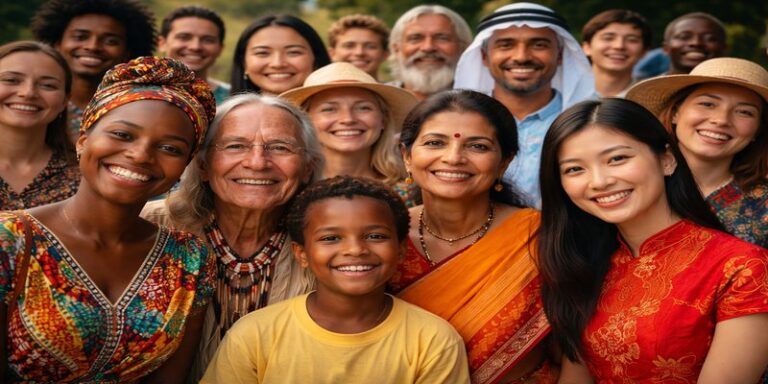
Ethnicity refers to a person’s identification with a particular cultural, historical or ancestral group, often shaped by shared language, traditions, religion, heritage and collective memory. Sociologists emphasise that ethnicity is not simply biological but a socially constructed identity, continually shaped by historical experiences, migration, political structures and cultural interaction (Nagel, 1994). Understanding ethnicity is essential because it influences identity formation, social relationships, access to opportunities and patterns of inclusion or exclusion within societies (Cornell & Hartmann, 2007). Recognising ethnic diversity therefore contributes to social cohesion, intercultural understanding and global harmony.
1.0 Understanding Ethnicity as Identity
Ethnicity plays a central role in shaping how individuals perceive themselves and others. It can provide a sense of belonging, continuity and cultural pride, particularly when communities share traditions, language or religious practices. For example, second-generation immigrants in Britain often maintain elements of their ancestral culture—such as food, festivals or language—while also integrating into British society. This demonstrates that ethnicity is often fluid rather than fixed, evolving across generations (Nagel, 1994).
Scholars distinguish ethnicity from race, although the two may overlap socially. Race often refers to perceived physical characteristics, whereas ethnicity emphasises cultural heritage and shared historical experience (Cornell & Hartmann, 2007). This distinction is important in academic discussions about identity, discrimination and multicultural policy.
2.0 Global Diversity of Ethnic Groups
The world contains thousands of ethnic communities, each contributing unique cultural practices, belief systems and artistic traditions. Anthropologists argue that this diversity forms a rich global cultural tapestry, fostering innovation, creativity and resilience across societies (Harrison, 2010).
2.1 African Ethnicities
Africa is one of the most ethnically diverse continents, with groups such as the Zulu, Yoruba, Hausa and Kikuyu demonstrating linguistic, cultural and religious diversity. For instance, the Yoruba people of West Africa possess complex artistic traditions, religious beliefs and oral storytelling practices that have influenced global culture, including music and literature (Arnold, 2016). Such diversity illustrates how ethnicity shapes regional identities, governance systems and cultural heritage.
2.2 Asian Ethnicities
Asia contains enormous ethnic diversity, including the Han Chinese, Indians, Japanese, Koreans and Filipinos, among many others. These groups differ in language, religion and historical development. For example, India alone contains hundreds of ethnic groups with distinct linguistic and religious traditions. This diversity highlights how ethnicity can influence social organisation, political structures and economic development (Yinger, 2005).
2.3 European Ethnicities
Europe’s ethnic landscape includes groups such as the Germans, French, Italians, Spanish and Greeks, each shaped by historical nation-building processes, migration and linguistic development. Gellner (1983) argues that modern nationalism often emerges from ethnic identity, linking shared culture with political structures. European history demonstrates how ethnicity can foster both cultural unity and political tension, particularly during periods of conflict or state formation.
2.4 Indigenous Peoples and Cultural Continuity
Indigenous peoples represent ethnic groups whose identities are closely tied to specific lands, traditional knowledge systems and long-standing cultural practices. Examples include Native American tribes, Aboriginal Australians and Māori communities in New Zealand. These groups often emphasise collective memory, oral traditions and spiritual relationships with the environment (Smith, 2012).
Educational research highlights how preserving indigenous languages and traditions supports cultural resilience and social wellbeing. Lomawaima and McCarty (2006) show that culturally responsive education strengthens identity and academic engagement among indigenous youth. These examples illustrate the importance of respecting indigenous ethnic identities in modern multicultural societies.
2.5 Middle Eastern Ethnicities
The Middle East includes diverse ethnic groups such as Arabs, Kurds, Persians and Turks, each with distinct linguistic, religious and historical traditions. Hourani (1991) notes that historical trade networks, imperial rule and migration shaped ethnic diversity in the region. For example, Kurdish communities span several modern nation-states, demonstrating how ethnicity can transcend political borders and influence contemporary geopolitics.
2.6 Latin American Ethnicities
Latin America represents a complex blend of indigenous peoples, European settlers, African diaspora populations and Asian migrants. Groups such as the Maya, Quechua and Afro-Brazilians illustrate how colonial history, migration and cultural exchange created diverse ethnic identities (Wade, 1997). The concept of mestizaje—mixed ancestry—shows how ethnicity may involve hybrid identities rather than clearly bounded groups.
2.7 Oceanian Ethnicities
The Pacific region includes diverse ethnic communities such as Polynesians, Melanesians, Māori and Aboriginal Australians. These groups maintain strong cultural traditions related to navigation, oral storytelling, ecological knowledge and artistic expression (Keesing, 1982). Their experiences highlight how ethnicity can be closely connected to environmental adaptation and cultural sustainability.
3.0 Ethnicity, Society and Social Dynamics
Ethnicity influences social dynamics in both positive and challenging ways. On the positive side, shared ethnic identity often promotes:
- Community solidarity and mutual support
- Cultural preservation and intergenerational learning
- Creative contributions in arts, cuisine and language
However, ethnicity can also become a source of tension when linked to inequality, discrimination or political conflict. Sociologists emphasise the need for inclusive policies, intercultural dialogue and equitable representation to prevent ethnic divisions from escalating into conflict (Cornell & Hartmann, 2007).
For example, multicultural policies in countries such as Canada aim to recognise ethnic diversity while promoting national unity. Such approaches demonstrate how societies can balance cultural pluralism with social cohesion.
4.0 Ethnicity in a Globalised World
Globalisation, migration and digital communication have transformed ethnic identity. Individuals increasingly maintain multiple cultural affiliations, blending heritage traditions with contemporary global influences. Diaspora communities often preserve language and customs while participating in new social environments.
This process can foster cross-cultural understanding, but it also raises questions about assimilation, cultural preservation and identity negotiation. Scholars emphasise that recognising diversity while promoting equality remains a key challenge for modern societies (Harrison, 2010).
Ethnicity represents a fundamental aspect of human identity, encompassing shared heritage, cultural traditions, language, belief systems and collective memory. Across Africa, Asia, Europe, the Americas, the Middle East and Oceania, ethnic diversity enriches global culture and social experience. While ethnicity can sometimes contribute to social tension, it more often provides community strength, cultural continuity and creative vitality.
Promoting respect for ethnic diversity encourages tolerance, inclusivity and mutual understanding in an increasingly interconnected world. By recognising the complexity and value of ethnic identities, societies can foster cooperation and cultural appreciation, strengthening the fabric of humanity.
References
Arnold, J. (2016) ‘African Ethnicities: Diversity Within the Continent’, African Studies Quarterly, 17(3), pp. 1–23.
Cornell, S. and Hartmann, D. (2007) Ethnicity and Race: Making Identities in a Changing World. Pine Forge Press.
Gellner, E. (1983) Nations and Nationalism. Cornell University Press.
Harrison, L.E. (2010) ‘The Panethnicity of Latin America’, American Historical Review, 115(2), pp. 387–388.
Hourani, A. (1991) A History of the Arab Peoples. Harvard University Press.
Keesing, R.M. (1982) ‘Theories of Culture Revisited’, Current Anthropology, 23(1), pp. 57–58.
Lomawaima, K.T. and McCarty, T.L. (2006) To Remain an Indian: Lessons in Democracy from a Century of Native American Education. Teachers College Press.
Nagel, J. (1994) ‘Constructing Ethnicity: Creating and Recreating Ethnic Identity and Culture’, Social Problems, 41(1), pp. 152–176.
Smith, L.T. (2012) Decolonising Methodologies: Research and Indigenous Peoples. Zed Books.
Wade, P. (1997) Race and Ethnicity in Latin America. Pluto Press.
Yinger, J.M. (2005) Ethnicity: Source of Strength? Source of Conflict? Pearson.