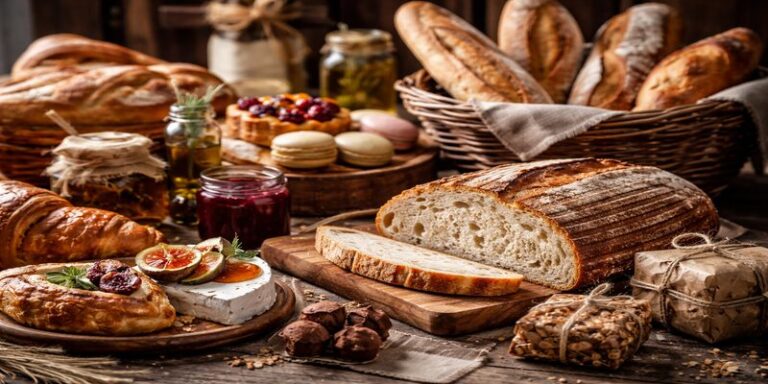
Walk into any modern bakery, deli or speciality food shop and you are likely to see a familiar set of labels: artisan, gourmet, handcrafted, small-batch, premium and authentic. These expressions are everywhere, yet many customers are unsure what they really mean. Understanding artisan food terms matters because these words shape expectations about quality, craftsmanship, tradition and value.
In food, baking and branding, such language does more than describe a loaf of bread or a box of chocolates. It helps businesses position products, signal identity and appeal to consumer emotions. Research suggests that shoppers often associate artisanal and authentic foods with skill, care, tradition, and a closer link between producer and product (Rivaroli, Baldi and Spadoni, 2020; Groves, 2001). This article explains the most important artisan food terms, shows how they are used in practice, and highlights why they matter for both customers and food businesses.
1.0 What Are Artisan Food Terms?
1.1 A Simple Definition
Artisan food terms are words and phrases used to communicate a product’s style of production, quality level, heritage, or market position. They often appear on packaging, menus, websites and bakery signage. Some describe how food is made, while others are more about branding and perception.
For example, a sourdough loaf sold as artisan may suggest hand-shaping, slow fermentation and traditional baking methods. A chocolate gift box labelled gourmet may imply luxurious ingredients and refined presentation. These are not always strict legal categories, so context matters.
1.2 Why These Terms are Popular
The popularity of artisan food terms reflects wider consumer interest in authenticity, local identity and craftsmanship. Studies show that consumers often respond positively to foods perceived as handmade, traditional and authentic, especially where trust and provenance are important (Chousou and Mattas, 2021; Bryła, 2015). In a crowded market, these terms help products stand out.
2.0 Key Artisan Food Terms and What They Mean
2.1 Artisan and Artisanal
The word artisan usually refers to food made with skill, care and often traditional methods, rather than fully industrialised production. Artisanal is closely related and simply means made in an artisan style. An artisanal loaf, for instance, may be fermented more slowly, shaped by hand and baked in smaller quantities.
Consumers often link artisan foods with craftsmanship, authenticity and personal expertise (Dezecot and Fleck, 2021). A neighbourhood bakery advertising artisan bread is therefore not just selling bread; it is selling a story of know-how and care.
2.2 Gourmet
Gourmet is one of the most recognisable artisan food terms, though it is slightly different from artisan. It usually refers to food seen as high-quality, refined or luxurious. Gourmet products may include superior ingredients, elegant presentation or more complex flavour combinations. A gourmet brownie, for example, might contain single-origin chocolate, sea salt and a premium gift-style finish.
2.3 Handcrafted and Craft
Handcrafted suggests that food has been made largely by hand rather than by automated mass production. Craft carries a similar meaning and often signals a skilled, small-scale process. A craft bakery or craft chocolate brand usually wants to communicate detail, expertise and individuality.
Research on food craftsmanship indicates that consumers value these cues because they imply human input and higher perceived quality (Rivaroli, Baldi and Spadoni, 2020).
2.4 Small-batch
Among common artisan food terms, small-batch refers to limited production runs. This phrase suggests closer quality control, consistency and attention to detail. A jam maker producing strawberry preserve in small batches may want customers to feel that the product is more carefully made than a factory-produced alternative.
2.5 Premium and Fine
Premium is a strong branding term used to position food above standard market offerings. It may refer to ingredients, packaging, flavour profile or exclusivity. Fine foods and fine baking work in a similar way, implying a more sophisticated or higher-end range. These words are especially common in retail, gifting and hospitality.
2.6 Speciality and Boutique
A speciality product has a particular niche or area of expertise, such as speciality coffee, speciality bread or speciality desserts. Boutique usually refers to a small, stylish and often premium business. A boutique patisserie, for example, may focus on a carefully curated range of elegant pastries rather than mass-market baked goods.
2.7 Bespoke
Bespoke means made to order or customised. In baking, it is often used for wedding cakes, celebration cakes and event dessert tables. Of all artisan food terms, bespoke is the clearest signal of personalisation.
3.0 Terms Linked to Tradition and Authenticity
3.1 Traditional, Rustic and Farmhouse
Some artisan food terms are less about luxury and more about heritage. Traditional suggests older methods or established recipes. Rustic points to a simple, hearty, intentionally less polished appearance. Farmhouse evokes countryside baking, comfort and home-style abundance.
A rustic sourdough with a thick crust and uneven shape may look less refined than a supermarket loaf, but that very appearance may strengthen its artisanal appeal.
3.2 Authentic and Homestyle
Authentic is used to suggest that a product is true to a place, tradition or method. For example, an authentic French patisserie would imply techniques and products associated with French pastry-making. Homestyle or home-style suggests comfort, familiarity and a domestic feel.
Scholars note that authenticity is especially influential in food marketing because it connects products with trust, culture and identity (Krystallis, 2017; Mapes, 2020).
4.0 Why Artisan Food Terms Matter in Branding
Food businesses use artisan food terms because they carry powerful emotional and commercial signals. They can suggest that a bakery is more skilled, a confectionery brand is more luxurious, or a café is more distinctive than its competitors. They also help shape price expectations. A handcrafted small-batch brownie is likely to be priced differently from a standard packaged brownie.
However, these terms should be used carefully. Because many are not tightly regulated, overuse can make them feel empty or misleading. Customers increasingly look for proof behind the language, such as visible baking processes, ingredient transparency, local sourcing or genuine expertise. In other words, the strongest branding happens when the reality matches the words.
5.0 Practical Examples of Usage
A bakery might describe itself as an artisan bakery if it specialises in naturally leavened bread, laminated pastries and daily small-batch production. A chocolatier may prefer gourmet, premium or boutique to highlight luxury and gifting appeal. A cake business offering wedding and celebration work may lean towards bespoke, handcrafted and speciality.
This shows that artisan food terms are not interchangeable. Each word creates a slightly different impression, and the most effective choice depends on the product, audience and brand identity.
Understanding artisan food terms helps consumers read food language more critically and helps businesses choose words more strategically. Terms such as artisan, gourmet, handcrafted, small-batch, premium, authentic and bespoke all carry different shades of meaning. Some highlight craftsmanship, some signal luxury, and others evoke tradition or personalisation.
The most successful brands do not simply use fashionable labels. They support them with genuine quality, coherent storytelling and a product experience that feels credible. In that sense, artisan food terms are most powerful when they are not just marketing language, but a truthful reflection of how food is actually made and presented.
References
Bryła, P. (2015) ‘The role of appeals to tradition in origin food marketing. A survey among Polish consumers’, Appetite, 91, pp. 302–310. Available at: https://www.sciencedirect.com/science/article/pii/S0195666315002020.
Chousou, C. and Mattas, K. (2021) ‘Assessing consumer attitudes and perceptions towards food authenticity’, British Food Journal, 123(5), pp. 1947–1963. Available at: https://www.emerald.com/bfj/article/123/5/1947/32837.
Dezecot, J. and Fleck, N. (2021) ‘Consumer perceptions, barriers and motivations around craft food artisans’, Décisions Marketing, 104, pp. 11–30. Available at: https://www.jstor.org/stable/27298084.
Gerosa, A. (2022) ‘The resurgence of craft retailing: marketing and branding strategies in the food and beverage sector’, in The Artisan Brand. Cheltenham: Edward Elgar. Available at: https://www.elgaronline.com/edcollchap/book/9781839106132/book-part-9781839106132-24.xml.
Groves, A.M. (2001) ‘Authentic British food products: A review of consumer perceptions’, International Journal of Consumer Studies, 25(3), pp. 246–254. Available at: https://onlinelibrary.wiley.com/doi/abs/10.1046/j.1470-6431.2001.00179.x.
Krystallis, A. (2017) ‘The concept of authenticity and its relevance to consumers: Country and place branding in the context of food authenticity’, in Food Authentication: Management, Analysis and Regulation. Hoboken, NJ: Wiley. Available at: https://onlinelibrary.wiley.com/doi/abs/10.1002/9781118810224.ch3.
Mapes, G. (2020) ‘Marketing elite authenticity: Tradition and terroir in artisanal food discourse’, Discourse, Context & Media, 35, 100391. Available at: https://www.sciencedirect.com/science/article/pii/S221169581930114X.
Petz, M. and Haas, R. (2017) ‘The authenticity trend’, in Consumer Trends and New Product Opportunities in the Food Sector. Wageningen: Wageningen Academic Publishers. Available at: https://brill.com/edcollchap/book/9789086868520/BP000005.xml.
Rivaroli, S., Baldi, B. and Spadoni, R. (2020) ‘Consumers’ perception of food product craftsmanship: A review of evidence’, Food Quality and Preference, 79, 103796. Available at: https://www.sciencedirect.com/science/article/pii/S0950329319304288.
Le Cordon Bleu (2026) What are pâtisserie, boulangerie and viennoiserie? Available at: https://www.cordonbleu.edu/news/what-are-patisserie-boulangerie-viennoiserie/en (Accessed: 16 March 2026).