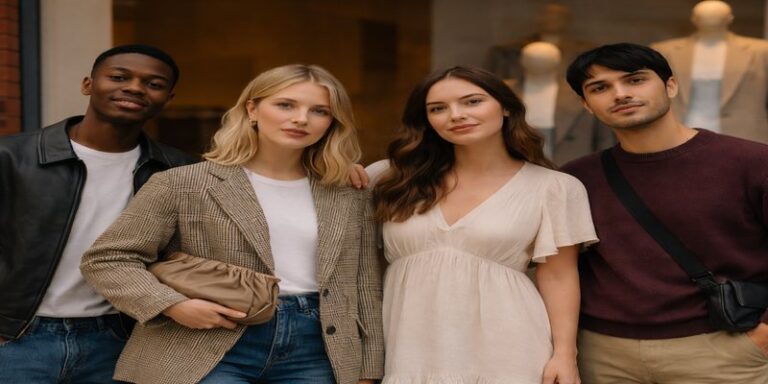
While the catwalk continues to influence seasonal direction, it is the high street that translates fashion into everyday accessibility. In 2026, the relationship between runway and retail is increasingly shaped by digital forecasting, sustainability imperatives, and consumer demand for authenticity. Rather than chasing fleeting novelty, shoppers are encouraged to adopt a strategic, values-led approach to trend adoption.
According to The State of Fashion 2026 (Business of Fashion & McKinsey, 2025), consumers are prioritising durability, versatility, and transparency amid economic uncertainty and environmental concern. Similarly, Fletcher (2014) argues in Sustainable Fashion and Textiles that long-term wardrobe thinking is central to reducing fashion’s environmental impact. This article explores how to shop 2026 fashion trends on the high street intelligently, affordably, and responsibly.
1.0 Curated Individualism: Personal Style Without Excess
In 2026, individualism remains central, but it has matured into what trend analysts describe as curated expression rather than chaotic maximalism (Vogue, 2026). Consumers are moving away from algorithm-driven uniformity towards intentional styling choices.
On the high street, brands such as COS, Arket and Mango are offering structured blazers, embroidered blouses and wide-leg trousers that allow for expressive yet polished outfits.
From a theoretical perspective, Kawamura (2005) explains that fashion operates as a system of symbolic communication, meaning personal styling choices convey identity and social positioning. Shoppers can therefore adopt trends selectively—for example, pairing a bold oxblood coat with neutral tailoring—rather than replicating full runway looks.
Key strategy: Invest in one statement item per season and anchor it with existing wardrobe staples.
2.0 Heritage Remix: Tradition Meets Modern Retail
The heritage revival seen in previous years continues into 2026 but is refined through modern tailoring and sustainable fabrication. Tweed jackets, pleated skirts and lace-trimmed blouses remain prevalent, yet they are cut with contemporary proportions.
Marks & Spencer and Uniqlo, for example, offer tailored waistcoats and structured knitwear that reinterpret archival aesthetics without appearing theatrical.
According to Crane (2012), fashion frequently revisits historical styles as a means of cultural continuity. However, in 2026, heritage is combined with technological efficiency and sustainable materials, reflecting what Fletcher (2014) describes as a shift towards slow fashion values.
Practical advice: Pair a heritage tweed blazer with relaxed denim or minimalist trainers to avoid costume-like styling.
3.0 Elevated Comfort and Soft Structure
Post-pandemic consumer behaviour continues to favour comfort-driven design, but with elevated construction. The contrast between slouch and structure—oversized knitwear styled with tailored coats—reflects what McKinsey (2025) identifies as the consumer demand for “polished practicality”.
High street retailers such as & Other Stories and Zara now offer relaxed tailoring, sculptural knit dresses and structured outerwear at accessible price points.
From a consumer psychology perspective, Solomon (2020) notes that clothing choices often reflect lifestyle aspirations. In 2026, the aspiration is effortless sophistication, not ostentation.
Shopping tip: Examine fabric blends. Natural fibres or high-quality blends generally retain shape longer than low-grade synthetics.
4.0 Sustainability as Standard Practice
Perhaps the most significant shift in 2026 is that sustainability is no longer optional. Gazzola et al. (2020) highlight the growing importance of circular economy principles within fashion consumption, particularly among younger demographics.
High street examples include:
- H&M Conscious collections
- Mango Committed
- M&S Autograph ranges featuring organic cotton
- Uniqlo recycled down initiatives
Fletcher (2014) argues that sustainable fashion requires not only better production but also reduced consumption and increased garment longevity.
Strategic approach: Apply the “20-wear test”—if you cannot envisage wearing an item at least twenty times, reconsider the purchase.
5.0 AI, Trend Forecasting and Smart Consumption
Artificial intelligence now plays a significant role in forecasting and stock management. Bansal and Tharun (2025) demonstrate how social media sentiment analysis can predict fashion trends with notable accuracy. Retailers use such data to respond rapidly to demand.
While this enhances availability, it can also accelerate overconsumption. The Business of Fashion (2025) cautions against hyper-reactive buying patterns driven by digital visibility.
Practical guidance: Use social platforms for inspiration rather than impulse. Save ideas, compare options, and delay purchasing decisions to ensure intentionality.
6.0 The New Prep and Intellectual Minimalism
The 2026 evolution of preppy style—often termed “intelligent dressing”—emphasises clean lines, subtle tailoring and quality fabrics. Rugby shirts, pleated skirts and ballet flats are widely available at Uniqlo, COS and M&S.
Unlike earlier logo-heavy interpretations, this version prioritises cut over branding, aligning with the broader quiet luxury movement (Vogue Business, 2025).
According to Kawamura (2005), fashion legitimacy is constructed through shared aesthetic codes. In 2026, those codes favour restraint and craftsmanship.
7.0 Romantic Realism and Balanced Styling
Romantic silhouettes—lace overlays, sheer layers and flowing dresses—continue but are styled pragmatically. Retailers such as Monsoon and ASOS offer wearable interpretations of this aesthetic.
Crane (2012) observes that fashion cycles often oscillate between structure and fluidity. In 2026, romance is tempered with practicality—such as pairing a flowing dress with a structured blazer.
Styling advice: Balance softness with architectural elements for everyday wearability.
8.0 Colour Strategy: Expressive Yet Grounded
Colour in 2026 is deliberate rather than playful for novelty’s sake. Deep grape, oxblood and clay tones dominate alongside mineral neutrals.
The State of Fashion (McKinsey, 2025) identifies a shift towards investment colourways that transcend seasons.
Approach: Introduce bold hues through knitwear or outerwear rather than full ensembles to maximise longevity.
9.0 Accessories and Cost-Effective Trend Adoption
Accessories remain the most affordable method of trend participation. Structured hobo bags, sculpted belts and ergonomic ballet flats are available from Primark, Charles & Keith and Accessorize.
Solomon (2020) highlights how accessories allow consumers to signal identity with lower financial risk.
Recommendation: Use accessories to experiment without committing to full wardrobe overhauls.
What to Avoid in 2026
- Ultra-fast microtrends
- Poor-quality synthetics
- Excessive logo branding
- Impulse-driven social media purchases
The emphasis has shifted from quantity to wardrobe cohesion and cost-per-wear value.
High Street, High Awareness
Shopping the high street in 2026 requires more than trend awareness; it demands critical consumption. As Fletcher (2014) argues, sustainable fashion begins with mindful purchasing decisions. By combining heritage influence, digital awareness, elevated comfort and environmental responsibility, consumers can build wardrobes that are both stylish and ethically aligned.
The most fashionable decision in 2026 is not chasing every trend—it is choosing selectively, wearing confidently, and investing wisely.
References
Bansal, A. and Tharun, A. (2025) ‘Emotional analysis of fashion trends using social media and AI: Sentiment analysis on Twitter for fashion trend forecasting’, arXiv preprint. Available at: https://arxiv.org/abs/2505.00050 (Accessed: 1 February 2026).
Business of Fashion and McKinsey & Company (2025) The State of Fashion 2026. Available at: https://www.mckinsey.com/industries/retail/our-insights/state-of-fashion (Accessed: 1 February 2026).
Crane, D. (2012) Fashion and Its Social Agendas. 2nd edn. Chicago: University of Chicago Press.
Fletcher, K. (2014) Sustainable Fashion and Textiles: Design Journeys. 2nd edn. London: Routledge.
Gazzola, P., Pavione, E., Pezzetti, R. and Grechi, D. (2020) ‘Trends in the fashion industry: The perception of sustainability and circular economy’, Sustainability, 12(7), 2809. doi:10.3390/su12072809.
Kawamura, Y. (2005) Fashion-ology: An Introduction to Fashion Studies. Oxford: Berg.
Solomon, M. (2020) Consumer Behaviour: Buying, Having and Being. 13th edn. Harlow: Pearson.
Vogue (2026) ‘Key fashion trends for 2026’. Available at: https://www.vogue.com (Accessed: 1 February 2026).
Vogue Business (2025) ‘What’s fashion’s next big idea?’ Available at: https://www.voguebusiness.com (Accessed: 1 February 2026).