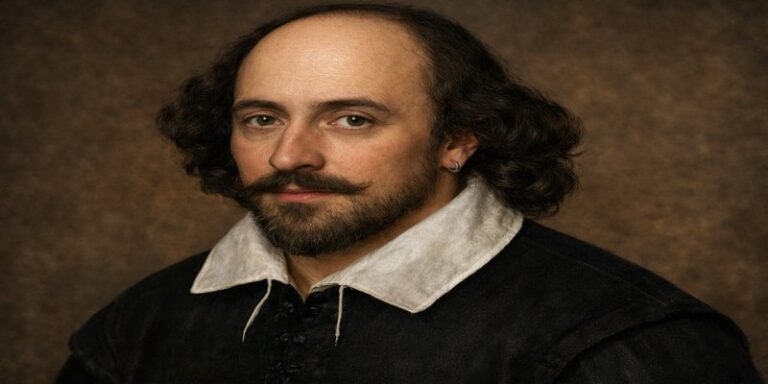
Few writers have shaped the trajectory of a language and its literary traditions as profoundly as William Shakespeare. Born in 1564 in Stratford-upon-Avon, Shakespeare authored 39 plays, 154 sonnets and several narrative poems, leaving an unparalleled legacy in English literature. His influence extends beyond artistic achievement; he fundamentally transformed the lexical richness, thematic complexity and structural possibilities of the English language. As Bloom (1998) famously contends, Shakespeare did not merely reflect humanity—he helped to define it. This article explores Shakespeare’s lasting impact on the English language and literature, focusing on his linguistic innovation, psychological realism, dramatic structure and cultural afterlife.
1.0 Shakespeare and the Expansion of the English Lexicon
Shakespeare wrote during the Early Modern English period, a time of significant linguistic flux. The English language was absorbing influences from Latin, French and other European languages, and spelling conventions were not standardised. Within this dynamic context, Shakespeare demonstrated extraordinary verbal inventiveness.
David Crystal (2004) estimates that Shakespeare either coined or popularised more than 1,700 words, including “assassination”, “lonely”, “majestic”, “radiance” and “eventful”. His creative manipulation of grammar—turning nouns into verbs (e.g., “to elbow”), verbs into adjectives, and inventing compound expressions—expanded the expressive capacity of English. Crystal (2008, p. 29) argues that Shakespeare possessed an “extraordinary capacity to exploit the resources of the language of his time”, enabling him to stretch vocabulary without alienating audiences.
Moreover, Shakespeare embedded numerous idiomatic expressions into everyday speech. Phrases such as “break the ice” (The Taming of the Shrew), “heart of gold” (Henry V), “wild-goose chase” (Romeo and Juliet) and “in a pickle” (The Tempest) remain integral to contemporary English (McCrum, Cran and MacNeil, 2011). These idioms illustrate how Shakespeare’s language permeates both literary and colloquial registers.
His rhetorical mastery—particularly in metaphor, antithesis, wordplay and irony—shaped stylistic conventions for centuries. The density of figurative language in plays such as Romeo and Juliet elevated dramatic dialogue into poetic expression, setting a standard emulated by subsequent dramatists and poets.
2.0 Psychological Realism and the Invention of Modern Character
Beyond vocabulary, Shakespeare transformed the representation of human consciousness. Bloom (1998, p. xvi) asserts that Shakespeare “invented the human as we continue to know it”, emphasising his pioneering portrayal of interiority. Characters such as Hamlet, Lady Macbeth and Othello exhibit complex psychological motivations, self-doubt and moral ambiguity rarely seen in earlier drama.
In Hamlet, the soliloquy “To be, or not to be” exemplifies early introspective narration. The audience is invited into the protagonist’s existential crisis, creating a dramatic model later mirrored in the stream-of-consciousness techniques of modernist writers such as Virginia Woolf and James Joyce. Greenblatt (2010) notes that Shakespeare’s soliloquies marked a turning point in Western literature by foregrounding individual subjectivity.
Similarly, Macbeth examines ambition and moral disintegration, anticipating later psychological and philosophical explorations of power. Othello dissects jealousy and manipulation with acute emotional precision. These themes resonate because they address universal aspects of the human condition—love, betrayal, authority and identity.
Shakespeare’s characters are rarely static archetypes; they evolve, contradict themselves and experience internal conflict. This dynamic characterisation influenced novelists such as Charles Dickens and William Faulkner, who developed similarly layered protagonists.
3.0 Dramatic Structure and Literary Innovation
Shakespeare revolutionised dramatic architecture through his adaptation of the five-act structure, which builds exposition, rising tension, climax, falling action and resolution. While derived from classical models, Shakespeare’s flexible application of this structure created heightened dramatic momentum.
His blending of genres further challenged convention. Plays such as The Merchant of Venice and The Winter’s Tale defy strict categorisation, combining tragic tension with comic resolution. This hybridisation expanded the possibilities of dramatic storytelling and influenced later playwrights including Henrik Ibsen, George Bernard Shaw and Tom Stoppard.
Shakespeare’s mastery of blank verse—unrhymed iambic pentameter—became the dominant poetic form in English drama. Furnivall (2004) observes that his manipulation of metre enhanced emotional expression; variations in rhythm often signal psychological instability or heightened intensity. For example, the irregular metre in Lady Macbeth’s speeches reflects her mental turmoil.
In addition to structural innovation, Shakespeare employed subplots that mirrored or contrasted main narratives, creating thematic cohesion. The Gloucester subplot in King Lear deepens the central exploration of blindness—both literal and metaphorical.
4.0 Cultural Legacy and Global Adaptation
Shakespeare’s influence transcends literature, permeating theatre, film, education and political discourse. His works have been translated into over 100 languages and adapted into diverse cultural contexts. Akira Kurosawa’s Throne of Blood (1957), inspired by Macbeth, reimagines the narrative within feudal Japan, demonstrating the global malleability of Shakespearean themes.
Modern adaptations such as Baz Luhrmann’s Romeo + Juliet (1996) transpose Renaissance Verona into contemporary urban settings, illustrating the enduring adaptability of Shakespeare’s storytelling. The British Council (2023) states that Shakespeare remains the most widely studied playwright in the English-speaking world, underscoring his educational centrality.
Political rhetoric frequently invokes Shakespearean imagery. References to Julius Caesar often frame debates about leadership and betrayal, while King Lear is cited in discussions of generational conflict and governance. Such references testify to the archetypal power embedded in his narratives.
5.0 Critical Reassessment and Contemporary Debates
Despite widespread admiration, Shakespeare’s works have been re-evaluated through modern critical lenses. Postcolonial scholars interpret The Tempest as an allegory of imperial domination, with Prospero symbolising colonial authority (Loomba, 2002). Similarly, feminist critics scrutinise portrayals of female characters, questioning the constraints imposed upon figures such as Ophelia and Desdemona.
Debates surrounding Shylock in The Merchant of Venice highlight concerns about anti-Semitic representation. Yet these critiques do not diminish Shakespeare’s significance; rather, they demonstrate the textual richness and interpretive openness that enable continuous reinterpretation.
Loomba (2002) argues that Shakespeare’s works endure precisely because they can be recontextualised to address contemporary social and political concerns. His plays function as cultural mirrors, reflecting both their original historical milieu and modern ethical debates.
William Shakespeare’s contribution to the English language and literature is vast and multifaceted. Through linguistic innovation, he expanded vocabulary and embedded idioms that remain in daily usage. Through psychological depth, he reshaped characterisation and narrative interiority. Through structural experimentation, he redefined dramatic form. And through his cultural afterlife, he continues to inform global artistic and intellectual discourse.
More than four centuries after his death, Shakespeare’s works persist not as relics but as living texts—adapted, debated and rediscovered by each generation. His influence endures because he captured the complexity of human experience while simultaneously enriching the language used to articulate it. In doing so, Shakespeare not only reflected his world but also profoundly shaped the literary and linguistic landscape of ours.
References
Bloom, H. (1998) Shakespeare: The Invention of the Human. New York: Riverhead Books.
British Council (2023) ‘Why is Shakespeare still so relevant today?’ Available at: https://www.britishcouncil.org/school-resources/find/lesson-plans/shakespeare (Accessed: 21 February 2026).
Crystal, D. (2004) The Stories of English. London: Penguin Books.
Crystal, D. (2008) Think on My Words: Exploring Shakespeare’s Language. Cambridge: Cambridge University Press.
Furnivall, F.J. (2004) Leopold Shakespeare: The Poet’s Works in Chronological Order. London: Routledge.
Greenblatt, S. (2010) Will in the World: How Shakespeare Became Shakespeare. New York: W.W. Norton.
Loomba, A. (2002) Shakespeare, Race, and Colonialism. Oxford: Oxford University Press.
McCrum, R., Cran, W. and MacNeil, R. (2011) The Story of English. London: Penguin Books.