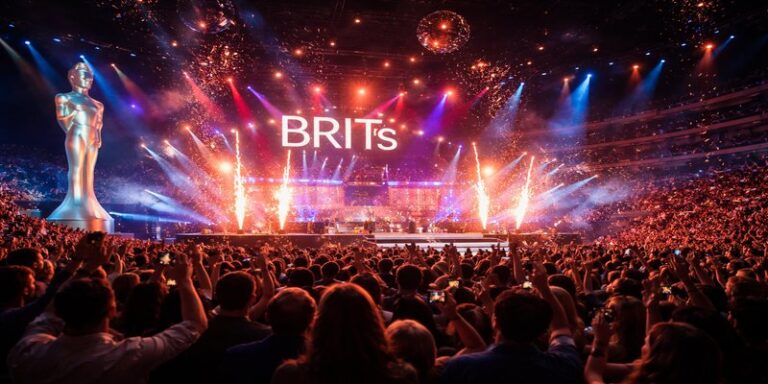
Every February, the UK music industry gathers for one of its most glittering evenings: the Brit Awards. Broadcast to millions, dissected by critics, and followed closely by fans around the world, the ceremony has become a defining fixture in Britain’s cultural calendar. For many viewers, it is a night of spectacle — designer outfits, dramatic performances, emotional speeches and headline-making moments. Yet beneath the red-carpet glamour lies a deeper narrative about identity, influence, legitimacy, and industry power.
The Brit Awards are not simply about handing out trophies. They help define what counts as success, artistic merit, and cultural relevance in British music. As music historian Simon Frith (2007) argues, award ceremonies do not merely reflect value — they actively produce it. In doing so, the Brit Awards shape the sound, image and international standing of British popular music.
1.0 A Brief History of the Brit Awards
The Brit Awards were first held in 1977 as the British Record Industry Britannia Awards, marking the Queen’s Silver Jubilee. Organised by the British Phonographic Industry (BPI), the awards were designed both to celebrate artistic achievement and to promote the commercial strength of UK music (BPI, 2023). What began as an industry celebration gradually evolved into a nationally televised spectacle during the 1980s, coinciding with the expansion of music television and celebrity culture.
The 1990s cemented the Brit Awards as a cultural event. The era of Britpop transformed the ceremony into a battleground for national pride and musical rivalry. Iconic confrontations between Oasis and Blur symbolised broader cultural tensions about class, identity and authenticity. Frith (2007) notes that award shows dramatise competition, transforming commercial chart rivalries into compelling public narratives.
Memorable incidents — from Jarvis Cocker’s stage protest during Michael Jackson’s 1996 performance to Adele’s truncated acceptance speech in 2012 — have reinforced the Brits’ reputation for unpredictability. These moments reveal how the ceremony functions as both celebration and controversy, reflecting the dynamic nature of British culture.
2.0 Cultural Influence and National Identity
2.1 Celebrating “Britishness”
The Brit Awards play a powerful role in shaping perceptions of British musical identity. By honouring artists such as Adele, Stormzy, Dua Lipa and Harry Styles, the ceremony projects an image of Britain as diverse, innovative and globally competitive. According to Street (2012), music frequently acts as a vehicle for national storytelling, and award ceremonies amplify these narratives on a mass scale.
The global success of British artists reinforces this image. IFPI’s (2023) Global Music Report consistently ranks the UK among the world’s leading exporters of music. The Brit Awards serve as a symbolic stamp of approval, signalling quality to international audiences and markets.
2.2 Music as Social Commentary
At times, the Brit Awards have also provided a platform for political expression. Stormzy’s 2018 performance, which referenced the Grenfell Tower tragedy and criticised governmental response, demonstrated how the ceremony can transcend entertainment. Such moments illustrate how popular music intersects with politics, echoing Street’s (2012) argument that musicians often function as cultural commentators.
Through these performances, the Brit Awards help frame music not merely as commercial product, but as social voice and collective memory.
3.0 Economic Impact: More Than a Trophy
Winning a Brit Award can have tangible economic consequences. Research on cultural industries shows that awards confer symbolic capital, enhancing reputation and market value (Watson and Anand, 2006). Recognition often translates into increased sales, streaming numbers and touring demand.
Industry data supports this claim. According to the BPI (2023), nominees and winners frequently experience measurable spikes in consumption following the ceremony. IFPI (2023) similarly reports that awards exposure can expand international streaming audiences.
A notable example is Adele’s 2012 success. After winning multiple awards, her album 21 surged back to the top of the charts. Such cases illustrate what Hesmondhalgh (2013) describes as the integration of culture and commerce within the creative industries. Awards ceremonies operate not only as cultural validators but also as powerful marketing engines.
4.0 The Power of Television and Celebrity
4.1 Constructing Stardom
Television has been central to the Brit Awards’ influence. Broadcast live, the ceremony transforms musicians into national spectacles. Turner (2014) describes this process as part of the “celebrity apparatus”, in which media institutions construct and sustain public personas.
Performances at the Brits often become defining career moments. Arctic Monkeys’ irreverent acceptance speech in 2011 sparked debate about authenticity in mainstream pop. Madonna’s dramatic fall during her 2015 performance generated viral global coverage within minutes. In the digital era, such moments circulate instantly on social media, magnifying their cultural impact.
These performances demonstrate how the Brit Awards contribute to the ongoing negotiation of authenticity, rebellion and commercial success within British pop culture.
5.0 Controversy and Change
5.1 Diversity and Gender Representation
Like many longstanding institutions, the Brit Awards have faced scrutiny over representation. A 2019 report by the UK Parliament’s Women and Equalities Committee identified persistent gender disparities in the music industry (UK Parliament, 2019). Critics argued that award nominations often reflected structural inequalities.
In response, organisers introduced gender-neutral categories in 2022. The reform aimed to promote inclusivity, yet sparked debate when initial nominee lists lacked female representation in certain categories. As Savage (2022) reported, reactions were mixed: some praised the move as progressive, while others questioned its practical consequences.
Negus (1999) reminds us that categorisation systems shape recognition and legitimacy. Altering categories can therefore reshape outcomes in unexpected ways. The debate surrounding the Brit Awards reflects wider conversations about equality, representation and institutional reform in contemporary Britain.
5.2 Global Reach in a Digital Age
The streaming revolution has fundamentally altered music consumption. Today, Brit Awards performances are clipped, shared and streamed globally within seconds. Social media platforms transform a three-minute performance into an international talking point.
IFPI (2023) data indicates that British artists continue to command significant global audiences. The Brit Awards amplify this reach by showcasing talent to worldwide viewers. International categories further reflect the interconnected nature of today’s music economy.
In this sense, the ceremony operates as both a national celebration and a global promotional platform. It reinforces Britain’s status as a cultural exporter in an increasingly competitive digital marketplace.
The Brit Awards represent far more than an annual music celebration. They are a cultural institution that shapes artistic legitimacy, fuels commercial success and contributes to national identity. Through spectacle, competition and televised performance, the ceremony constructs narratives about what British music is — and what it aspires to become.
From the rivalries of Britpop to contemporary debates about inclusivity, the awards mirror the evolving character of the United Kingdom itself. As Hesmondhalgh (2013) and Frith (2007) argue, cultural institutions are never neutral; they actively shape the industries and identities they celebrate.
In an era defined by streaming, globalisation and rapid social change, the Brit Awards remain Britain’s most visible reminder that music is not merely entertainment. It is culture, commerce, politics and identity intertwined — performed each year under the spotlight of a nation watching.
References
BPI (2023) The Brit Awards and UK Music Industry Data. Available at: https://www.bpi.co.uk.
Frith, S. (2007) Taking Popular Music Seriously. Aldershot: Ashgate.
Hesmondhalgh, D. (2013) The Cultural Industries. 3rd edn. London: Sage.
IFPI (2023) Global Music Report 2023. Available at: https://www.ifpi.org.
Negus, K. (1999) Music Genres and Corporate Cultures. London: Routledge.
Savage, M. (2022) ‘Brit Awards go gender neutral’, BBC News. Available at: https://www.bbc.co.uk/news.
Street, J. (2012) Music and Politics. Cambridge: Polity Press.
Turner, G. (2014) Understanding Celebrity. 2nd edn. London: Sage.
UK Parliament Women and Equalities Committee (2019) Unequal outcomes: Gender inequality in the music industry. Available at: https://www.parliament.uk.
Watson, M. and Anand, N. (2006) ‘Award ceremony as cultural capital’, American Sociological Review, 71(5), pp. 743–765.