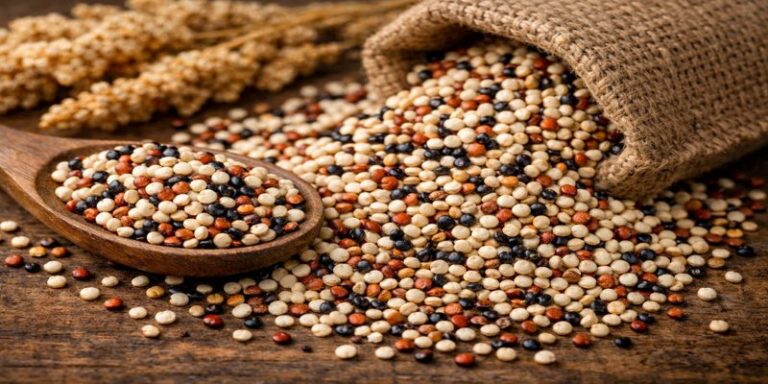
In recent decades, quinoa seeds have emerged as one of the most celebrated foods in global nutrition. Often labelled a “superfood”, quinoa (Chenopodium quinoa Willd.) is technically a seed rather than a true cereal grain, yet it is prepared and consumed in much the same way as rice, couscous or barley. Originating in the Andean regions of South America, quinoa represents a remarkable convergence of ancient agricultural tradition and modern nutritional science. Its rise in popularity reflects growing interest in plant-based diets, gluten-free foods, and sustainable agriculture.
1.0 Historical Origins and Cultural Importance
Quinoa has been cultivated for over 7,000 years, particularly in the high-altitude regions surrounding Lake Titicaca in present-day Peru and Bolivia (Martínez et al., 2015). For pre-Columbian civilisations such as the Incas, quinoa was regarded as a sacred crop, often referred to as the “mother grain”. It played a central role in religious ceremonies as well as daily nutrition, valued for its ability to thrive in harsh environments characterised by frost, drought and poor soils (Tapia, 2015).
Following Spanish colonisation, quinoa cultivation declined as European cereals such as wheat were imposed. Nevertheless, indigenous communities preserved quinoa farming practices and seed diversity, enabling its survival into the modern era. Renewed scientific interest in the late twentieth century led to quinoa’s global rediscovery as a nutrient-dense and resilient crop (FAO, 2013).
2.0 Botanical and Physical Characteristics
Quinoa seeds are small, flattened and lens-shaped, with colours ranging from white and yellow to red, purple and black. They are commonly categorised into white quinoa (mild flavour and soft texture), red quinoa (firmer texture, suitable for salads), and black quinoa, which has a more earthy flavour and slightly higher antioxidant content (Angeli et al., 2020).
A distinctive feature of quinoa is its natural coating of saponins, bitter-tasting compounds that protect the seed from pests. Although saponins are not harmful in small amounts, they must be removed before consumption to improve flavour and nutrient absorption.
3.0 Key Nutritional Facts
Quinoa is widely recognised for its exceptional nutritional profile, making it one of the most valuable plant-based foods available.
Key facts include:
- Highly nutritious: rich in protein, dietary fibre, vitamins and minerals
- Complete protein: contains all nine essential amino acids
- Gluten-free: suitable for individuals with coeliac disease or gluten intolerance
- Mineral-rich: provides magnesium, iron, zinc, potassium and folate
Unlike most plant foods, quinoa is considered a complete protein, supplying adequate levels of essential amino acids such as lysine and methionine, which are often limited in cereals (Vega-Gálvez et al., 2010). Protein content typically ranges between 14–16%, depending on variety and growing conditions (Agarwal et al., 2023).
Quinoa is also a valuable source of dietary fibre, supporting digestive health, glycaemic control and satiety. Studies suggest that quinoa contains more fibre than many commonly consumed grains, which may aid weight management and cardiovascular health (Medical News Today, 2024).
4.0 Bioactive Compounds and Health Potential
Beyond macronutrients, quinoa seeds contain a range of bioactive compounds, including polyphenols, flavonoids, phytosterols and antioxidant peptides. These compounds are associated with anti-inflammatory and antioxidant effects, which may help reduce the risk of chronic diseases such as cardiovascular disease and type 2 diabetes (Navruz-Varli and Sanlier, 2016; Xi et al., 2024).
Emerging research also suggests that quinoa consumption may positively influence the gut microbiota, producing beneficial fermentation products that support intestinal health (Huang et al., 2024). While these findings are promising, experts emphasise that quinoa should be consumed as part of a balanced and varied diet, rather than viewed as a cure-all food.
5.0 Gluten-Free and Dietary Significance
Quinoa’s natural absence of gluten makes it particularly important for individuals with coeliac disease. Many gluten-free products are low in protein and fibre; quinoa offers a nutrient-dense alternative that combines complex carbohydrates with high-quality protein (Harvard T.H. Chan School of Public Health, 2024). As a result, quinoa flour is increasingly used in gluten-free bread, pasta and baked goods.
6.0 Common Culinary Uses
Quinoa’s mild, slightly nutty flavour and light, fluffy texture make it extremely versatile in the kitchen.
Common uses include:
- Cooked like rice (ready in about 15 minutes)
- Salads, grain bowls and savoury dishes
- Porridge or breakfast bowls
- Baking using quinoa flour
- Sprouted quinoa for salads and garnishes
Different quinoa varieties offer subtle differences in texture and taste, allowing flexibility across both sweet and savoury recipes.
7.0 Basic Cooking Method
Preparing quinoa is simple and requires minimal equipment:
- Rinse thoroughly under running water to remove saponins, which cause bitterness.
- Cook using a ratio of 1 cup quinoa to 2 cups water.
- Bring to the boil, then simmer for around 15 minutes until the water is absorbed and the seeds are fluffy.
Once cooked, quinoa can be stored in the refrigerator and incorporated into meals throughout the week.
8.0 Agricultural Resilience and Sustainability
From an environmental perspective, quinoa is increasingly valued for its agronomic resilience. It tolerates salinity, drought and temperature extremes better than many conventional crops (Bazile et al., 2016). The Food and Agriculture Organization has highlighted quinoa’s potential contribution to global food security, particularly in the context of climate change (FAO, 2013).
However, rising global demand has also raised concerns about price volatility and access in traditional producing regions. While international markets have created economic opportunities, ensuring ethical production and fair access for local communities remains a critical challenge.
Quinoa seeds exemplify the successful integration of traditional knowledge and modern nutritional science. Their complete protein profile, high fibre content, micronutrient richness and bioactive compounds make them a valuable addition to contemporary diets. Combined with their gluten-free nature, culinary versatility and environmental adaptability, quinoa has earned its place as more than a passing trend.
As global food systems face increasing pressure from climate change and population growth, quinoa offers important lessons about biodiversity, sustainability and respect for indigenous crops. Its continued success will depend not only on scientific research and market demand, but also on responsible production that honours its cultural origins.
References
Agarwal, A. et al. (2023) Nutritional and functional perspectives of quinoa. Nutrients, 15(4), pp. 1–18.
Angeli, V. et al. (2020) ‘Quinoa (Chenopodium quinoa Willd.): An overview of the potentials of the “golden grain”’, Foods, 9(2), pp. 1–27. Available at: https://www.mdpi.com/2304-8158/9/2/216.
Bazile, D., Jacobsen, S.E. and Verniau, A. (2016) ‘The global expansion of quinoa: Trends and limits’, Frontiers in Plant Science, 7, pp. 1–14.
FAO (2013) Quinoa: An ancient crop to contribute to world food security. Rome: Food and Agriculture Organization of the United Nations.
Harvard T.H. Chan School of Public Health (2024) Quinoa – The Nutrition Source. Available at: https://www.hsph.harvard.edu/nutritionsource/food-features/quinoa/.
Huang, H. et al. (2024) ‘Progress in research on the health effects of quinoa’, Frontiers in Nutrition, 11, pp. 1–12.
Medical News Today (2024) Quinoa: Nutrition, health benefits and dietary tips. Available at: https://www.medicalnewstoday.com.
Navruz-Varli, S. and Sanlier, N. (2016) ‘Nutritional and health benefits of quinoa’, Journal of Cereal Science, 69, pp. 371–376.
Tapia, M.E. (2015) The long journey of quinoa. Rome: FAO.
Vega-Gálvez, A. et al. (2010) ‘Nutrition facts and functional potential of quinoa’, Journal of the Science of Food and Agriculture, 90(15), pp. 2541–2547.