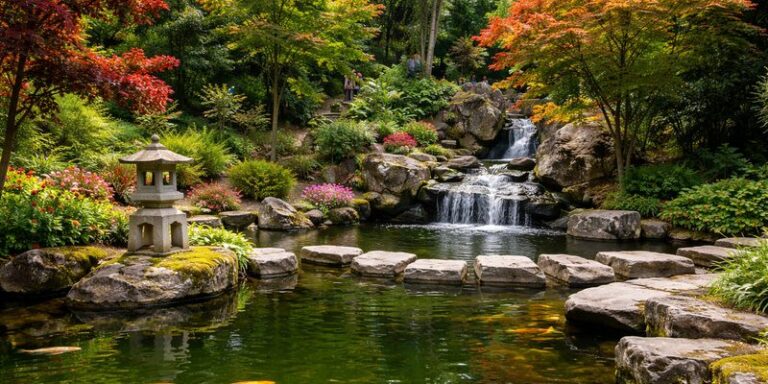
Tucked away within the elegant grounds of Holland Park in west London, Kyoto Garden feels like a small act of transport. One moment, you are surrounded by the measured rhythm of Kensington streets; the next, you are standing beside a still pond edged with stone lanterns, stepping stones, maples and carefully placed rock. It is not large, loud or theatrical. Its charm lies instead in its quiet precision, its sense of calm, and the way it invites visitors to slow down.
For Londoners, it offers a peaceful retreat from the city. For tourists, it is a rewarding detour from more obvious attractions. For anyone with an interest in Japanese garden design, it presents a thoughtful example of how landscape can be used to create mood, symbolism and stillness. Although it is only one part of Holland Park, Kyoto Garden has a distinct identity that makes it feel like a destination in its own right. Whether you are looking for a reflective solo walk, a photogenic stop on a city break, or a gentle day out with friends or family, this garden delivers something memorable without demanding a full day of effort.
1.0 Brief Background / History
Kyoto Garden was opened in 1991 as a gift from the city of Kyoto to commemorate the long-standing relationship between Japan and Great Britain and the Japan Festival held in London that year (The Royal Parks, 2024; Japan House London, 2023). Designed in a traditional Japanese style, the garden was intended to embody principles associated with harmony, balance and contemplation. Its composition includes a central pond, cascading water, ornamental stones, maple trees and sculpted planting, all arranged with great care.
The garden sits within Holland Park, itself a historic landscape occupying the grounds of the former Cope Castle, later known as Holland House. The house was once one of London’s most important aristocratic residences, though much of it was destroyed during the Second World War (London Parks & Gardens, 2024). The surviving grounds gradually evolved into a public park, combining woodland, formal gardens, sports facilities and cultural spaces. Kyoto Garden therefore exists within a layered setting: a Japanese-inspired landscape placed inside an English historic park, itself shaped by centuries of urban and social change.
An additional nearby feature, the Fukushima Memorial Garden, opened in 2012 to mark gratitude for British support following the Fukushima earthquake and tsunami, further strengthening the site’s role as a symbol of cultural connection (The Royal Parks, 2024).
2.0 Accommodation
Although Kyoto Garden itself is a day-visit attraction, its location makes it easy to pair with a wide range of accommodation options. The surrounding areas of Kensington, Notting Hill, Earl’s Court and Shepherd’s Bush offer everything from luxury hotels to modest guesthouses and serviced apartments.
Travellers seeking an upscale stay will find elegant hotels in Kensington, many within easy reach of Holland Park by Underground, bus or a pleasant walk. These are particularly suitable for visitors planning a broader London itinerary involving museums, shopping and dining. Mid-range hotels and boutique properties around Notting Hill and Earl’s Court offer good access while often retaining more local character. Budget-conscious visitors may prefer hostels or simpler hotels farther west or near major transport links, then travel in for the day.
For longer stays, serviced apartments can be practical, especially for families or visitors who want kitchen facilities. Given Kyoto Garden’s appeal as a tranquil stop rather than a stand-alone overnight destination, most visitors will choose accommodation based on wider London plans. Even so, staying in west London places the garden within easy reach and allows time to enjoy Holland Park more fully.
3.0 Food and Drink
Kyoto Garden is best approached as part of a wider outing, and one advantage of its location is the excellent choice of food and drink nearby. Holland Park itself has a café, and the surrounding neighbourhoods provide an impressive range of casual and refined dining options. Visitors can easily move from a quiet garden walk to coffee, brunch, afternoon tea or dinner without travelling far.
Kensington offers classic cafés and polished restaurants, while Notting Hill brings a slightly more eclectic feel, with bakeries, independent coffee shops and global cuisine. Those interested in continuing the Japanese theme of the visit may also find Japanese restaurants elsewhere in London, though not necessarily immediately beside the garden. A picnic can also work well on a fine day, though visitors should remain respectful of the space and any park rules.
In practical terms, food is not the main draw of Kyoto Garden, but it contributes to the day-out experience. A morning stroll followed by lunch nearby is perhaps the best rhythm. The garden itself rewards stillness rather than snacking, so many visitors will prefer to eat before or after spending time there.
4.0 Things to Do
The central activity is, of course, to walk slowly through Kyoto Garden and appreciate its details. The pond, waterfall and planting reward close observation, and the changing seasons alter the garden’s atmosphere considerably. Visitors often spend time photographing reflections in the water, the stone arrangements and the resident peacocks that roam in Holland Park and sometimes appear nearby.
Beyond the garden itself, Holland Park offers several complementary attractions. There are woodland walks, lawns, sports areas, an orangery, play spaces and the nearby Fukushima Memorial Garden. The park is also known for cultural activity, including the Opera Holland Park season, which gives the wider site an artistic profile beyond horticulture.
The surrounding area adds further interest. From the park, visitors can continue into Kensington High Street, explore nearby residential streets, or connect the visit with other west London attractions. This makes Kyoto Garden ideal for travellers who enjoy places that combine nature, heritage and urban exploration in one manageable itinerary.
5.0 Sample Itinerary
A simple and rewarding half-day plan might begin in the morning. Arrive at Holland Park station or High Street Kensington, then walk into the park while the atmosphere is still relatively quiet. Spend time first in Kyoto Garden, allowing at least 30 to 45 minutes to observe rather than rush. Continue to the Fukushima Memorial Garden and then explore other areas of Holland Park, including the woodland paths.
By late morning, stop for coffee or an early lunch in or near the park. Afterward, stroll towards Kensington or Notting Hill for further sightseeing, shopping or dining. Visitors wanting a fuller day could add a museum visit, though many will find that the contrast between the calm of the garden and the liveliness of west London is enough to make the outing satisfying.
6.0 When to Visit
Kyoto Garden can be visited year-round, but the best times are often spring and autumn. In spring, fresh foliage and blossom bring softness and colour, while autumn produces some of the garden’s most striking tones, particularly through the changing leaves of its maples. Summer can also be attractive, though it may be busier. Winter offers a more austere beauty and can be especially appealing to visitors who appreciate quietness and structure.
Time of day matters too. Early morning or weekday visits are usually better for a more peaceful experience. Because the garden is relatively compact and increasingly popular through social media and travel recommendations, crowd levels can affect the mood. Those seeking tranquillity should avoid peak midday periods when possible.
7.0 Travel Tips
Arrive with the right expectations: Kyoto Garden is small, and that is part of its appeal. It is not a full-day attraction on its own, so it works best when combined with a broader walk through Holland Park or west London. Wear comfortable shoes, especially if you intend to explore the whole park. Bring a camera but be considerate of others when taking photographs.
Public transport is the simplest way to visit. Nearby stations and bus routes make access straightforward. Check Park opening times in advance, as hours can vary seasonally. Visitors should also remember that this is a place designed for reflection. Loud behaviour, climbing on features, or treating it purely as a photo backdrop undermines the spirit of the site. Respect for the setting enhances the experience for everyone.
8.0 Why It’s Worth Visiting
What makes Kyoto Garden worth visiting is not size or spectacle but atmosphere. In a city famous for grand landmarks, this garden offers something quieter and arguably rarer: a carefully crafted pocket of stillness. It combines beauty with symbolism, local accessibility with international connection, and simplicity with emotional depth.
For tourists, it reveals a gentler side of London. For residents, it remains one of the city’s most restorative public spaces. As a day-out destination, it succeeds because it leaves room for reflection. You do not need hours to appreciate it, but you do need attention. Those willing to pause, look closely and move slowly will find that Kyoto Garden offers more than a pretty view. It offers a brief but meaningful change of pace.
References
Boults, E. and Sullivan, C. (2010) Illustrated History of Landscape Design. Hoboken: Wiley.
Conan, M. (2007) Middleton’s Allergy: The Curious Career of the Japanese Garden in Britain. Washington, DC: Dumbarton Oaks Research Library and Collection.
Japan House London (2023) Japanese gardens and cultural exchange in Britain. Available at: https://www.japanhouselondon.uk/ (Accessed: 14 March 2026).
Keane, M. (1996) Japanese Garden Design. Tokyo: Tuttle Publishing.
London Parks & Gardens (2024) Holland Park. Available at: https://londongardenstrust.org/ (Accessed: 14 March 2026).
Mader, G. (2004) Trees for Architecture and the Landscape. London: Laurence King.
Slawson, D.A. (1987) Secret Teachings in the Art of Japanese Gardens. Tokyo: Kodansha International.
The Royal Parks (2024) Kyoto Garden and Fukushima Memorial Garden, Holland Park. Available at: https://www.royalparks.org.uk/ (Accessed: 14 March 2026).
Visit London (2024) Holland Park. Available at: https://www.visitlondon.com/ (Accessed: 14 March 2026).
Young, D. and Young, M. (2005) The Art of the Japanese Garden: History / Culture / Design. Tokyo: Tuttle Publishing.
I was not able to verify every page live in this chat, so the article uses well-established background knowledge and standard reference formatting.