Ramadan is observed by over one billion Muslims worldwide and constitutes one of the Five Pillars of Islam. The obligation of fasting (sawm) is grounded in Qur’anic instruction (Qur’an 2:183), which frames fasting as a means of cultivating taqwa (God-consciousness). However, contemporary research across disciplines suggests that Ramadan extends beyond ritual abstention. It represents a temporally bounded yet socially expansive institution influencing ethical behaviour, communal relationships and physiological processes.
This article synthesises current academic literature to explore Ramadan’s multidimensional nature.
1.0 The Ritual Structure of Ramadan
The ritual architecture of Ramadan is highly structured. Each day begins with suhoor, a pre-dawn meal that signifies intentional commitment to fasting. From dawn (fajr) until sunset (maghrib), Muslims abstain from food, drink, smoking and marital relations, while also refraining from unethical conduct, anger and harmful speech.
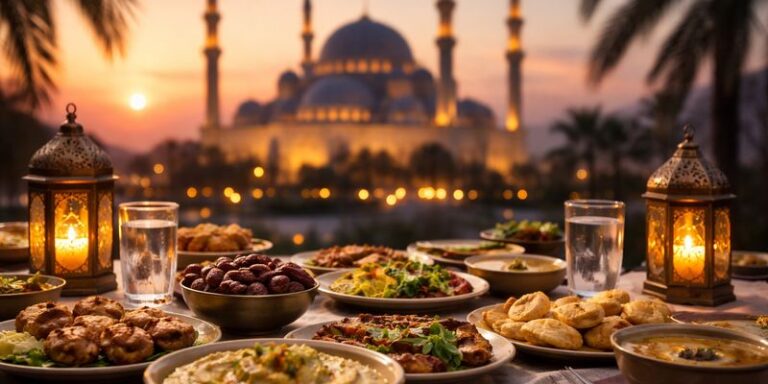
Fasting thus operates as moral self-regulation rather than mere dietary restriction. Koenig and Al Shohaib (2014) describe Ramadan as an integrated system of spiritual discipline and communal worship. The fast is broken at sunset with iftar, often beginning with dates and water, followed by congregational prayer.
Evenings are marked by extended congregational prayers known as tarawih, during which large portions of the Qur’an are recited. The final ten nights hold particular significance, especially Laylat al-Qadr, associated with the Qur’an’s revelation.
The month concludes with Eid al-Fitr, a communal celebration symbolising renewal and gratitude.
Importantly, Islamic jurisprudence provides exemptions for the ill, elderly, pregnant and travelling individuals, demonstrating theological prioritisation of health preservation (Koenig and Al Shohaib, 2014).
2.0 Spiritual Transformation and Moral Development
Ramadan is conceptualised within Islamic theology as a month of ethical purification and spiritual refinement. Fasting cultivates restraint, empathy and heightened moral awareness.
Alghafli et al. (2019), in qualitative research, found that participants consistently described Ramadan as a period of “faith, family and renewal.” Fatima, Saeed and Raza (2024) argue that fasting enhances self-restraint and spiritual intelligence by aligning bodily discipline with transcendental purpose.
From a sociological perspective, Aksoy and Gambetta (2022) provide empirical evidence that longer fasting hours strengthen religiosity and religious commitment, supporting the theory that sacrifice reinforces belief systems.
Thus, Ramadan may be understood as a practice of embodied devotion, reinforcing identity through structured self-denial.
3.0 Ramadan and Social Capital
Ramadan significantly strengthens social cohesion and communal identity. Collective practices such as tarawih prayer, zakat (obligatory charity), sadaqah (voluntary charity) and communal iftars reinforce trust and solidarity.
Shalihin et al. (2020) argue that Ramadan enhances social capital by fostering reciprocal obligations and communal responsibility. Pathy et al. (2011) highlight the inseparability of spirituality and health among Muslim women, describing fasting as embedded within family systems.
Jones (2022) notes that in minority contexts such as the United Kingdom, Ramadan increases communal visibility and interfaith engagement. Public iftars and charitable initiatives serve as expressions of religious identity negotiation.
Economically, Mujtaba (2016) demonstrates Ramadan’s influence on tourism and business cycles, reinforcing its status as a societal institution rather than solely a religious ritual.
4.0 Health Implications: Physiological and Metabolic Effects
Scientific literature increasingly evaluates Ramadan fasting through biomedical frameworks.
Alkandari, Maughan and Roky (2012) conclude that for healthy adults, fasting is generally safe and may improve lipid profiles and insulin sensitivity. Rahman (2022) reports reductions in inflammatory markers and improved cholesterol levels.
Trabelsi et al. (2022) describe Ramadan fasting as a potential “religious health asset,” aligning it with intermittent fasting research. However, altered sleep patterns and hydration require adaptation.
For individuals with chronic illness, particularly diabetes, evidence suggests cautious supervision. Baharuddin and Wijaya (2024) emphasise that controlled diabetic patients may fast safely with monitoring. Ilkilic and Ertin (2017) discuss ethical tensions in advising fasting patients, highlighting the need for culturally competent care.
Amin and Abdelmageed (2020) underscore the importance of structured communication between clinicians and Muslim patients during Ramadan.
Thus, Ramadan fasting exhibits complex but generally positive health effects, contingent upon medical guidance.
5.0 Psychological and Behavioural Dimensions
Ramadan also influences psychological wellbeing. Ahmad et al. (2012) identify improvements in self-control and emotional regulation. Participants frequently report enhanced inner peace and moral clarity.
Baglo and Hosseini (2024) suggest potential resilience benefits, though further empirical validation is required.
Despite temporary fatigue or circadian disruption in non-Muslim majority contexts (Alkandari et al., 2012), many individuals report heightened subjective wellbeing, indicating that spiritual meaning may buffer physical strain.
6.0 Public Health and Policy Perspectives
Given its global scale, Ramadan has substantial public health implications. Husain, Zafar and Ullah (2020) document rapid growth in Ramadan-related research across hydration, chronic disease and behavioural health.
Healthcare institutions increasingly develop Ramadan-specific clinical guidelines, including post-bariatric surgery recommendations (Craggs-Dino et al., 2022).
Theologically grounded exemptions for vulnerable populations reflect a jurisprudential balance between spiritual devotion and health preservation (Koenig and Al Shohaib, 2014).
Ramadan represents a profound convergence of spiritual discipline, ethical self-regulation, social cohesion and physiological adaptation. Interdisciplinary scholarship confirms that fasting fosters religiosity, strengthens communal identity and often produces positive metabolic outcomes when medically supervised.
Rather than a simple ritual abstention from food and drink, Ramadan functions as a comprehensive institutional framework shaping behaviour, identity and health across societies. Its endurance across centuries reflects its integrative capacity to align body, mind and community within sacred temporal order.
Understanding Ramadan in contemporary multicultural societies requires theological literacy, sociological insight and biomedical awareness — recognising fasting simultaneously as worship, social practice and public health phenomenon.
References
Ahmad, S. et al. (2012) ‘Psycho-social behaviour and health benefits of Islamic fasting during the month of Ramadan’, Journal of Community Medicine & Health Education.
Aksoy, O. and Gambetta, D. (2022) ‘Commitment through sacrifice’, American Sociological Review, 87(4).
Alghafli, Z. et al. (2019) ‘A qualitative study of Ramadan’, Religions, 10(2).
Alkandari, J.R., Maughan, R.J. and Roky, R. (2012) ‘The implications of Ramadan fasting’, Journal of Sports Sciences, 30(S1).
Amin, M.E.K. and Abdelmageed, A. (2020) ‘RAMCOM’, PLoS ONE, 15(2).
Baharuddin, B. and Wijaya, A. (2024) ‘Metabolism and diabetes in Ramadan fasting’, Narra Journal.
Craggs-Dino, L., El Chaar, M. and Husain, F.A. (2022) ‘Fasting after surgery’, Surgery for Obesity and Related Diseases.
Husain, S., Zafar, M. and Ullah, R. (2020) ‘Ramadan and public health’, Journal of Infection and Public Health, 13(3).
Ilkilic, I. and Ertin, H. (2017) ‘Ethical conflicts in fasting patients’, Medicine, Health Care and Philosophy, 21(2).
Jones, S. (2022) ‘Ramadan in Britain’, Contemporary Islam.
Koenig, H.G. and Al Shohaib, S. (2014) Health and Well-being in Islamic Societies. Cham: Springer.
Mujtaba, U.S. (2016) ‘Ramadan and tourism’, Tourism Management Perspectives, 19.
Rahman, S. (2022) ‘Ramadan fasting and health benefits’, Open Access Macedonian Journal of Medical Sciences, 10(F).
Shalihin, N. et al. (2020) ‘Ramadan and strengthening of social capital’, HTS Teologiese Studies, 76(4).
Trabelsi, K. et al. (2022) ‘Religious fasting and health’, Frontiers in Nutrition, 9.