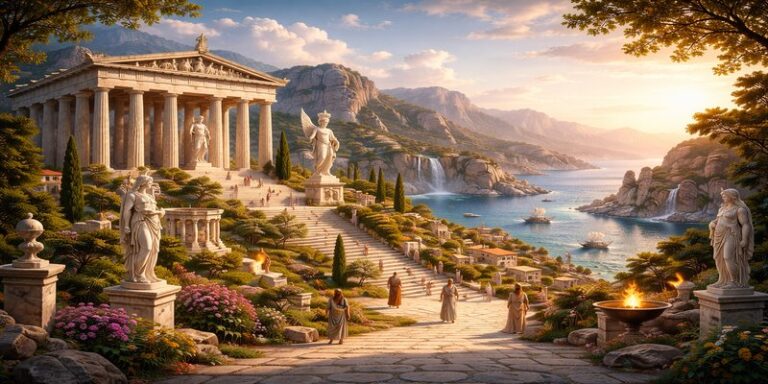
Greek mythology is one of the most influential bodies of traditional narratives in human history. Originating in ancient Greece, these myths were used to explain the origins of the world, the workings of nature, the complexities of human behaviour and the authority of social institutions. Far from being mere fairy tales, they formed the religious, cultural and moral framework of Greek civilisation.
Preserved in literary works such as Homer’s Iliad and Odyssey and Hesiod’s Theogony, as well as in dramatic poetry and visual art, Greek myths have shaped Western literature, philosophy, psychology and even modern popular culture (Homer, trans. 1996; Hesiod, trans. 1988). This article explores the origins, major themes, key deities and heroes of Greek mythology, while also examining its continuing cultural relevance.
1.0 The Origins of the Cosmos
1.1 From Chaos to Cosmos
Greek mythology begins with a powerful idea: before the ordered universe existed, there was Chaos, a formless void. From Chaos emerged primordial deities such as Gaia (Earth), Tartarus (the abyss) and Eros (desire or creative force) (Hesiod, trans. 1988).
Gaia gave birth to Uranus (the Sky), and together they produced the Titans, including Cronus. In a dramatic cycle of rebellion, Cronus overthrew Uranus, only to be overthrown in turn by his son Zeus, who established the reign of the Olympian gods.
This mythic succession reflects what scholars interpret as symbolic struggles between generations and cosmic order emerging from disorder (Buxton, 2004). It illustrates a key theme in Greek mythology: conflict as the engine of creation and transformation.
2.0 The Olympian Gods
2.1 Mount Olympus and Divine Hierarchy
The twelve principal gods resided on Mount Olympus, forming a divine hierarchy mirroring Greek social and political structures. At the summit stood Zeus, god of thunder and ruler of the heavens.
Other major Olympians include:
- Hera, goddess of marriage
- Poseidon, god of the sea
- Athena, goddess of wisdom and strategy
- Apollo, god of music and prophecy
- Artemis, goddess of the hunt
- Ares, god of war
- Aphrodite, goddess of love
- Hermes, messenger of the gods
- Demeter, goddess of agriculture
- Hephaestus, god of craftsmanship
Unlike many other ancient deities, Greek gods were profoundly anthropomorphic — they possessed human emotions, ambitions and flaws (Burkert, 1985). Zeus could be just yet impulsive; Hera fiercely loyal yet jealous. This human-like portrayal made the divine world accessible and dramatically compelling.
3.0 Heroes and the Human Condition
3.1 Heracles and the Ideal of Strength
Among the most famous heroes is Heracles (Hercules), celebrated for completing the Twelve Labours, including slaying the Nemean Lion and capturing Cerberus from the Underworld. These trials symbolise perseverance and redemption, as Heracles undertook them to atone for wrongdoing.
3.2 Achilles and the Tragedy of Pride
In Homer’s Iliad, Achilles embodies both heroic excellence and destructive pride. His withdrawal from battle due to wounded honour leads to catastrophic consequences. The epic explores themes of fate, mortality and glory, central concerns in Greek thought (Homer, trans. 1996).
3.2 Odysseus and the Value of Intelligence
Unlike Achilles’ physical prowess, Odysseus represents cunning and intellect. In the Odyssey, his long journey home from Troy is marked by encounters with mythical beings such as the Cyclops and the Sirens. His success depends on cleverness rather than brute force, reflecting Greek admiration for strategic intelligence.
These heroic narratives provided moral lessons while exploring enduring human dilemmas: pride, loyalty, revenge, love and destiny.
4.0 Mythical Creatures and Symbolism
Greek mythology is populated with striking creatures:
- Medusa, whose gaze turns onlookers to stone
- The Minotaur, trapped within the Labyrinth
- The Hydra, regenerating multiple heads
- Pegasus, the winged horse
Such figures often symbolised psychological fears or natural dangers. For example, the labyrinth may represent confusion and moral complexity, while the Hydra reflects the difficulty of overcoming recurring problems.
5.0 Myth and Religion
Greek mythology was not separate from religion; it was integral to it. Rituals, festivals and sacrifices honoured the gods. Temples such as the Parthenon in Athens, dedicated to Athena, were expressions of both devotion and civic pride.
However, Greek religion lacked a single sacred scripture. Instead, myth functioned as a flexible narrative tradition, evolving across regions and generations (Burkert, 1985). This adaptability allowed myths to respond to social and political change.
6.0 Themes in Greek Mythology
6.1 Fate and Free Will
A central concept is moira (fate). Even Zeus could not entirely escape destiny. In tragedies such as Sophocles’ Oedipus Rex, attempts to avoid fate ironically fulfil it, illustrating the tension between human agency and predetermined destiny.
6.2 Hubris and Nemesis
Greek myths frequently warn against hubris — excessive pride. Characters who challenge divine authority, such as Icarus flying too close to the sun, face inevitable punishment. This moral framework reinforced social values of moderation and humility.
6.3 The Relationship Between Mortals and Gods
Unlike distant, abstract deities, Greek gods intervened directly in human affairs. The Trojan War itself began with divine rivalry. This interplay reflects a worldview in which human life was deeply entwined with cosmic forces.
7.0 Cultural and Modern Influence
Greek mythology has profoundly shaped Western culture.
In literature, writers from Shakespeare to James Joyce have drawn on classical myths. In psychology, Freud’s concept of the Oedipus complex derives directly from Sophocles’ tragedy (Freud, 1923). In astronomy, planets such as Mars (Ares) and constellations like Orion bear mythological names.
Modern films, novels and video games continue to reinterpret these ancient narratives, demonstrating their enduring adaptability and relevance.
8.0 Scholarly Perspectives
Modern scholars approach Greek mythology through multiple lenses. Structuralist interpretations examine recurring narrative patterns (Lévi-Strauss, 1963), while comparative mythologists identify parallels with Near Eastern traditions.
Buxton (2004) argues that myths functioned as cultural memory, encoding social norms and collective identity. Meanwhile, Burkert (1985) highlights the ritual context of myth, emphasising its religious foundations.
These academic perspectives reveal that Greek mythology is not static folklore but a dynamic cultural system.
Greek mythology is far more than a collection of fantastical tales about gods and monsters. It is a complex narrative framework that shaped ancient Greek religion, politics and philosophy, while continuing to influence modern culture. Through stories of creation, heroism, tragedy and divine power, Greek myths explore timeless human concerns: mortality, ambition, love, justice and fate.
Their survival across millennia testifies to their profound psychological and cultural resonance. In examining Greek mythology, we do not merely study the past; we engage with foundational narratives that continue to shape how we understand ourselves and the world.
References
Buxton, R. (2004) The Complete World of Greek Mythology. London: Thames & Hudson.
Burkert, W. (1985) Greek Religion. Oxford: Blackwell.
Freud, S. (1923) The Ego and the Id. London: Hogarth Press.
Hesiod (1988) Theogony, trans. M.L. West. Oxford: Oxford University Press.
Homer (1996) The Iliad, trans. R. Fagles. London: Penguin Classics.
Homer (1996) The Odyssey, trans. R. Fagles. London: Penguin Classics.
Lévi-Strauss, C. (1963) Structural Anthropology. New York: Basic Books.
Sophocles (2008) Oedipus the King, trans. R. Fagles. London: Penguin Classics.