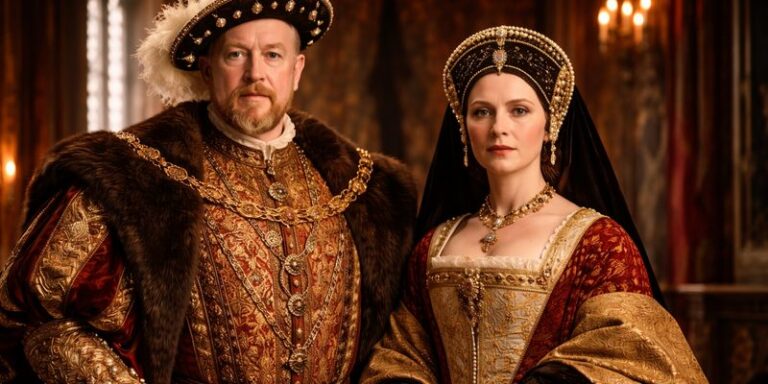
Why Henry VIII Married Catherine of Aragon is a question that opens up one of the most important royal, political and religious stories in English history. The marriage of Henry VIII to Catherine of Aragon may seem surprising at first, since Catherine had already been married to Henry’s elder brother, Prince Arthur. Yet the match was not simply a matter of personal preference. It was shaped by dynastic ambition, international diplomacy, financial calculation and religious law. In the early sixteenth century, royal marriages were political tools, designed to secure alliances, preserve stability and strengthen claims to power. Henry’s marriage to Catherine in 1509 reflected all of these priorities. To understand the reasons behind it, it is necessary to examine the position of the Tudor dynasty, England’s relationship with Spain, and the role of the papacy in approving marriages that would otherwise have been forbidden by canon law.
1.0 The Dynastic Background
1.1 The Tudor Need for Stability
The Tudor dynasty was still relatively new when Henry came to the throne. His father, Henry VII, had won the crown in 1485 after the Wars of the Roses, a long struggle between rival royal houses. Because Tudor rule was not yet ancient or universally secure, Henry VII worked carefully to strengthen the dynasty through diplomacy and marriage (Guy, 2014).
Marriage alliances were central to this strategy. Royal families across Europe married into one another not for love but for political advantage. A good marriage could bring peace, prestige and allies. A poor one could weaken a kingdom. For the Tudors, connecting the English crown to one of Europe’s strongest ruling families was extremely valuable.
1.2 Arthur’s Marriage to Catherine
In 1501, Catherine of Aragon married Arthur, Prince of Wales, Henry VII’s eldest son and heir. Catherine was the daughter of Ferdinand of Aragon and Isabella of Castile, the Catholic Monarchs of Spain. This made her one of the most prestigious brides in Europe. Her marriage to Arthur symbolised an important Anglo-Spanish alliance, aimed partly at balancing the power of France (Loades, 2007).
However, Arthur died in 1502, only a few months after the wedding. His death created a political problem. If Catherine returned to Spain, the alliance could weaken. It also raised questions about her dowry, since large payments and agreements had been tied to the marriage contract (Starkey, 2008).
2.0 Why Henry Married Catherine
2.1 Preserving the Spanish Alliance
The most important reason Henry married Catherine was to preserve England’s alliance with Spain. In the early sixteenth century, Spain was one of the most powerful states in Europe. Ferdinand and Isabella had united major Spanish kingdoms, sponsored overseas expansion and become leading Catholic rulers. For England, friendship with Spain was a major diplomatic asset (Scarisbrick, 1997).
If Catherine had been sent home after Arthur’s death, England risked losing that alliance. By marrying her to the younger prince, the Tudor government could maintain continuity. This was especially important in a Europe where shifting alliances could quickly affect war, trade and dynastic security.
A useful example is England’s constant concern about France. Spain could serve as a valuable counterweight to French influence. Keeping Catherine in England therefore helped the Tudors remain connected to a strong continental partner.
2.2 Protecting Dynastic Prestige
Catherine was not only politically useful; she was also a highly prestigious royal bride. Marrying her to Henry reinforced the status of the Tudor dynasty. Henry VII had come to power by conquest, not by an undisputed hereditary claim. A marriage into the Spanish royal family gave the Tudors added legitimacy in the eyes of Europe (Guy, 2014).
This mattered greatly in a period when bloodlines, inheritance and dynastic honour carried enormous weight. Catherine’s presence at the English court linked the Tudors to one of the grandest Catholic monarchies of the age.
2.3 Financial Considerations
Money also played a part. Catherine’s marriage arrangements involved a substantial dowry, and disputes had already arisen over payment after Arthur’s death. A second marriage to Henry offered a way to preserve the financial and diplomatic terms that had already been negotiated (Loades, 2007).
Royal marriages were costly political contracts. They involved not only ceremony but also land, promises, pensions and trade relationships. In that context, it made practical sense to keep Catherine in England rather than start new negotiations for another foreign bride.
3.0 The Religious Obstacle
3.1 Marriage to a Brother’s Widow
The main barrier to the marriage was canon law. Under Church rules, a man could not normally marry his brother’s widow. The proposed union therefore required special permission from the Pope. This permission took the form of a papal dispensation (Bernard, 2005).
The case turned partly on whether Catherine’s marriage to Arthur had been consummated. Catherine later maintained that it had not been. If that were true, the marriage had not been fully completed in the physical sense, which made the dispensation easier to justify. Pope Julius II eventually granted the dispensation, allowing Henry and Catherine to marry (Historic Royal Palaces, 2024).
3.2 Why the Dispensation Mattered
The dispensation was crucial because it gave the marriage legal and religious legitimacy in the eyes of the Church. Without it, the union could have been seen as invalid from the start. At the time, however, the papal approval seemed to settle the matter. Few could have predicted that Henry would later use the same biblical and legal questions to challenge the marriage when he sought an annulment.
This is one of the great ironies of Tudor history: the papal permission that enabled the marriage in 1509 became part of the argument Henry rejected in the 1520s and 1530s.
4.0 Henry’s Personal Position
4.1 Was It Only Politics?
Although politics was central, Henry himself may also have viewed Catherine positively. Contemporary evidence suggests that the early years of their marriage were not unhappy. Catherine was intelligent, well educated, pious and capable. She later served as regent in Henry’s absence and was respected by many in England (Mattingly, 1941; Historic Royal Palaces, 2024).
Henry was young when he became king in 1509, and marrying Catherine soon after his accession projected confidence and continuity. Whether or not affection played a role at the start, the marriage certainly made political sense. In the beginning, it appeared to be a successful and respectable royal union.
5.0 Long-Term Consequences
5.1 From Advantage to Crisis
The marriage achieved its initial purpose: it linked England and Spain, enhanced Tudor prestige and gave Henry a queen of high status. Yet the union later became a source of instability because Catherine did not provide the surviving male heir Henry desperately wanted. Their daughter, Mary, survived, but repeated pregnancy losses increased Henry’s anxiety over succession (Scarisbrick, 1997).
By the 1520s, Henry began to argue that the marriage had been unlawful despite the papal dispensation. His attempt to end it led to the King’s Great Matter, the break with Rome and the creation of the Church of England under royal supremacy. Thus, a marriage originally designed to strengthen the Tudor dynasty ended up transforming the religious and constitutional structure of England.
In conclusion, why Henry VIII married Catherine of Aragon can be explained through a combination of political necessity, dynastic strategy, financial interest and religious approval. After the death of Prince Arthur, marrying Catherine to Henry helped preserve the crucial Spanish alliance, protect Tudor prestige and maintain the value of existing marriage agreements. The union was made possible by a papal dispensation, which overcame the Church’s usual ban on marrying a brother’s widow. What began as a practical and advantageous royal marriage, however, later became one of the most consequential unions in English history. Understanding why Henry VIII married Catherine of Aragon helps explain not only Tudor diplomacy, but also the deeper crisis that eventually transformed the English monarchy and the Church of England.
References
Bernard, G.W. (2005) The King’s Reformation: Henry VIII and the Remaking of the English Church. New Haven: Yale University Press.
Guy, J. (2014) Tudor England. Oxford: Oxford University Press.
Haigh, C. (1993) English Reformations: Religion, Politics and Society under the Tudors. Oxford: Clarendon Press.
Historic Royal Palaces (2024) Katherine of Aragon. Available at: https://www.hrp.org.uk/hampton-court-palace/history-and-stories/katherine-of-aragon/ (Accessed: 13 March 2026).
Loades, D. (2007) The Tudors: History of a Dynasty. London: Continuum.
Mattingly, G. (1941) Catherine of Aragon. London: Jonathan Cape.
Scarisbrick, J.J. (1997) Henry VIII. New Haven: Yale University Press.
Starkey, D. (2008) Henry: Virtuous Prince. London: HarperPress.
The Literary Encyclopedia (n.d.) Papal dispensation for marriage of Henry, Prince of Wales and Catherine of Aragon. Available at: https://www.litencyc.com/php/stopics.php?rec=true&UID=14085 (Accessed: 13 March 2026).
Weir, A. (2001) Henry VIII: The King and His Court. London: Jonathan Cape.