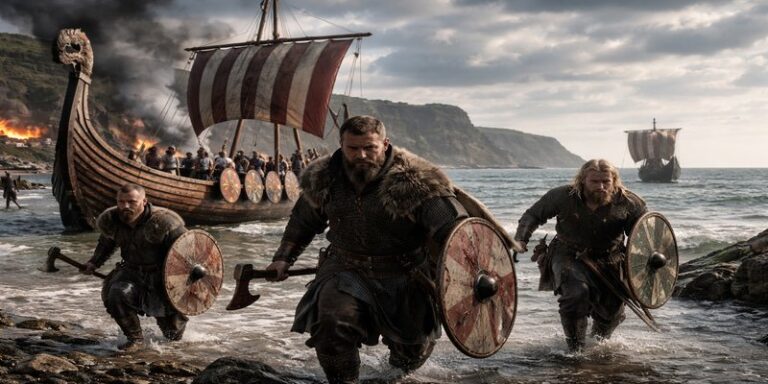
The Viking invasions of Britain began in the late eighth century and fundamentally altered the political and cultural landscape of the British Isles. Traditionally dated from the raid on Lindisfarne in 793, these incursions evolved from sporadic coastal attacks into organised campaigns of conquest and settlement.
1.0 Early Raids and the Shock of Lindisfarne
Although minor Scandinavian contacts likely preceded it, the raid on Lindisfarne marked a psychological turning point. The Anglo-Saxon Chronicle describes heathen raiders devastating the monastery, an event that symbolised both religious outrage and political vulnerability (Lavelle, 2010). Monasteries were attractive targets due to their wealth and limited defences.
The Vikings’ success depended largely on their advanced maritime technology. Their longships, equipped with shallow draughts and flexible hulls, allowed them to navigate both open seas and inland rivers (Black, 2017). This mobility enabled swift attacks and rapid retreats, confounding Anglo-Saxon forces.
Yet historians caution against taking the Chronicle’s dramatic tone at face value. As Black (1996; 2017) notes, casualty figures may be exaggerated, reflecting monastic authors’ biases. Modern historians therefore combine textual sources with archaeological findings to build a balanced understanding.
2.0 From Raiding to Conquest: The Great Heathen Army
By 865, Viking activity shifted dramatically with the arrival of the Great Heathen Army, a large coalition force described in the Anglo-Saxon Chronicle (Raffield, 2020). Unlike earlier raiders, this army overwintered in England and systematically conquered territories.
Within a decade, major Anglo-Saxon kingdoms—Northumbria, East Anglia, and Mercia—fell under Scandinavian control. The resulting territory became known as the Danelaw, a region where Danish laws and customs prevailed.
Recent scholarship argues that the Danelaw was not merely an occupied zone but a structured political entity. Raffield (2020) reassesses colonisation patterns, suggesting organised settlement supported by archaeological evidence, including weapon burials and Scandinavian-style artefacts. Similarly, Novko (2016) highlights how material culture and place-names ending in -by and -thorpe demonstrate lasting Scandinavian influence.
This transformation indicates that Viking objectives extended beyond plunder; they aimed to create enduring communities.
3.0 King Alfred and Anglo-Saxon Resistance
The survival of Wessex under King Alfred the Great (r. 871–899) proved pivotal. Initially defeated and forced into hiding in the marshes of Somerset, Alfred reorganised his kingdom’s defences. According to Lavelle (2010), Alfred implemented reforms including:
- The construction of fortified towns (burhs).
- The reorganisation of the fyrd (militia).
- The development of a naval fleet to counter Viking ships.
Abels (2024) emphasises Alfred’s innovative military strategies, particularly his adaptation of shipbuilding techniques to rival Scandinavian naval power. Although his early naval experiments were imperfect, they demonstrated strategic foresight.
The Treaty of Wedmore (878) between Alfred and the Viking leader Guthrum established boundaries between Wessex and the Danelaw. Rather than complete expulsion, the agreement institutionalised coexistence. This pragmatic settlement laid foundations for later English unification.
4.0 Life in the Danelaw
Archaeological and documentary evidence reveals that Viking settlers integrated with local populations. Hill (2012) stresses that economic exchange flourished, especially in towns such as York (Jórvík), which became a major commercial hub linking England to Scandinavian and European trade networks.
Richards (2025) highlights the archaeological discoveries in York, including workshops, coinage, and evidence of craft production, demonstrating vibrant urban life. Rather than cultural erasure, the Danelaw fostered hybrid identities, blending Scandinavian and Anglo-Saxon traditions.
Religious change further illustrates assimilation. Rodrigues (1993) discusses the gradual conversion of Viking settlers to Christianity, a process that facilitated political stability. Conversion was often pragmatic, easing governance and alliances.
5.0 Cultural and Linguistic Legacy
The Viking presence left an enduring imprint on the English language. Words such as sky, law, window, and husband derive from Old Norse. Place-names across northern and eastern England reflect Scandinavian settlement patterns (Lindsay, 2024).
Moreover, legal terminology in the Danelaw differed from that in Wessex, suggesting administrative adaptation rather than simple domination. As Wright (2023) notes, the synthesis of legal traditions contributed to the development of a more unified English kingdom in the tenth century.
6.0 Violence, Conflict and Integration
While cultural exchange occurred, conflict remained frequent. Jensen (1975) argues that earlier scholarship overstated Viking brutality, yet archaeological discoveries of mass graves, such as those examined by Josefsson Bernhardsdotter (2012), confirm episodes of intense violence.
The invasions were neither wholly destructive nor peacefully integrative. Instead, they combined warfare, negotiation, settlement, and assimilation.
7.0 The End of the Viking Age in Britain
The Viking Age in Britain did not conclude with Alfred. Renewed Scandinavian invasions occurred in the late tenth and early eleventh centuries, culminating in the reign of King Cnut (1016–1035), who ruled a North Sea empire encompassing England, Denmark, and Norway.
Ultimately, the Norman Conquest of 1066 marked the end of the distinct Viking Age. Yet Norman rulers themselves descended from Scandinavian settlers in France, illustrating the far-reaching consequences of Viking expansion.
The Viking invasions of Britain were transformative events that reshaped political boundaries, military organisation, culture, and identity. Far from being simple raiders, the Vikings were adaptable warriors, traders, and settlers who established the Danelaw and influenced English development profoundly.
Modern scholarship, drawing on archaeology, place-name studies, and critical analysis of primary sources, presents a balanced interpretation. The story of Viking Britain is therefore one of conflict and creativity, destruction and integration. In resisting, adapting to, and absorbing Scandinavian influence, Anglo-Saxon England laid foundations for the unified kingdom that would emerge in the tenth and eleventh centuries.
References
Abels, R.P. (2024) Anglo-Saxon and Viking Military Strategies. In: Routledge Handbook of Medieval Military Strategy. Routledge. Available at: https://api.taylorfrancis.com/content/chapters/edit/download?identifierName=doi&identifierValue=10.4324/9781003315391-4&type=chapterpdf.
Black, J. (1996) ‘Saxons, Vikings and Celts, AD 400–1066’, in A History of the British Isles. London: Macmillan.
Black, J. (2017) ‘British, English and Scandinavians, AD 400–1066’, in A History of the British Isles. Springer. Available at: https://link.springer.com/content/pdf/10.1007/978-1-349-24974-9_2.
Hill, P. (2012) The Anglo-Saxons at War, 800–1066. Barnsley: Pen & Sword. Available at: https://books.google.com/books?id=5OC3DwAAQBAJ.
Jensen, G.F. (1975) ‘The Vikings in England: a review’, Anglo-Saxon England, 4, pp. 181–206. Available at: https://www.cambridge.org/core/journals/anglo-saxon-england/article/vikings-in-england-a-review/C24A069DFF633D8A5FFD346F2E241886.
Josefsson Bernhardsdotter, E. (2012) Vikings’ demise on foreign soil. Available at: https://www.diva-portal.org/smash/record.jsf?pid=diva2:538659.
Lavelle, R. (2010) Alfred’s Wars: Sources and Interpretations of Anglo-Saxon Warfare in the Viking Age. Woodbridge: Boydell. Available at: https://books.google.com/books?id=oRsQI2gvY3QC.
Novko, L. (2016) The Danelaw: The Scandinavian Influence on English Identity. Available at: https://scholarsarchive.library.albany.edu/cgi/viewcontent.cgi?article=1000&context=honorscollege_mrsp.
Raffield, B. (2020) ‘The Danelaw reconsidered: colonization and conflict in Viking-Age England’, Viking and Medieval Scandinavia, 16, pp. 1–30. Available at: https://www.brepolsonline.net/content/journals/10.1484/J.VMS.5.121523.
Richards, J.D. (2025) ‘Viking Britain’, in The Archaeology of Britain. Routledge. Available at: https://www.taylorfrancis.com/chapters/edit/10.4324/9780429445521-13/viking-britain-julian-richards.
Rodrigues, T.A. (1993) Christians or Pagans: The Conversion of the Vikings in the Danelaw. ProQuest Dissertation. Available at: https://search.proquest.com/openview/453a59ede9c151898db18bdf60dbbf16/1.
Wright, A.C. (2023) The Battles That Created England 793–1100. Barnsley: Pen & Sword. Available at: https://books.google.com/books?id=bOSdEAAAQBAJ.