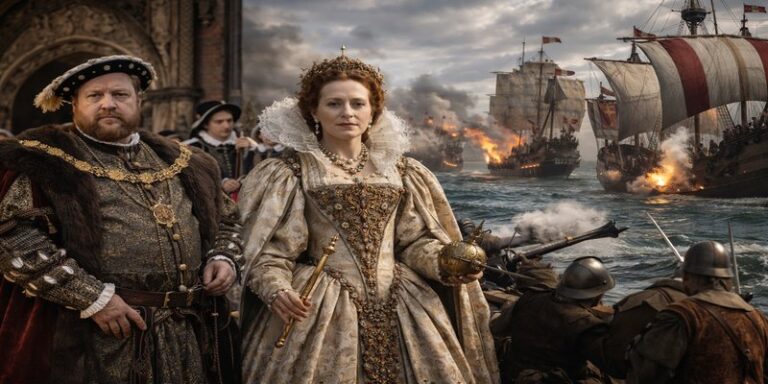
The Tudor era (1485–1603) began in the aftermath of the Wars of the Roses, a prolonged civil conflict that had destabilised England’s nobility and monarchy. When Henry VII seized the throne after the Battle of Bosworth in 1485, he inherited a fractured kingdom. By the time of Elizabeth I’s death in 1603, England had become more politically centralised, religiously distinct, and increasingly assertive on the European stage.
1.0 Background of Tudor Era
It is called the Tudor era because England was ruled by the House of Tudor, a royal dynasty that held the throne from 1485 to 1603. The name comes from Henry Tudor, who became King Henry VII after defeating Richard III at the Battle of Bosworth Field in 1485. His victory ended the Wars of the Roses and began a new ruling family — the Tudor dynasty. He is called Henry VII because he was the seventh king of England named Henry, and the “VII” is simply the Roman numeral for seven.
Henry’s claim to the throne came through his mother, Margaret Beaufort, who was descended from John of Gaunt (son of Edward III). Although his claim was not especially strong by bloodline, his victory in battle secured his crown.
The House of Tudor included five monarchs:
- Henry VII (1485–1509) – Restored stability after civil war.
- Henry VIII (1509–1547) – Broke with Rome and created the Church of England.
- Edward VI (1547–1553) – Advanced Protestant reforms.
- Mary I (1553–1558) – Attempted to restore Catholicism.
- Elizabeth I (1558–1603) – Defeated the Spanish Armada and strengthened England’s global presence.
The Tudor line ended when Elizabeth I died without children. The crown then passed to James VI of Scotland, who became James I of England, starting the Stuart dynasty.
2.0 Henry VII: Restoring Stability and Strengthening the Crown
Henry VII’s foremost achievement was the restoration of stability. As Guy (1988) argues, Henry’s rule marked a careful consolidation rather than dramatic reform. He curtailed the power of over-mighty nobles through bonds and recognisances—legal devices that enforced loyalty through financial penalties. By limiting private armies and strengthening royal justice, he reduced the likelihood of renewed aristocratic rebellion.
Financial management was central to his authority. Henry restored royal revenues by reclaiming lands lost during civil war and improving tax administration. According to Bucholz and Key (2019), this fiscal prudence enabled the monarchy to operate independently of excessive parliamentary taxation, thereby reinforcing royal autonomy.
Henry also pursued diplomatic marriages to secure the dynasty. The marriage of his son Arthur, and later Henry, to Catherine of Aragon aligned England with Spain, while the marriage of his daughter Margaret to James IV of Scotland laid the groundwork for the later union of the English and Scottish crowns in 1603. Thus, Henry VII’s reign stabilised England both domestically and internationally.
3.0 Henry VIII and the Break with Rome
If Henry VII consolidated royal authority, Henry VIII (r. 1509–1547) transformed it. His reign is most famously associated with the break with Rome in 1534, formalised through the Act of Supremacy, which declared the king Supreme Head of the Church of England.
The origins of this rupture lay in Henry’s desire to annul his marriage to Catherine of Aragon. However, as Elton (1953) demonstrated in his influential thesis on the “Tudor Revolution in Government”, the break with Rome facilitated a profound administrative transformation. Under the guidance of Thomas Cromwell, governance became more bureaucratic, with the expansion of departments such as the Court of Augmentations to manage confiscated monastic lands.
The Dissolution of the Monasteries (1536–1541) not only redistributed wealth but also redefined the religious and social fabric of England. O’Day (2012) notes that this shift consolidated central authority, as ecclesiastical structures were subordinated to the Crown.
Henry also invested heavily in naval development. Loades (2016) highlights that although Henry VII laid foundations for a royal navy, it was Henry VIII who expanded it significantly, establishing dockyards and building larger warships. This naval infrastructure would later prove crucial in defending England.
4.0 Religious Settlement and Mid-Tudor Challenges
The mid-Tudor period witnessed religious oscillation. Edward VI advanced Protestant reforms, while Mary I sought to restore Catholicism. These shifts revealed the fragility of religious consensus. Nevertheless, they also underscored the monarchy’s central role in determining national faith.
By the time Elizabeth I ascended the throne in 1558, England required religious stability. Her Elizabethan Religious Settlement (1559) established a moderate Protestant framework. According to Bernard (2021), Elizabeth’s political skill lay in balancing doctrinal compromise with firm enforcement, thereby preventing large-scale civil unrest.
5.0 Elizabeth I: Stability and Maritime Expansion
Under Elizabeth I (1558–1603), England experienced relative political stability and expanding international ambition. Her long reign allowed for continuity in governance and the consolidation of Protestant identity.
One of the defining moments of her reign was the defeat of the Spanish Armada in 1588. Philip II of Spain’s attempt to invade England represented both religious and political rivalry. The English navy, utilising faster ships and effective tactics, repelled the invasion. While storms contributed to Spanish losses, the engagement symbolised England’s growing naval strength (Bucholz and Key, 2019).
This victory carried immense symbolic weight. It bolstered Protestant morale and enhanced England’s reputation abroad. As Trim (1999) notes, warfare in the sixteenth century reinforced emerging national identities, and 1588 became a foundational myth of English resilience.
Elizabeth’s reign also saw increased maritime exploration and commercial expansion. Figures such as Sir Francis Drake and Sir Walter Raleigh ventured into the Atlantic world, challenging Spanish dominance. Hower (2020) argues that these ventures formed the early stages of a Tudor imperial vision, linking England to broader Atlantic networks.
6.0 Governance and the Growth of the State
Beyond personalities and battles, the Tudor era is notable for its administrative evolution. Central government expanded in scope and sophistication. Parliament met more frequently, particularly during Henry VIII’s reign, embedding statute law into governance (Elton, 1953).
Local government structures, including Justices of the Peace, extended royal authority into the counties. This integration of central and local administration ensured more consistent enforcement of law.
Cannadine (2017) contends that the Tudor period contributed significantly to the long-term emergence of England as a coherent political entity within Europe. Although England remained less powerful than Spain or France during much of the sixteenth century, the institutional foundations of later power were firmly established.
7.0 Cultural and National Identity
The Tudor era also witnessed flourishing cultural expression, including the works of William Shakespeare. Religious reform, printing, and humanist education reshaped intellectual life. These developments reinforced a sense of English distinctiveness, especially after separation from Rome.
The monarchy’s projection of authority—through portraits, progresses, and ceremonies—helped cultivate loyalty. Elizabeth’s image as the “Virgin Queen” symbolised both personal authority and national unity.
The Tudor era (1485–1603) was a period of profound transformation. Henry VII restored order after civil war and strengthened the monarchy’s financial and political base. Henry VIII’s break with Rome redefined religious and political structures, embedding royal supremacy at the heart of governance. Elizabeth I’s long reign consolidated Protestantism and witnessed maritime expansion, culminating in the defeat of the Spanish Armada.
By 1603, England was more centralised, more religiously distinct, and increasingly outward-looking. The institutional, naval, and ideological foundations laid during the Tudor period prepared England for its later emergence as a significant European and eventually global power.
References
Bernard, G. (2021) Who Ruled Tudor England? Paradoxes of Power. London: Routledge. Available at: https://books.google.com/books?id=DyNCEAAAQBAJ.
Bucholz, R. and Key, N. (2019) Early Modern England 1485–1714: A Narrative History. Oxford: Wiley-Blackwell. Available at: https://books.google.com/books?id=epe4DwAAQBAJ.
Cannadine, D. (2017) The Undivided Past: Humanity Beyond Our Differences. London: Allen Lane.
Elton, G.R. (1953) The Tudor Revolution in Government. Cambridge: Cambridge University Press.
Guy, J. (1988) Tudor England. Oxford: Oxford University Press.
Hower, J.S. (2020) Tudor Empire: The Making of Early Modern Britain and the British Atlantic World, 1485–1603. Amsterdam: Amsterdam University Press.
Loades, D. (2016) The Tudor Navy: An Administrative, Political and Military History. London: Routledge. Available at: https://api.taylorfrancis.com/content/books/mono/download?identifierName=doi&identifierValue=10.4324/9781315236728&type=googlepdf.
O’Day, R. (2012) The Routledge Companion to the Tudor Age. London: Routledge. Available at: https://api.taylorfrancis.com/content/books/mono/download?identifierName=doi&identifierValue=10.4324/9780203850466&type=googlepdf.
Trim, D.J.B. (1999) ‘The context of war and violence in sixteenth-century English society’, Journal of Early Modern History, 3(3), pp. 233–255. Available at: https://brill.com/view/journals/jemh/3/3/article-p233_12.xml.