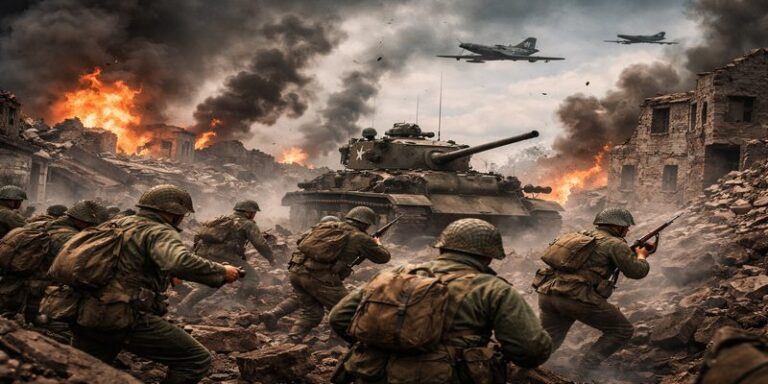
✧ In September 1939, Europe entered a war that would spread across continents, destroy cities and transform the international order. The Second World War began when Nazi Germany invaded Poland, prompting Britain and France to declare war. Its origins reached back to the unsettled peace after 1918, the economic shocks of the 1930s and authoritarian expansionism.
Fought between 1939 and 1945, the conflict involved more than 30 countries and caused tens of millions of deaths. Civilians experienced occupation, bombing, forced labour, displacement and genocide. The conflict weakened European empires and elevated the United States and Soviet Union. Its impact was felt across Europe, Asia, Africa, the Middle East and the Pacific (Imperial War Museums, 2025).
Understanding the Second World War therefore requires attention not only to battles, but also to ideology, economics, diplomacy and total mobilisation.
1.0 What Caused the Second World War?
1.1 The Legacy of Versailles
The Treaty of Versailles stripped Germany of territory, restricted its armed forces and demanded reparations. These terms did not make renewed conflict inevitable, but they encouraged resentment that Adolf Hitler exploited through promises of national revival and territorial restoration (Taylor, 1961).
Germany was not the only dissatisfied power. Italy believed that it had received insufficient rewards after the First World War, while Japan increasingly challenged the influence of Western empires in Asia. The post-war settlement created tensions that authoritarian leaders could manipulate.
1.2 Depression, Dictatorship and Expansion
The Great Depression intensified unemployment, insecurity and distrust of democracy. In Germany, the Nazi movement combined economic promises with militarism, antisemitism and aggressive nationalism. Fascist Italy sought imperial prestige, while Japanese military leaders pursued dominance in East Asia.
The origins of the Second World War were therefore global. Japan occupied Manchuria in 1931, Italy invaded Ethiopia in 1935 and Germany openly overturned post-war restrictions (Overy, 2021). In each case, aggression was presented as a solution to national weakness.
Expansionism, racial ideology and authoritarian power became mutually reinforcing. Conquest promised territory and resources, while dictatorship enabled governments to silence opposition and mobilise their populations for war.
1.3 The Failure of Collective Security
The League of Nations lacked the strength and unity needed to deter aggression. Britain and France adopted appeasement because their societies feared another catastrophic conflict and their governments needed time to rearm.
However, concessions encouraged Hitler to take further risks. The 1938 Munich Agreement transferred the Sudetenland from Czechoslovakia to Germany without Czechoslovak participation. Historians still debate whether appeasement was naïve, unavoidable or temporarily useful, but its failure to restrain Hitler is clear (Hucker, 2008).
2.0 How the Second World War Began
Germany invaded Poland on 1 September 1939, using fast-moving armoured forces supported by aircraft. The method became known as blitzkrieg, or “lightning war”. Poland was defeated rapidly and divided between Germany and the Soviet Union under the secret terms of the Nazi–Soviet Pact.
Britain and France declared war on Germany on 3 September. German forces subsequently occupied Denmark and Norway before attacking the Netherlands, Belgium and France in May 1940. France collapsed within weeks, leaving Britain fighting on in Western Europe (The National Archives, 2024).
3.0 The Battle of Britain
During the summer and autumn of 1940, the Luftwaffe attempted to gain air superiority over southern England. The Royal Air Force benefited from radar, an effective command system and pilots from Britain, the Commonwealth and occupied Europe.
German failure prevented an immediate invasion and demonstrated that technology, intelligence and organisation could outweigh numerical pressure (Bungay, 2000). The Second World War had become a conflict in which the home front and battlefield could no longer be separated.
4.0 The Second World War Becomes Global
4.1 Operation Barbarossa and the Eastern Front
On 22 June 1941, Germany invaded the Soviet Union in Operation Barbarossa, opening the largest and most lethal theatre of the war. German troops advanced rapidly but failed to destroy Soviet resistance before winter.
Ideological warfare accompanied conquest. Communities were starved, prisoners were mistreated and mass shootings followed the advancing armies. Nazi racial beliefs presented the conflict as a war of destruction rather than a conventional military campaign (Evans, 2008).
The battles of Moscow, Stalingrad and Kursk shifted the balance. At Stalingrad, Soviet forces encircled the German Sixth Army, which surrendered in February 1943. The defeat shattered the image of unstoppable Nazi expansion and became one of the conflict’s most important turning points (Beevor, 1999).
4.2 Pearl Harbor and the Pacific
Japan attacked Pearl Harbor on 7 December 1941, bringing the United States directly into the Second World War. Japanese forces then seized Hong Kong, Malaya, Singapore, the Philippines and much of Southeast Asia, threatening Allied supply routes.
The Battle of Midway in June 1942 weakened Japan’s carrier force and changed the strategic balance. American-led campaigns then advanced across the Pacific through naval warfare, amphibious landings and air power (Keegan, 1989).
5.0 Total War, Occupation and Genocide
The Second World War demanded the mobilisation of factories, agriculture, transport, science and labour. Governments rationed food and fuel, directed industry and recruited women into roles previously dominated by men. Propaganda encouraged sacrifice, while censorship controlled information.
6.0 Strategic Bombing and Civilian Suffering
Cities became military and psychological targets. London, Hamburg, Dresden and Tokyo suffered devastating raids, while occupation exposed millions to hunger, forced labour and reprisals.
Strategic bombing remains controversial because it sought to disrupt industry, transport and civilian morale while killing large numbers of non-combatants (Bell, 2007). The bombing campaigns demonstrated the increasingly blurred boundary between the military front and civilian life.
7.0 The Holocaust
The Holocaust was central to Nazi racial policy. Six million Jewish people were murdered through mass shootings, ghettos, starvation, deportation and killing centres. Roma, disabled people, Soviet prisoners of war, political opponents and other persecuted groups were also targeted.
The genocide relied on cooperation between Nazi leaders, police units, civil servants, railway authorities and collaborators. Officials were often encouraged to interpret and advance Hitler’s ideological goals, contributing to the radicalisation of persecution (Kershaw, 1993; Evans, 2008).
The Holocaust demonstrates that the Second World War was not only a contest between states. It was also an ideological struggle in which bureaucratic systems were used to classify, dispossess and destroy human beings (United States Holocaust Memorial Museum, n.d.).
8.0 Turning Points and the End of the Second World War
Allied success in North Africa, Soviet victory at Stalingrad and American advances in the Pacific gradually reversed Axis expansion. On 6 June 1944, Allied troops landed in Normandy, opening a major western front. Soviet armies advanced from the east, and Germany surrendered in May 1945.
War continued in Asia. The United States dropped atomic bombs on Hiroshima and Nagasaki in August 1945, while the Soviet Union entered the war against Japan. Japan announced its surrender on 15 August and signed formal documents on 2 September.
Debate continues over whether the atomic bombings were necessary to end the conflict or were also intended to influence the Soviet Union. Whatever the motivations, nuclear weapons permanently changed global security (Gaddis, 2005).
9.0 The Lasting Impact of the Second World War
The consequences of the Second World War reshaped global politics. Germany was divided, Eastern Europe came under Soviet influence, and rivalry between the United States and Soviet Union developed into the Cold War. The United Nations was founded in 1945.
European imperial control also weakened. Wartime mobilisation strengthened independence movements in India, Southeast Asia, the Middle East and Africa. Colonial populations that had contributed soldiers, labour and resources increasingly challenged claims of European superiority.
The Marshall Plan supported recovery in Western Europe, while new welfare policies reflected demands for greater economic and social security. Reconstruction encouraged international cooperation but also divided Europe into competing political and economic blocs.
The Nuremberg and Tokyo trials established precedents for prosecuting war crimes and crimes against humanity. International human-rights law developed partly from recognition of wartime atrocities. Displacement and competing memories ensured that the conflict continued to shape national identities.
∎ The Second World War emerged from a dangerous combination of unstable peace settlements, economic crisis, dictatorship, expansionism and failed diplomacy. Its course was shaped by industrial capacity, technological innovation, military leadership and the willingness of societies to endure extraordinary pressure.
Its legacy remains visible in international institutions, nuclear strategy, decolonisation, human-rights law and public remembrance. Studying the Second World War involves more than recounting famous battles. It requires recognition of how political choices, ideological hatred and institutional failure can produce global catastrophe—and why cooperation, accountability and historical memory remain essential.
References
Beevor, A. (1999) Stalingrad. London: Penguin. Available at: https://books.google.com/books?q=Antony+Beevor+Stalingrad+1999
Bell, P.M.H. (2007) The Second World War in Europe. Harlow: Pearson Education. Available at: https://books.google.com/books?q=P.M.H.+Bell+The+Second+World+War+in+Europe
Bungay, S. (2000) The Most Dangerous Enemy: A History of the Battle of Britain. London: Aurum Press. Available at: https://books.google.com/books?q=Stephen+Bungay+The+Most+Dangerous+Enemy
Evans, R.J. (2008) The Third Reich at War. London: Allen Lane. Available at: https://books.google.com/books?q=Richard+J.+Evans+The+Third+Reich+at+War
Gaddis, J.L. (2005) The Cold War: A New History. New York: Penguin Press. Available at: https://books.google.com/books?q=John+Lewis+Gaddis+The+Cold+War+A+New+History
Hucker, D. (2008) ‘The unending debate: Appeasement, Chamberlain and the origins of the Second World War’, Intelligence and National Security, 23(4), pp. 536–551. Available at: https://doi.org/10.1080/02684520802293114
Imperial War Museums (2025) ‘What was the Second World War?’. Available at: https://www.iwm.org.uk/history/what-was-the-second-world-war (Accessed: 15 March 2026).
Keegan, J. (1989) The Second World War. London: Hutchinson. Available at: https://books.google.com/books?q=John+Keegan+The+Second+World+War
Kershaw, I. (1993) ‘“Working towards the Führer”: Reflections on the nature of the Hitler dictatorship’, Contemporary European History, 2(2), pp. 103–118. Available at: https://doi.org/10.1017/S0960777300000383
Overy, R. (2021) Blood and Ruins: The Great Imperial War, 1931–1945. London: Allen Lane. Available at: https://books.google.com/books?q=Richard+Overy+Blood+and+Ruins
Roberts, A. (2009) The Storm of War: A New History of the Second World War. London: Allen Lane. Available at: https://books.google.com/books?q=Andrew+Roberts+The+Storm+of+War
Taylor, A.J.P. (1961) The Origins of the Second World War. London: Hamish Hamilton. Available at: https://books.google.com/books?q=A.J.P.+Taylor+The+Origins+of+the+Second+World+War
The National Archives (2024) ‘The Second World War’. Available at: https://www.nationalarchives.gov.uk/education/resources/the-second-world-war/ (Accessed: 15 March 2026).
United States Holocaust Memorial Museum (n.d.) ‘Introduction to the Holocaust’. Holocaust Encyclopedia. Available at: https://encyclopedia.ushmm.org/content/en/article/introduction-to-the-holocaust (Accessed: 24 July 2026).