The Second World War was the most destructive conflict in modern history, reshaping politics, societies and economies across the world. Fought between 1939 and 1945, it involved more than 30 countries and caused tens of millions of military and civilian deaths. The war began in Europe with Germany’s invasion of Poland in September 1939 and gradually expanded into a truly global struggle involving Europe, Asia, Africa and the Pacific. Understanding the Second World War matters because it explains the rise and fall of empires, the emergence of the United States and the Soviet Union as superpowers, the creation of the United Nations, and the long shadow of genocide and total war. This article explores the causes, major phases and enduring significance of the Second World War through a clear, evidence-based overview.
1.0 The Causes of the Second World War
1.1 The legacy of the First World War
One major cause of the Second World War was the unstable peace settlement that followed the First World War. The Treaty of Versailles imposed territorial losses, military restrictions and reparations on Germany, generating humiliation and resentment that extremist leaders later exploited (Taylor, 1961). Although historians debate whether Versailles made another war inevitable, it clearly contributed to political instability.
1.2 Economic Crisis and Political Extremism
The global economic depression of the 1930s deepened social tensions and helped authoritarian regimes gain support. In Germany, Adolf Hitler promised national revival, military strength and revenge against perceived enemies. In Italy, Benito Mussolini promoted fascist expansion, while militarists in Japan pursued conquest in East Asia. As Overy (2021) notes, economic hardship and nationalist politics created fertile ground for aggressive expansion.
1.3 Failure of Collective Security
The League of Nations proved too weak to stop aggression. Japan invaded Manchuria in 1931, Italy attacked Ethiopia in 1935, and Germany remilitarised the Rhineland in 1936. Britain and France largely followed a policy of appeasement, hoping to avoid another major war. The 1938 Munich Agreement, which allowed Germany to annex the Sudetenland, became the clearest example of this failed strategy (Roberts, 2009).
2.0 The Second World War Begins
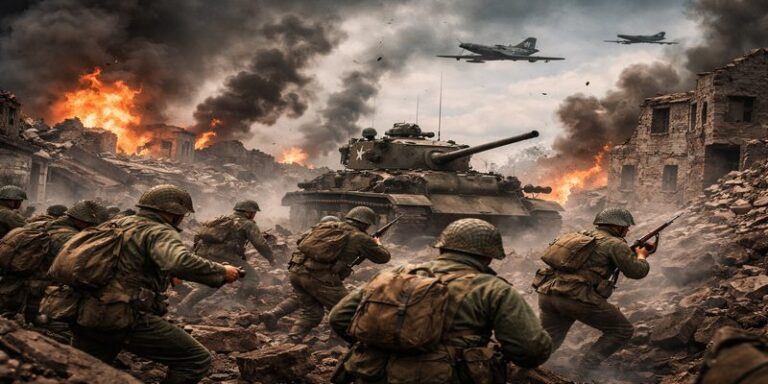
Germany invaded Poland on 1 September 1939 using blitzkrieg, or “lightning war”, combining tanks, aircraft and rapid movement. Britain and France declared war two days later. Early German victories in Poland, Norway, the Low Countries and France revealed how unprepared many European powers were for modern mechanised warfare.
2.1 The Fall of France and the Battle of Britain
In 1940, France collapsed with surprising speed. Britain then stood largely alone in Western Europe. The Battle of Britain became a turning point because the Royal Air Force prevented a German invasion by resisting sustained Luftwaffe attacks. This example shows that air power, radar and civilian resilience could alter the course of the Second World War (Bungay, 2000).
3.0 The Global Expansion of the Second World War
3.1 The Eastern Front
In June 1941, Hitler launched Operation Barbarossa, the invasion of the Soviet Union. This opened the largest and bloodiest theatre of the Second World War. Initial German advances were dramatic, but the campaign failed to secure a quick victory. The battles of Moscow, Stalingrad and Kursk became decisive. Stalingrad in particular marked a major shift, as Soviet forces encircled and destroyed the German Sixth Army in early 1943 (Beevor, 1999).
3.2 The Pacific War
The war expanded further when Japan attacked Pearl Harbor on 7 December 1941, bringing the United States directly into the Second World War. Japan rapidly captured territory across Southeast Asia and the Pacific, including Malaya, Singapore and the Philippines. However, battles such as Midway in 1942 turned the tide by weakening Japanese naval power (Keegan, 1989).
4.0 The Nature of Total War
The Second World War was a total war, meaning entire societies and economies were mobilised for conflict. Governments directed industry, rationed food and fuel, recruited women into essential work, and used mass propaganda to sustain morale. Civilian populations were not separate from the battlefield; they became central targets and participants.
4.1 Strategic Bombing and Civilian Suffering
Cities such as London, Dresden, Hamburg, Tokyo and Coventry suffered heavy bombing. The Blitz in Britain demonstrated how civilians experienced fear, disruption and loss on a daily basis. In Asia and Europe alike, occupation brought forced labour, famine and mass displacement. The scale of suffering during the Second World War blurred the line between combatant and non-combatant (Bell, 2007).
4.2 The Holocaust
The Holocaust remains one of the darkest dimensions of the Second World War. Nazi Germany systematically murdered six million Jews, alongside Roma, disabled people, political opponents, Soviet prisoners of war and others. This genocide was not a side effect of war but a central feature of Nazi ideology and policy (Evans, 2008). The extermination camps at Auschwitz-Birkenau, Treblinka and Sobibor reveal the horrifying industrialisation of murder.
5.0 The Turning Points and the End of the War
Several turning points changed the direction of the Second World War. In North Africa, Allied victories weakened Axis control of the Mediterranean. On the Eastern Front, Soviet advances pushed German forces westward. In Western Europe, the Allied landings in Normandy on 6 June 1944 opened a new front against Nazi Germany. By May 1945, Germany had surrendered.
In the Pacific, fighting continued until August 1945. The United States dropped atomic bombs on Hiroshima and Nagasaki, while the Soviet Union declared war on Japan. Japan surrendered on 15 August 1945, formally ending the Second World War in September. Historians still debate the military and moral significance of the atomic bombings, but there is no doubt that they transformed warfare forever (Gaddis, 2005).
6.0 The Legacy of the Second World War
The consequences of the Second World War were immense. The war accelerated the decline of European empires and encouraged decolonisation in Asia and Africa. It also led to the division of Europe, the beginning of the Cold War, and the emergence of the United States and the Soviet Union as rival superpowers. Institutions such as the United Nations were established in an effort to prevent another catastrophe.
The Second World War also shaped memory, law and human rights. The Nuremberg Trials established that political and military leaders could be held accountable for war crimes and crimes against humanity. At the same time, reconstruction policies such as the Marshall Plan helped rebuild devastated economies. The conflict remains central to public memory because it combined military innovation, ideological extremism and human suffering on an unprecedented scale.
The Second World War was not simply a military contest between rival states. It was a global conflict driven by dictatorship, expansionism, economic instability and the failure of international diplomacy. Its battles ranged from Stalingrad to Midway, from El Alamein to Normandy, while its moral consequences were seen most clearly in the Holocaust and the atomic bombings. The war transformed borders, power structures and international institutions, leaving a legacy that still shapes the modern world. To study the Second World War is to confront both the destructive potential of modern states and the urgent need for international cooperation, historical memory and human rights.
References
Beevor, A. (1999) Stalingrad. London: Penguin.
Bell, P.M.H. (2007) The Second World War in Europe. Harlow: Pearson Education.
Bungay, S. (2000) The Most Dangerous Enemy: A History of the Battle of Britain. London: Aurum Press.
Evans, R.J. (2008) The Third Reich at War. London: Allen Lane.
Gaddis, J.L. (2005) The Cold War: A New History. New York: Penguin Press.
Keegan, J. (1989) The Second World War. London: Hutchinson.
Overy, R. (2021) Blood and Ruins: The Great Imperial War, 1931–1945. London: Allen Lane.
Roberts, A. (2009) The Storm of War: A New History of the Second World War. London: Allen Lane.
Taylor, A.J.P. (1961) The Origins of the Second World War. London: Hamish Hamilton.
The National Archives (2024) The Second World War. Available at: https://www.nationalarchives.gov.uk/education/resources/the-second-world-war/ (Accessed: 15 March 2026).
Imperial War Museums (2025) What was the Second World War? Available at: https://www.iwm.org.uk/history/what-was-the-second-world-war (Accessed: 15 March 2026).
Encyclopaedia Britannica (2025) World War II. Available at: https://www.britannica.com/event/World-War-II (Accessed: 15 March 2026).