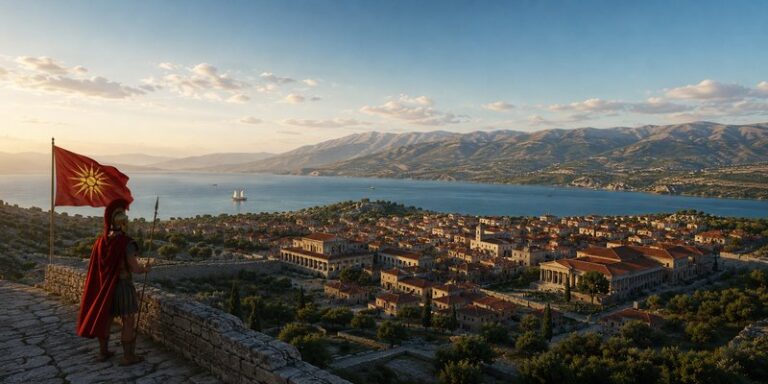
✧ The Kingdom of Macedon emerged from the rugged landscapes of northern Greece to become one of the most influential states in ancient history. Although initially regarded by many southern Greek city-states as a peripheral kingdom, Macedon transformed itself into a formidable military and political power that reshaped the ancient world. Within little more than half a century, the kingdom evolved from a regional monarchy into the centre of an empire stretching across three continents under Alexander the Great (Errington, 1990).
The remarkable rise of the Kingdom of Macedon was neither accidental nor inevitable. It resulted from visionary leadership, military innovation, diplomatic skill and effective administration. The kingdom’s influence extended far beyond territorial conquest, laying the foundations for the Hellenistic Age, during which Greek language, culture, philosophy and science spread throughout the eastern Mediterranean and western Asia (Roisman & Worthington, 2011).
1.0 The Origins of the Kingdom of Macedon
1.1 Early Development of the Kingdom of Macedon
The Kingdom of Macedon occupied the northern part of the Greek peninsula, bordered by Thrace, Illyria and Thessaly. According to ancient tradition, the Argead dynasty established the kingdom during the early first millennium BCE. Although the exact origins remain debated, archaeological discoveries and literary sources indicate that Macedon gradually developed into a centralised monarchy governed by hereditary kings (Borza, 1992).
Unlike many Greek city-states, which operated through various forms of civic government, the Kingdom of Macedon was ruled by a powerful monarch supported by aristocratic nobles and military commanders. This political structure enabled quicker decision-making, particularly during periods of warfare.
2.0 Philip II and the Transformation of the Kingdom of Macedon
2.1 Military Innovation
The turning point in the history of the Kingdom of Macedon came with the accession of Philip II in 359 BCE. At the time, the kingdom faced invasion, political instability and economic weakness. Philip introduced comprehensive reforms that transformed Macedon into the strongest military state in Greece (Hammond & Griffith, 1979).
Among his greatest innovations was the development of the Macedonian phalanx, equipped with the exceptionally long sarissa spear, which provided considerable advantages on the battlefield. Philip also strengthened cavalry units, improved logistics and introduced professional military training, creating one of antiquity’s most disciplined armies.
2.2 Political Expansion
Military success allowed the Kingdom of Macedon to expand rapidly. Philip combined conquest with diplomacy, forging strategic alliances through marriage and negotiation. His decisive victory over Athens and Thebes at the Battle of Chaeronea in 338 BCE effectively established Macedonian dominance over mainland Greece (Green, 2013).
Following this victory, Philip founded the League of Corinth, uniting most Greek states under Macedonian leadership while preserving a degree of local autonomy.
3.0 Alexander the Great and the Kingdom of Macedon
3.1 Building an Empire
Following Philip’s assassination in 336 BCE, his son Alexander III, later known as Alexander the Great, inherited the Kingdom of Macedon. Despite his youth, Alexander rapidly consolidated power before launching an ambitious campaign against the Persian Empire.
Over the next decade, Alexander defeated the Persians in a series of decisive engagements, including the Battles of Granicus, Issus and Gaugamela. His victories extended Macedonian authority across Egypt, Mesopotamia, Persia and as far as north-western India (Worthington, 2005).
This extraordinary expansion transformed the Kingdom of Macedon from a regional European kingdom into the political centre of one of history’s largest empires.
4.0 Cultural Influence
Alexander’s achievements extended beyond military conquest. Numerous cities named Alexandria were established throughout the empire, becoming centres of commerce, scholarship and cultural exchange. Greek language and customs spread widely, while local traditions also influenced Macedonian governance, creating a distinctive Hellenistic civilisation (Waterfield, 2021).
For example, the famous Library of Alexandria in Egypt became one of the ancient world’s greatest centres of learning, attracting scholars from across the Mediterranean.
5.0 Government and Society in the Kingdom of Macedon
5.1 Royal Authority
The Kingdom of Macedon remained a monarchy throughout its existence. The king served as commander-in-chief, chief diplomat, religious leader and supreme judge. Nevertheless, royal authority depended upon maintaining the loyalty of influential noble families and the army (Errington, 1990).
5.2 Economy
Agriculture formed the foundation of the Macedonian economy. Fertile plains produced cereals, grapes and olives, while forests supplied valuable timber for shipbuilding. Rich deposits of gold and silver generated substantial revenue, enabling the monarchy to finance military expansion and public works (Borza, 1992).
Trade also flourished through connections with Greek city-states and neighbouring regions, facilitating economic growth.
5.3 Military Society
Military service occupied a central position within the Kingdom of Macedon. Success in warfare brought prestige, wealth and political influence. Consequently, the kingdom developed a highly organised military culture that underpinned its expansion.
6.0 The Decline of the Kingdom of Macedon
Alexander died unexpectedly in Babylon in 323 BCE without leaving a clear adult successor. His generals, known as the Diadochi, divided the empire after prolonged conflicts. Although the Kingdom of Macedon survived as an independent state under successive dynasties, it never regained the global influence achieved during Alexander’s reign (Roisman & Worthington, 2011).
Increasing Roman intervention eventually led to a series of Macedonian Wars during the second century BCE. Following the decisive Battle of Pydna in 168 BCE, Roman forces defeated King Perseus, bringing Macedonian independence to an end (Hammond & Griffith, 1979).
In 148 BCE, Macedonia officially became a Roman province.
7.0 The Lasting Legacy of the Kingdom of Macedon
The historical significance of the Kingdom of Macedon extends well beyond its political existence.
Firstly, Macedonian military reforms influenced warfare for centuries. The professional army created by Philip II established new standards in organisation, training and combined-arms tactics.
Secondly, Alexander’s campaigns spread Greek culture across vast territories, encouraging developments in philosophy, mathematics, astronomy, medicine and literature. This Hellenistic world profoundly influenced later Roman civilisation and, ultimately, European intellectual history (Green, 2013).
Thirdly, archaeological discoveries at sites such as Vergina, identified by many scholars as ancient Aigai, have provided valuable insights into royal burials, architecture and artistic achievement, enhancing understanding of Macedonian society (UNESCO, 2024).
Finally, the Kingdom of Macedon continues to attract scholarly attention because it demonstrates how effective leadership, institutional reform and military innovation can dramatically alter the balance of power within a relatively short period.
∎ The Kingdom of Macedon stands among the most transformative civilisations of the ancient world. Emerging from modest beginnings, it became a dominant political and military force through the leadership of Philip II and Alexander the Great. Its innovations in warfare, governance and diplomacy enabled unprecedented territorial expansion, while its cultural legacy shaped the Hellenistic Age and influenced subsequent civilisations.
Although the kingdom ultimately fell to Rome, its historical impact remains profound. The spread of Greek culture, advances in military organisation and enduring archaeological discoveries ensure that the Kingdom of Macedon continues to occupy a central place in the study of ancient history. Its remarkable journey from regional kingdom to imperial power illustrates how visionary leadership and strategic reform can permanently transform world history.
Borza, E.N. (1992) In the Shadow of Olympus: The Emergence of Macedon. Princeton: Princeton University Press.
Errington, R.M. (1990) A History of Macedonia. Berkeley: University of California Press.
Green, P. (2013) Alexander of Macedon, 356–323 BC: A Historical Biography. Berkeley: University of California Press.
Hammond, N.G.L. and Griffith, G.T. (1979) A History of Macedonia, Volume II: 550–336 BC. Oxford: Clarendon Press.
Roisman, J. and Worthington, I. (eds.) (2011) A Companion to Ancient Macedonia. Oxford: Wiley-Blackwell.
UNESCO (2024) Archaeological Site of Aigai (Vergina). Available at: https://whc.unesco.org/ (Accessed: 25 June 2026).
Waterfield, R. (2021) The Making of a King: Antigonus Gonatas of Macedon and the Greeks. Chicago: University of Chicago Press.
Worthington, I. (2005) Alexander the Great: A Reader. London: Routledge.