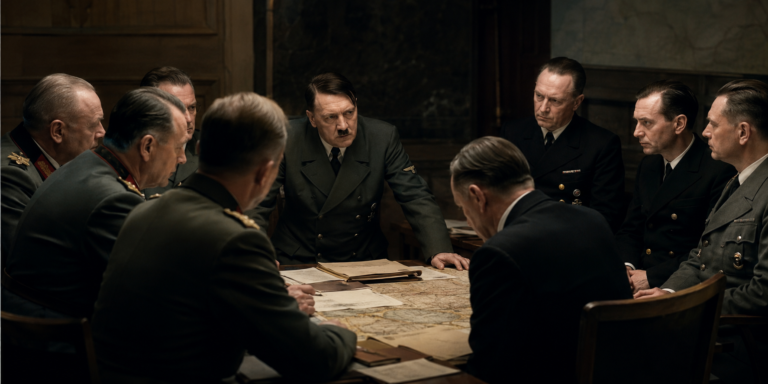
✧ In the guarded corridors of Nazi power, decisions were rarely produced by an orderly cabinet. They emerged from private meetings, competing offices and men eager to prove their usefulness to Adolf Hitler. Hitler’s Circle of Evil was not simply a group of obedient followers. It was a shifting network of ambitious officials who gained influence through loyalty, ideological commitment and ruthless competition.
The phrase captures figures such as Heinrich Himmler, Joseph Goebbels, Hermann Göring, Martin Bormann, Reinhard Heydrich and Albert Speer. Each controlled part of the regime, from propaganda and policing to armaments and access to Hitler. Their authority often overlapped, creating confusion that was politically useful. Hitler remained the ultimate source of power while subordinates fought to interpret and advance his wishes (Kershaw, 1993).
Understanding Hitler’s Circle of Evil therefore reveals more than the biographies of notorious individuals. It shows how dictatorship can function through personal rule, institutional rivalry and shared responsibility. That system became possible after democratic institutions had been dismantled and opposition suppressed (Evans, 2003; Fulbrook, 2011).
1.0 Who Belonged to Hitler’s Circle of Evil?
There was no fixed membership list. Nazi leadership resembled a court more than a modern government: status depended on proximity to Hitler, control of resources and success in bureaucratic battles. Göring accumulated offices, wealth and authority. Himmler built the SS into a vast organisation of policing, surveillance and racial domination. Goebbels transformed propaganda into an instrument of mobilisation and exclusion (Evans, 2005; Longerich, 2015).
Bormann‘s power was less visible but increasingly important. As head of the Party Chancellery, he controlled documents, appointments and access to Hitler. Heydrich became one of the principal organisers of the security apparatus and anti-Jewish policies. Speer represented another type of insider: the technocrat who presented himself as efficient and apolitical while benefiting from dictatorship and forced labour (Evans, 2008).
Hitler’s Circle of Evil was united not by friendship but by dependence on Hitler and participation in a common ideological project.
2.0 Hitler’s Circle of Evil and the “Working Towards the Führer” System
A central explanation of Nazi government is Ian Kershaw’s idea of “working towards the Führer”. Hitler often issued broad ideological goals rather than detailed instructions. Officials then attempted to anticipate what he wanted, frequently proposing more radical measures to win approval or expand their authority (Kershaw, 1993).
This system encouraged competitive radicalisation. Agencies duplicated one another, responsibilities remained unclear and officials competed for prestige. In many states, administrative overlap produces delay. Under Nazism, it often produced escalation because advancement depended on demonstrating initiative in support of Hitler’s worldview (Kershaw, 2000).
The members of Hitler’s Circle of Evil were therefore not passive tools. Their rivalries helped drive policy. Göring sought economic control, Himmler wider police powers and Goebbels greater influence over public life. Hitler could intervene as final arbiter while remaining above everyday disputes. The disorder strengthened his personal supremacy.
3.0 Propaganda, Terror and Bureaucracy
3.1 Goebbels and the Manufacture of Consent
Goebbels understood that dictatorship required more than fear. It also required spectacle, repetition and emotional identification. Radio, rallies, newspapers, film and staged public appearances promoted Hitler as Germany’s indispensable leader. Propaganda did not convert every citizen into a committed Nazi, but it narrowed debate, normalised exclusion and linked national recovery to obedience (Longerich, 2015; Overy, 2004).
Within Hitler’s Circle of Evil, Goebbels specialised in shaping perception. Victories were celebrated as proof of genius, while setbacks were concealed or reframed. Antisemitic messages were embedded in stories about national unity, conspiracy and war.
3.2 Himmler, Heydrich and the Machinery of Repression
Himmler and Heydrich built institutions that fused ideology with administration. The SS, police and security services identified, detained and persecuted people defined as enemies of the regime. Their power expanded because political policing, racial policy and imperial expansion became increasingly connected (Longerich, 2012).
The Holocaust did not result from a single office acting alone. It developed through cooperation among party agencies, ministries, police units, transport systems, local authorities and occupied administrations. Scholarship shows how central direction combined with initiatives from below, producing escalating persecution and mass murder (Browning, 2004; Evans, 2008; USHMM, n.d.).
This wider participation is essential to understanding Hitler’s Circle of Evil: the inner circle gave direction, but numerous institutions and officials made its policies possible.
4.0 Rivalry Inside Hitler’s Circle of Evil
Nazi elites publicly performed unity, yet personal distrust was constant. Göring, once designated Hitler’s successor, lost influence as the war turned against Germany. Himmler built an empire extending into policing, settlement, intelligence and military formations. Bormann strengthened his position by controlling access to Hitler, especially during the later war years (Kershaw, 2000).
These men often collected titles rather than replacing one another in a rational hierarchy. The result was a polycratic state—a system with multiple centres of power under one supreme leader. Rivalry reduced coherent planning but increased dependence on Hitler (Overy, 2004).
For example, the wartime economy involved competition among Göring’s Four Year Plan organisation, military authorities, government ministries and Speer’s armaments administration. Speer improved production in some areas, but later claims that he was merely a neutral expert have been challenged by evidence of his knowledge of exploitation and his central role in the war economy (Evans, 2008).
5.0 Ideology, Opportunism and Personal Responsibility
It is tempting to describe Hitler’s Circle of Evil as a collection of cynical opportunists. Personal ambition certainly mattered. Offices brought prestige, wealth and protection. Yet opportunism alone does not explain the regime’s behaviour. Leading Nazis also shared core beliefs in racial hierarchy, territorial expansion, authoritarian government and the destruction of supposed enemies (Paxton, 2004).
Different motives could coexist. An official might be ideologically committed, professionally ambitious and eager for material reward. This combination made the system especially dangerous. Radical policies did not depend solely on constant instructions from Hitler; they could be advanced by people who saw personal and political advantage in turning ideology into action.
The history of Hitler’s Circle of Evil rejects the excuse that responsibility belonged only to the dictator. Hitler created the political framework and set its central goals, but senior figures interpreted, organised and intensified them.
6.0 The Collapse of the Inner Circle
As defeat approached in 1945, the appearance of unity disintegrated. Göring attempted to assert authority when Hitler became increasingly isolated in Berlin. Himmler pursued separate contacts with the Western Allies. Both were denounced as traitors. Goebbels remained in Berlin, while Bormann attempted to escape after Hitler’s death (Kershaw, 2000).
The collapse exposed the foundations of Hitler’s Circle of Evil. Loyalty had been sustained by power, access and the expectation of victory. Once those rewards disappeared, rivalry and self-preservation became unmistakable. The regime that had demanded absolute obedience ended in fragmentation.
✧ Hitler’s Circle of Evil was not an ornamental group surrounding an all-powerful individual. It was a system of dictatorship in which ideology, bureaucracy and ambition reinforced one another. Hitler’s authority remained central, but it was exercised through men who built institutions, competed for favour and turned broad ideological goals into destructive policies.
The lasting lesson lies in the interaction between leader and followers. Dictatorship is strengthened when officials are rewarded for anticipation rather than restraint, when institutions compete to become more radical and when professional expertise is separated from moral responsibility.
Studying Hitler’s Circle of Evil explains not only who held power in Nazi Germany, but also how ordinary structures of administration can be transformed into instruments of persecution and war.
References
Browning, C.R. (2004) The Origins of the Final Solution: The Evolution of Nazi Jewish Policy, September 1939–March 1942. Lincoln: University of Nebraska Press.
Evans, R.J. (2003) The Coming of the Third Reich. London: Allen Lane.
Evans, R.J. (2005) The Third Reich in Power, 1933–1939. London: Allen Lane.
Evans, R.J. (2008) The Third Reich at War, 1939–1945. London: Allen Lane.
Fulbrook, M. (2011) A History of Germany 1918–2008: The Divided Nation. 3rd edn. Chichester: Wiley-Blackwell.
Kershaw, I. (1993) ‘“Working Towards the Führer”: Reflections on the Nature of the Hitler Dictatorship’, Contemporary European History, 2(2), pp. 103–118.
Kershaw, I. (2000) Hitler, 1936–1945: Nemesis. London: Allen Lane.
Longerich, P. (2012) Heinrich Himmler: A Life. Oxford: Oxford University Press.
Longerich, P. (2015) Goebbels: A Biography. London: The Bodley Head.
Overy, R. (2004) The Dictators: Hitler’s Germany, Stalin’s Russia. London: Allen Lane.
Paxton, R.O. (2004) The Anatomy of Fascism. New York: Alfred A. Knopf.
United States Holocaust Memorial Museum (USHMM) (n.d.) ‘Introduction to the Holocaust’, Holocaust Encyclopedia. Available at: https://encyclopedia.ushmm.org/content/en/article/introduction-to-the-holocaust (Accessed: 23 July 2026).