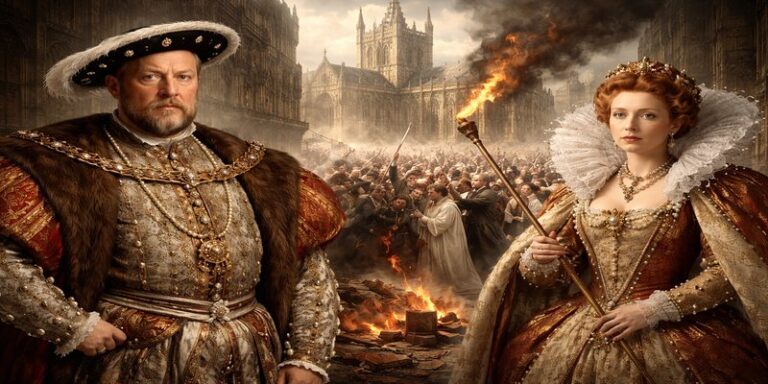
Religious tension has been one of the most powerful and enduring forces shaping the British monarchy. From medieval jurisdictional disputes between Crown and papacy, through the upheavals of the Reformation and Civil War, to the Protestant constitutional settlement of 1688 and the gradual liberalisation of the nineteenth and twentieth centuries, Christianity has profoundly influenced political authority, dynastic legitimacy, and constitutional structure.
Rather than a static relationship, monarchy and religion have existed in continual negotiation—at times cooperative, at others violently adversarial. The history of Britain’s constitutional monarchy cannot be understood apart from these confessional struggles.
1.0 Medieval Foundations: Dual Authority and Jurisdictional Conflict
1.1 Crown versus Papacy
In medieval England, kings ruled within a Christian polity but did not control the institutional Church. The Church possessed extensive lands, operated ecclesiastical courts, and owed ultimate obedience to the Pope. This produced structural tension between spiritual and temporal jurisdictions.
The conflict between Henry II and Archbishop Thomas Becket (1160s–1170) illustrates this struggle. Henry’s Constitutions of Clarendon (1164) sought to restrict clerical privilege and subject clergy accused of crimes to royal courts. Becket’s resistance, culminating in his murder in 1170, exposed the volatility of overlapping authorities (Barlow, 1986; Carpenter, 2003).
Although reconciliation followed, the episode established a central constitutional question that would resurface for centuries: whether ultimate authority within the realm lay with the Crown or with an external ecclesiastical power.
2.0 The English Reformation: Royal Supremacy and State Transformation
2.1 Henry VIII and Parliamentary Sovereignty
The Reformation marked the most dramatic realignment of monarchy and Christianity in British history. Henry VIII’s failure to obtain papal annulment from Catherine of Aragon catalysed legislative innovation. The Act of Supremacy (1534) declared the king “Supreme Head on earth of the Church of England,” transferring ecclesiastical allegiance from Rome to the Crown.
As G.R. Elton (1953) argued, this period witnessed a “Tudor revolution in government,” embedding religious supremacy within statute law and enhancing parliamentary authority. More recent scholarship (MacCulloch, 2003) emphasizes that while the initial break was political, it rapidly acquired theological substance, reshaping doctrine, liturgy, and ecclesiastical governance.
The dissolution of the monasteries redistributed immense wealth, strengthening royal finances and reshaping the social order. Yet resistance—most notably the Pilgrimage of Grace (1536)—demonstrated that religious change carried deep social consequences.
3.0 Confessional Volatility: 1547–1603
3.1 Edward VI and Mary I
Under Edward VI, Protestant reforms intensified, advancing liturgical change and doctrinal Calvinism. Mary I reversed these reforms, restoring papal authority and prosecuting Protestant dissenters (Haigh, 1993). The rapid oscillation between confessions entrenched suspicion and linked dynastic legitimacy with religious identity.
3.2 Elizabeth I and the Settlement of 1559
Elizabeth I sought moderation through the Elizabethan Religious Settlement, adopting the title Supreme Governor rather than Supreme Head. This semantic adjustment acknowledged sensitivities regarding spiritual authority while reaffirming royal supremacy (Guy, 2000).
However, Catholic recusancy laws and plots involving Mary, Queen of Scots reinforced the perception that religious dissent posed political danger. By the end of Elizabeth’s reign, Protestantism had become intertwined with English national identity.
4.0 The Stuart Crisis and Revolutionary Consequences
4.1 Divine Right and Religious Anxiety
The Stuart monarchs defended episcopacy and advanced the doctrine of divine right. James I and Charles I associated religious uniformity with political stability. Yet Puritan critics viewed episcopal governance and ceremonialism as crypto-Catholic (Russell, 1990).
Charles I’s religious policies—especially the imposition of the English Prayer Book in Scotland—provoked rebellion. As John Morrill (1993) argues, the English Civil War cannot be separated from confessional polarization across the three kingdoms.
4.2 Regicide and Republican Experiment
The execution of Charles I in 1649 shattered the sacral aura of monarchy. Under the Commonwealth, episcopacy and monarchy were abolished, and radical Protestant sects briefly flourished (Spurr, 1998).
Although the Restoration (1660) reinstated the monarchy, it did so within a transformed political environment: religious conformity remained contentious, and the Crown’s authority had been ideologically challenged.
5.0 The Glorious Revolution: Protestant Constitutional Monarchy
5.1 James II and Catholic Suspicion
James II’s open Catholicism and policies promoting toleration for Catholics and dissenters alarmed Protestant elites. Steve Pincus (2009) reinterprets the Glorious Revolution as a modern ideological revolution, not merely a dynastic adjustment.
5.2 Bill of Rights and Act of Settlement
The Bill of Rights (1689) limited royal prerogative, while the Act of Settlement (1701) barred Catholics from the throne. These statutes embedded Protestantism within constitutional law.
Mark Goldie (1991) emphasizes that after 1688 monarchy was reconceived as conditional and Protestant—a guardian of liberties rather than an absolutist sovereign. Religious identity thus became structurally embedded in succession law.
6.0 Religion, Union and Sectarian Division
6.1 Ireland
In Ireland, Protestant ascendancy over a Catholic majority linked monarchy with colonial authority. Religious allegiance shaped land ownership, governance, and resistance (Bradshaw, 1989).
6.2 Scotland
Scottish conflicts over episcopacy versus Presbyterianism repeatedly destabilised Stuart rule. Church governance became inseparable from questions of sovereignty within the composite monarchy (McLean & McMillan, 2009).
Religion therefore functioned as both a theological and geopolitical force within the British Isles.
8.0 Nineteenth and Twentieth-Century Reform
8.1 Catholic Emancipation
The Catholic Relief Act (1829) removed many civil disabilities, reflecting liberalizing attitudes in an industrialising society (Norman, 2000). However, the monarch remained constitutionally Protestant.
8.2 Contemporary Developments
The monarch today serves as Supreme Governor of the Church of England, yet exercises no doctrinal authority. The Succession to the Crown Act (2013) removed the prohibition on heirs marrying Catholics, though the sovereign must remain in communion with the Church of England.
Modern royal discourse increasingly emphasizes interfaith respect, reflecting Britain’s religious pluralism while maintaining historical continuity.
Across nine centuries, religious conflict repeatedly redefined British monarchy. Medieval jurisdictional disputes, the Reformation’s assertion of royal supremacy, the confessional wars of the seventeenth century, and the Protestant constitutional settlement of 1688 collectively transformed monarchy from a sacral, quasi-theocratic institution into a limited constitutional office embedded within statute and parliamentary sovereignty.
Yet religion has never vanished from the structure of the Crown. The requirement that the monarch be Protestant and Supreme Governor of the Church of England reflects accumulated historical compromises. The British monarchy today represents not the disappearance of confessional identity, but its constitutional domestication within a pluralist state.
References
Barlow, F. (1986) Thomas Becket. London: Weidenfeld & Nicolson.
Carpenter, D. (2003) The Struggle for Mastery: Britain 1066–1284. London: Penguin.
Elton, G.R. (1953) The Tudor Revolution in Government. Cambridge: Cambridge University Press.
Goldie, M. (1991) ‘The Revolution of 1689 and the Structure of Political Argument’, Bulletin of Research in the Humanities, 83, pp. 473–564.
Guy, J. (2000) Tudor England. Oxford: Oxford University Press.
Haigh, C. (1993) English Reformations: Religion, Politics and Society under the Tudors. Oxford: Clarendon Press.
MacCulloch, D. (2003) The Reformation: A History. London: Penguin.
McLean, I. and McMillan, A. (2009) State of the Union: Unionism and the Alternatives in the United Kingdom since 1707. Oxford: Oxford University Press.
Morrill, J. (1993) The Nature of the English Revolution. London: Longman.
Norman, E. (2000) The English Catholic Church in the Nineteenth Century. Oxford: Oxford University Press.
Pincus, S. (2009) 1688: The First Modern Revolution. New Haven: Yale University Press.
Russell, C. (1990) The Causes of the English Civil War. Oxford: Clarendon Press.
Spurr, J. (1998) English Puritanism 1603–1689. London: Macmillan.
Bradshaw, B. (1989) The Irish Constitutional Revolution of the Sixteenth Century. Cambridge: Cambridge University Press.