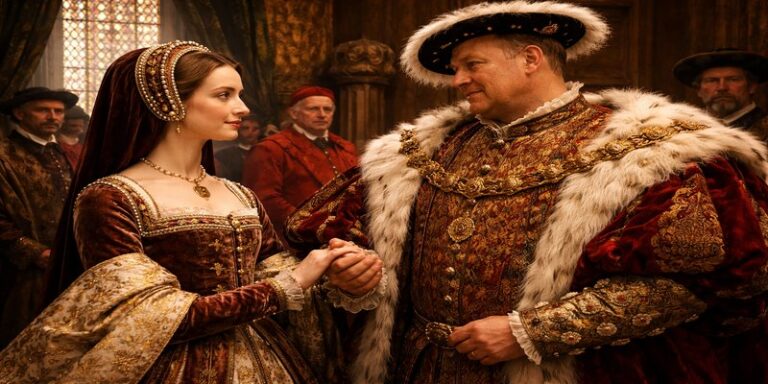
Few royal marriages in English history have had consequences as far-reaching as the union between Anne Boleyn and Henry VIII. What began as a personal and dynastic matter became a political and religious crisis that reshaped England’s relationship with Rome, altered the structure of the monarchy and ultimately led to the English Reformation. Anne’s rise from court lady to queen, and her dramatic fall, remains one of the most debated episodes of the Tudor period.
The controversy surrounding their marriage stemmed from issues of legitimacy, papal authority, succession and religious reform. As historians such as Starkey (2003) and Weir (2007) note, the marriage was not merely a romantic entanglement but a turning point in English constitutional and ecclesiastical history. This article explores the background, political manoeuvring, religious consequences and enduring legacy of Anne Boleyn’s marriage to Henry VIII.
1.0 The Dynastic Crisis
1.1 Henry VIII and the ‘Great Matter’
By the 1520s, Henry VIII had been married to Catherine of Aragon for over twenty years. Although the marriage had produced a daughter, Mary, it had failed to yield a surviving male heir. In a period when dynastic stability depended heavily on male succession, this posed a serious political problem.
Henry became convinced that his marriage was invalid, citing biblical passages that he interpreted as forbidding marriage to a brother’s widow (Leviticus 20:21). Catherine had previously been married to Henry’s brother Arthur, though she maintained that the marriage had not been consummated. Henry’s attempt to annul the marriage became known as the “Great Matter” (Haigh, 1993).
1.2 Anne Boleyn’s Role
Anne Boleyn, a lady-in-waiting at court, refused to become Henry’s mistress, insisting instead on marriage. Her refusal, combined with her intelligence and education—acquired partly during time spent in the Netherlands and France—made her an influential figure in court politics.
Anne supported religious reformist ideas circulating in Europe, including criticism of papal authority. According to Ives (2004), Anne played an active role in encouraging Henry’s break from Rome, rather than being a passive participant.
2.0 The Break with Rome
2.1 Papal Resistance
Henry sought an annulment from Pope Clement VII, arguing that his marriage to Catherine had been unlawful from the outset. However, the Pope faced immense political pressure from Catherine’s nephew, Emperor Charles V, who had significant influence in Rome.
When the papacy delayed and ultimately refused to grant the annulment, Henry pursued alternative solutions within England.
2.2 The English Reformation
Between 1532 and 1534, a series of parliamentary acts effectively severed England’s ties with Rome. The Act of Supremacy (1534) declared Henry the “Supreme Head of the Church of England”, transferring religious authority from the Pope to the monarch (Duffy, 1992).
In January 1533, Henry secretly married Anne Boleyn. Shortly thereafter, Archbishop Thomas Cranmer declared Henry’s marriage to Catherine null and void and validated the new marriage. Anne was crowned queen in June 1533.
Thus, what began as a marital dispute evolved into a fundamental transformation of English religious and political structures.
3.0 Public Reaction and Political Consequences
3.1 Divided Opinion
Anne’s marriage was controversial both domestically and internationally. Many English subjects remained loyal to Catherine, whom they regarded as the rightful queen. The displacement of Catherine and the declaration of Princess Mary as illegitimate caused public unrest.
Internationally, Catholic powers viewed Henry’s actions as heretical and unlawful. England’s diplomatic relations with Spain and the Holy Roman Empire deteriorated significantly.
3.2 The Dissolution of the Monasteries
The break with Rome facilitated broader religious reforms. Between 1536 and 1541, Henry ordered the Dissolution of the Monasteries, transferring vast ecclesiastical wealth to the Crown. Although Anne did not live to see the full implementation of these reforms, her marriage was instrumental in initiating this process (Haigh, 1993).
The redistribution of monastic lands reshaped English society, strengthening the gentry and consolidating royal authority.
4.0 The Birth of Elizabeth and Dynastic Implications
4.1 Expectation and Disappointment
In September 1533, Anne gave birth to a daughter, Elizabeth. While the child would later become one of England’s most celebrated monarchs, her birth initially disappointed Henry, who had hoped for a male heir.
Anne experienced subsequent miscarriages, including the loss of a male foetus in 1536. Her inability to secure a surviving son weakened her political position at court (Weir, 2007).
4.2 Changing Court Factions
Court politics shifted rapidly. Thomas Cromwell, once an ally of Anne, distanced himself amid policy disagreements and power struggles. Henry’s attention turned towards Jane Seymour, signalling Anne’s declining influence.
5.0 Trial and Execution
5.1 Charges of Treason
In May 1536, Anne Boleyn was arrested and charged with adultery, incest and treason. The accusations, widely regarded by modern historians as fabricated or exaggerated, alleged that Anne had engaged in relationships with several courtiers, including her brother George Boleyn (Ives, 2004).
After a swift trial, Anne was found guilty. On 19 May 1536, she was executed at the Tower of London.
5.2 Contested Interpretations
Historians continue to debate the extent to which Anne’s downfall resulted from factional politics, Henry’s personal disillusionment or deliberate manipulation by rivals. While contemporary propaganda portrayed her as immoral and ambitious, later scholarship has reassessed her as a politically astute and religiously engaged queen.
6.0 Historical Significance and Legacy
Anne Boleyn’s marriage to Henry VIII fundamentally altered England’s religious and constitutional trajectory. The establishment of the monarch as head of the Church created a precedent that shaped English governance for centuries.
Moreover, Anne’s daughter Elizabeth I would later preside over what many regard as a “Golden Age” in English history. Ironically, the daughter whose birth disappointed Henry ultimately secured the Tudor dynasty’s enduring reputation.
Modern historians increasingly recognise Anne as a catalyst for change rather than merely a victim of circumstance. As Duffy (1992) observes, the English Reformation was not inevitable; it was the product of specific political and personal decisions—among them Henry’s determination to marry Anne Boleyn.
The marriage of Anne Boleyn and Henry VIII was far more than a royal scandal. It triggered the break with Rome, initiated the English Reformation and redefined the relationship between church and state. Though brief and ultimately tragic, Anne’s queenship reshaped English history in profound ways.
Her story embodies the intersection of personal ambition, dynastic anxiety and religious upheaval. Whether viewed as reformer, victim or political actor, Anne Boleyn remains central to understanding the transformation of Tudor England and the emergence of a distinct English religious identity.
References
Duffy, E. (1992) The Stripping of the Altars: Traditional Religion in England 1400–1580. New Haven: Yale University Press.
Haigh, C. (1993) English Reformations: Religion, Politics and Society under the Tudors. Oxford: Clarendon Press.
Ives, E.W. (2004) The Life and Death of Anne Boleyn. Oxford: Blackwell.
Starkey, D. (2003) Six Wives: The Queens of Henry VIII. London: Vintage.
Weir, A. (2007) The Six Wives of Henry VIII. London: Vintage.