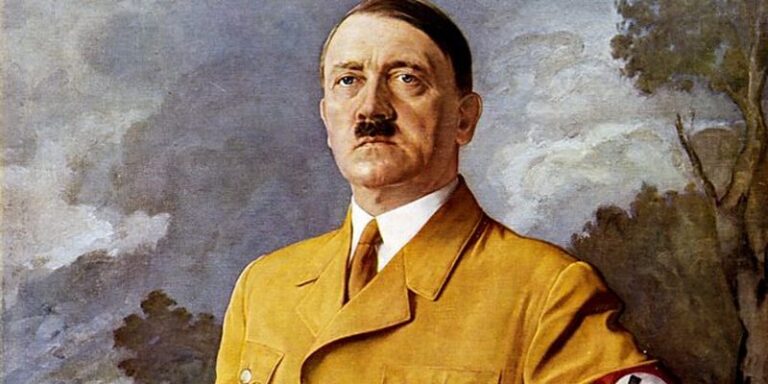
Adolf Hitler remains one of the most studied and condemned figures in modern history. As the leader of Nazi Germany, he transformed political unrest into a brutal dictatorship, helped trigger the Second World War, and oversaw policies that led to the Holocaust, in which six million Jews were murdered alongside millions of other victims, including Roma, disabled people, political opponents and Slavic civilians (Evans, 2003; United States Holocaust Memorial Museum, n.d.). Understanding Adolf Hitler matters not because his ideas deserve admiration, but because his career shows how extremism, propaganda and authoritarian power can destroy democratic institutions and human lives. This article examines the background, rise, rule and legacy of Adolf Hitler, using examples from reputable historians and reference sources.
1.0 Early Life of Adolf Hitler
1.1 Childhood, Vienna and Early Influences
Adolf Hitler was born on 20 April 1889 in Braunau am Inn, Austria-Hungary. His early life did not predict the scale of destruction he would later unleash, yet historians note that his years in Vienna helped shape many of his prejudices, including antisemitism, German nationalism and contempt for parliamentary politics (Kershaw, 1998). After failing to gain admission to art school, he lived in poverty for a period, developing a worldview built around resentment and racial hierarchy.
An important example of these influences can be seen in Vienna’s political climate at the time. Popular politicians such as Karl Lueger used mass politics and antisemitic rhetoric, showing how prejudice could be turned into public support. Although Hitler’s later ideology was more radical, this environment offered a model for the blend of hatred, performance and political messaging he would later exploit (Shirer, 1960).
2.0 Adolf Hitler and the Rise of the Nazi Party
2.1 From Soldier to Political Agitator
The First World War was a turning point for Adolf Hitler. He served in the German army and emerged from the war bitter over Germany’s defeat in 1918. Like many nationalists, he embraced the false claim that Germany had been “stabbed in the back” by internal enemies rather than defeated militarily (Evans, 2003). This myth became central to Nazi propaganda.
In 1919, Hitler joined the German Workers’ Party, which later became the National Socialist German Workers’ Party (NSDAP). His speaking ability quickly made him the party’s leading figure. By combining simple slogans, emotional speeches and scapegoating, Adolf Hitler helped turn a fringe movement into a national force (Kershaw, 2000).
2.2 Beer Hall Putsch and Mein Kampf
In 1923, Hitler attempted to seize power in Munich during the Beer Hall Putsch. The coup failed, and he was imprisoned. Yet this setback became an opportunity. While in prison, he wrote Mein Kampf, a book setting out his racial ideology, antisemitism and expansionist goals. Historians often cite this text as evidence that many of Hitler’s later actions were not accidental but closely tied to beliefs he had already expressed (Hitler, 1925/1999; Longerich, 2019).
3.0 Adolf Hitler in Power
3.1 The Collapse of Democracy
The Great Depression created conditions that favoured extremist politics. Mass unemployment, political instability and public distrust of the Weimar Republic enabled the Nazi Party to gain support. In January 1933, Adolf Hitler was appointed Chancellor of Germany. Within months, he dismantled democratic safeguards through intimidation, emergency decrees and the Enabling Act, which allowed him to rule without parliamentary consent (Evans, 2005).
This is a crucial example of how democracy can be undermined legally as well as violently. Hitler did not seize total power in a single moment; he used institutions, elite support and fear to erode them from within.
3.2 Propaganda, Terror and Control
Once in office, Adolf Hitler established a dictatorship built on propaganda, surveillance and terror. Joseph Goebbels managed propaganda, presenting Hitler as Germany’s saviour, while the Gestapo and SS crushed dissent. Schools, youth groups and the media were reshaped to promote loyalty to the regime (Welch, 2001).
The regime also targeted social and cultural life. Books were burned, political parties were banned, trade unions were destroyed and opponents were imprisoned in concentration camps. These actions reveal that the rule of Adolf Hitler depended not only on persuasion but also on coercion.
4.0 Adolf Hitler, War and the Holocaust
4.1 Expansion and the Second World War
A major aim of Adolf Hitler was territorial expansion. He sought Lebensraum (“living space”) for Germans, especially in Eastern Europe. His regime first remilitarised the Rhineland, then annexed Austria in 1938 and dismantled Czechoslovakia. In September 1939, Germany invaded Poland, prompting Britain and France to declare war and beginning the Second World War in Europe (Overy, 2021).
At first, Hitler’s military gambles appeared successful. However, the invasion of the Soviet Union in 1941 and the decision to fight multiple major powers at once proved disastrous. His increasingly erratic command decisions worsened Germany’s position as the war turned against the Nazis.
4.2 Adolf Hitler and the Holocaust
No discussion of Adolf Hitler is complete without addressing the Holocaust. Nazi antisemitism moved from discrimination and exclusion to organised mass murder. Laws such as the Nuremberg Laws stripped Jews of citizenship, while wartime radicalisation led to ghettos, shootings and extermination camps such as Auschwitz-Birkenau, Treblinka and Sobibor (Browning, 2004; USHMM, n.d.).
Historians continue to debate the exact mechanisms through which policy evolved, but there is broad agreement that Hitler’s ideology and authority were central. His speeches, directives and political leadership created the conditions in which genocide became state policy (Longerich, 2019). The victims included not only Jews but also Roma, disabled people, Soviet prisoners of war, gay men and many others persecuted by the Nazi regime.
5.0 The Fall and Legacy of Adolf Hitler
5.1 Defeat and Death
By 1945, Germany was collapsing under Allied military pressure. Soviet troops entered Berlin, and Adolf Hitler retreated to his bunker. On 30 April 1945, he died by suicide. Germany surrendered soon afterwards, leaving Europe devastated and millions dead (Beevor, 2002).
5.2 Historical Legacy
The legacy of Adolf Hitler is one of destruction, genocide and moral catastrophe. His rule demonstrated how charismatic leadership, economic crisis and weak institutions can combine to produce authoritarianism. It also reshaped international politics. The aftermath of Nazi crimes influenced the creation of the United Nations, the development of human rights law and later legal definitions of genocide and crimes against humanity (United States Holocaust Memorial Museum, n.d.).
Today, historians stress the importance of studying Hitler in context. He was not an isolated monster acting outside society; he rose within specific political and social conditions. That is why education about Adolf Hitler remains essential. It helps explain how prejudice, conspiracy thinking and anti-democratic movements can gain power when they are not confronted.
Adolf Hitler was the central figure in one of history’s darkest chapters. From his early radicalisation to his dictatorship, war-making and role in the Holocaust, his career illustrates the deadly consequences of racism, dictatorship and unchecked political extremism. Studying Adolf Hitler is not an exercise in fascination but a warning. His rise shows how fragile democracy can be, while his rule shows the human cost of hatred turned into state power. For that reason, the history of Adolf Hitler continues to matter in the modern world.
References
Beevor, A. (2002) Berlin: The Downfall 1945. London: Penguin.
Browning, C.R. (2004) The Origins of the Final Solution: The Evolution of Nazi Jewish Policy, September 1939–March 1942. Lincoln, NE: University of Nebraska Press.
Encyclopaedia Britannica (n.d.) ‘Adolf Hitler’. Available at: https://www.britannica.com/biography/Adolf-Hitler (Accessed: 15 March 2026).
Evans, R.J. (2003) The Coming of the Third Reich. London: Allen Lane.
Evans, R.J. (2005) The Third Reich in Power. London: Allen Lane.
Hitler, A. (1925/1999) Mein Kampf. Translated by R. Manheim. Boston: Houghton Mifflin.
Kershaw, I. (1998) Hitler 1889–1936: Hubris. London: Allen Lane.
Kershaw, I. (2000) Hitler 1936–1945: Nemesis. London: Allen Lane.
Longerich, P. (2019) Hitler: A Biography. Oxford: Oxford University Press.
Overy, R. (2021) Blood and Ruins: The Great Imperial War, 1931–1945. London: Allen Lane.
Shirer, W.L. (1960) The Rise and Fall of the Third Reich: A History of Nazi Germany. New York: Simon & Schuster.
United States Holocaust Memorial Museum (n.d.) ‘Adolf Hitler: Early years, 1889–1913’. Available at: https://encyclopedia.ushmm.org/content/en/article/adolf-hitler-early-years-1889-1913 (Accessed: 15 March 2026).
United States Holocaust Memorial Museum (n.d.) ‘Introduction to the Holocaust’. Available at: https://encyclopedia.ushmm.org/content/en/article/introduction-to-the-holocaust (Accessed: 15 March 2026).
Welch, D. (2001) Propaganda and the German Cinema 1933–1945. London: I.B. Tauris.