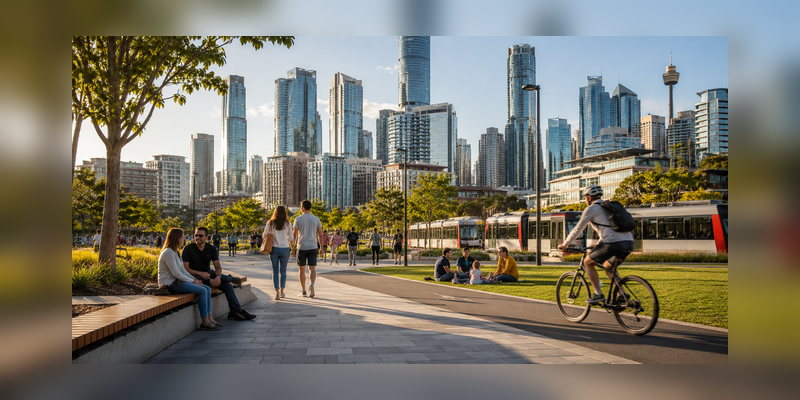
✧ A country may have shining towers, busy airports, luxury shopping districts and impressive economic headlines. Its factories may produce goods for the world, its stock market may rise, and its government may proudly announce strong economic growth. On paper, it looks wealthy. Yet, behind the skyline, some citizens may struggle with poor housing, costly healthcare, low wages, pollution or limited education. This contrast raises an important question: does High GDP and true wealth mean the same thing?
The answer is more complicated than it first appears. Gross Domestic Product, or GDP, is useful because it measures the total value of goods and services produced within a country. However, High GDP and true wealth are not identical. GDP can show economic size, but it does not fully reveal how people live, how wealth is shared, or whether prosperity can last. Economists have long argued that societies need broader ways to measure progress (Stiglitz, Sen and Fitoussi, 2009).
1.0 What GDP Actually Measures
GDP is one of the most widely used economic indicators in the world. It measures the market value of goods and services produced in a country during a specific period. If a country builds more houses, sells more cars, provides more financial services or exports more technology, GDP usually rises.
This makes GDP valuable for comparing economic activity, tracking recessions and estimating national income. Mankiw (2021) explains that GDP is a central measure in macroeconomics because it helps governments, businesses and analysts understand the scale and direction of an economy.
However, GDP was not designed to measure happiness, fairness, health or social trust. It counts production, not necessarily human wellbeing. This is where the gap between High GDP and true wealth begins.
2.0 High GDP and True Wealth: Why the Difference Matters
A country can have a high GDP for several reasons. It may have a very large population, abundant natural resources, a strong industrial base or a powerful financial sector. Yet, this does not automatically mean that most citizens are prosperous.
For example, a large country may have one of the world’s biggest economies simply because many people live and work there. But if GDP is divided across a huge population, average income may be modest. This is why GDP per capita is often more informative than total GDP. Even then, GDP per capita is only an average. It can hide large inequalities.
Stiglitz, Sen and Fitoussi (2010) argue that measuring national success only through GDP can mislead policy because it overlooks distribution, quality of life and sustainability. In other words, High GDP and true wealth should be judged together, not treated as the same thing.
3.0 Income Distribution: Who Actually Benefits?
3.1 When Growth Is Not Shared
One of the clearest limits of GDP is that it does not show who receives the income. A country may become richer overall while many households remain financially insecure. If economic gains flow mainly to a small elite, national GDP can rise while ordinary living standards stagnate.
This matters because wealth is not only about national output. It is also about whether people can afford food, housing, healthcare, education, transport and savings. Research on inequality and wellbeing suggests that income distribution plays a major role in how economic growth affects people’s lives (Singh and Singh, 2020).
For instance, two countries may have similar GDP per capita. In one, income may be widely shared through decent wages and public services. In another, wealth may be concentrated among a small group. The first country may feel more genuinely prosperous, even if the headline GDP figure is similar.
4.0 Human Development: Wealth Beyond Money
4.1 Health, Education and Life Expectancy
The idea of High GDP and true wealth becomes clearer when human development is considered. The United Nations Development Programme introduced the Human Development Index to shift attention from income alone to health, education and living standards (UNDP, 1990). This approach recognises that a country is not truly wealthy if people cannot live long, educated and dignified lives.
A nation with high GDP but poor hospitals, low literacy or weak public health systems may be economically large but socially fragile. By contrast, a smaller economy with strong schools, accessible healthcare and long life expectancy may provide a better quality of life.
Sen’s capability approach also supports this view. Sen (1999) argues that development should be understood as expanding people’s real freedoms and opportunities, not simply increasing income. True prosperity means people have the ability to live meaningful, healthy and secure lives.
5.0 Public Services and Infrastructure
5.1 The Everyday Signs of Real Prosperity
True wealth is often experienced in ordinary daily life. Safe roads, reliable trains, clean water, good schools, efficient hospitals, stable electricity and trustworthy institutions all shape national wellbeing. GDP may help fund these systems, but it does not guarantee them.
For example, an oil-rich country may record high GDP from exports, but if public institutions are weak, many citizens may see little improvement in daily life. Conversely, a country with moderate GDP but strong public services may feel stable, fair and liveable.
This is why High GDP and true wealth should be assessed through both economic and social indicators. The OECD’s wellbeing framework, for example, looks beyond income to areas such as housing, jobs, health, education, environment, safety and civic engagement (OECD, 2020).
6.0 Environmental Sustainability: Can Wealth Last?
6.1 Growth That Damages the Future
A country may increase GDP by cutting forests, mining aggressively, polluting rivers or burning fossil fuels. In the short term, this can raise national output. In the long term, it may reduce true wealth by damaging health, ecosystems and future economic security.
Giannetti et al. (2015) argue that GDP has major limitations because it does not properly account for environmental damage or ecosystem decline. If pollution increases hospital admissions, GDP may even rise because more money is spent on healthcare. Yet, society is not better off.
This is a key problem in measuring High GDP and true wealth. A country is not truly wealthy if it grows today by weakening tomorrow’s living conditions. Sustainable wealth requires protecting natural resources, climate stability and public health.
7.0 The Role of Debt and Economic Fragility
High GDP can also mask economic vulnerability. A country may appear rich while relying heavily on debt, unstable property markets or a narrow export sector. If growth depends on borrowing or one volatile industry, prosperity may be fragile.
Stiglitz (2015) argues that measuring wealth properly requires attention to sustainability and inequality, not just current production. Real wealth should include financial resilience, productive assets, human capital, natural capital and institutional strength.
For example, a country dependent on one natural resource may enjoy high GDP during a commodity boom. But if prices fall, national income may collapse. True wealth is stronger when an economy is diverse, adaptable and supported by skilled people.
8.0 Examples: When GDP Does and Does Not Tell the Full Story
A high-GDP country with advanced industries, good wages, effective public services and strong environmental protections may indeed be wealthy in a broad sense. In such cases, GDP reflects real capacity and widespread prosperity.
However, another country may have high GDP because of population size or resource exports while still facing poverty, inequality or weak public services. In that case, the headline number gives an incomplete picture.
Similarly, some smaller countries may not rank at the very top in total GDP, yet may perform strongly in life expectancy, education, safety and social trust. These examples show why High GDP and true wealth must be understood through several lenses.
9.0 Better Measures of National Wealth
A fairer assessment of national prosperity should include:
GDP per capita, to estimate average output per person.
Median income, to show what a typical household earns.
Inequality measures, such as the Gini coefficient.
Human development indicators, including health and education.
Environmental indicators, such as emissions, air quality and biodiversity.
Wellbeing measures, including life satisfaction and social trust.
Institutional quality, including rule of law, corruption control and public safety.
These measures do not replace GDP entirely. Instead, they help complete the picture. GDP remains useful, but it should be treated as one tool, not the final verdict.
∎ So, is a country truly wealthy if it has high GDP? The best answer is: not necessarily. High GDP shows that an economy produces a large amount of goods and services, but it does not prove that citizens are healthy, secure, educated or fairly supported.
High GDP and true wealth overlap when economic output leads to broad wellbeing, strong public services, shared opportunity and sustainable development. They diverge when growth benefits only a few, damages the environment, depends on debt or fails to improve daily life.
A truly wealthy country is not only one that produces more. It is one where prosperity is shared, durable and converted into better lives.
References
Giannetti, B.F., Agostinho, F., Almeida, C.M.V.B. and Huisingh, D. (2015) ‘A review of limitations of GDP and alternative indices to monitor human wellbeing and to manage eco-system functionality’, Journal of Cleaner Production, 87, pp. 11–25.
Mankiw, N.G. (2021) Principles of Economics. 9th edn. Boston: Cengage Learning.
OECD (2020) How’s Life? 2020: Measuring Well-being. Paris: OECD Publishing.
Sen, A. (1999) Development as Freedom. Oxford: Oxford University Press.
Singh, S.V.P. and Singh, S. (2020) ‘Exploring the linkage between income inequality, GDP and human well-being’, Business and Economics Research Journal, 11(4), pp. 1005–1019.
Stiglitz, J.E. (2015) ‘The measurement of wealth: Recessions, sustainability and inequality’, NBER Working Paper No. 21327. Cambridge, MA: National Bureau of Economic Research.
Stiglitz, J.E., Sen, A. and Fitoussi, J.P. (2009) Report by the Commission on the Measurement of Economic Performance and Social Progress. Paris: Commission on the Measurement of Economic Performance and Social Progress.
Stiglitz, J.E., Sen, A. and Fitoussi, J.P. (2010) Mismeasuring Our Lives: Why GDP Doesn’t Add Up. New York: The New Press.
UNDP (1990) Human Development Report 1990: Concept and Measurement of Human Development. New York: Oxford University Press.