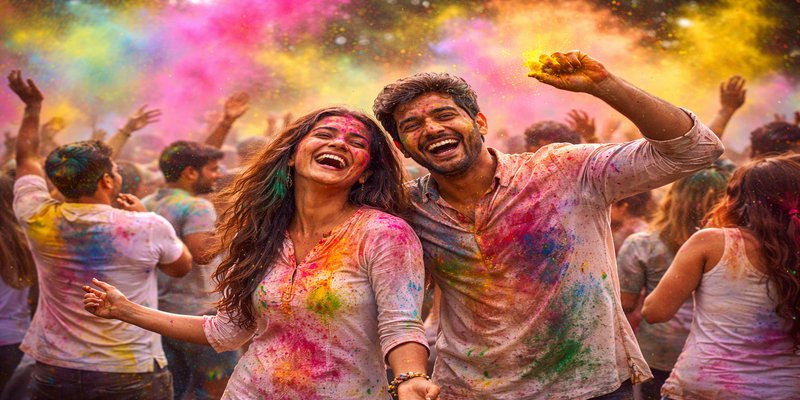
Every spring, as winter recedes and blossoms begin to appear, millions of people across India and around the world gather to celebrate Holi, the vibrant Festival of Colours. Marked by clouds of powdered pigments, joyful music, dancing and shared meals, Holi is one of the most recognisable and exuberant festivals in the Hindu calendar. Yet beneath its playful exterior lies a rich tapestry of mythology, seasonal change, social renewal and spiritual symbolism.
Holi is far more than an occasion for throwing colour. It represents the triumph of good over evil, the arrival of spring, and the breaking down of social barriers. As Fuller (2004) explains, Hindu festivals often combine religious devotion with communal celebration, blending sacred meaning with public festivity. Holi exemplifies this dynamic, uniting communities through ritual, symbolism and shared experience.
1.0 Origins and Mythological Foundations
1.1 The Legend of Prahlad and Holika
One of the central narratives associated with Holi is the story of Prahlad and Holika, drawn from Hindu mythology. According to tradition, Prahlad was a devout follower of Lord Vishnu, much to the anger of his father, King Hiranyakashipu, who demanded to be worshipped as a god. The king enlisted his sister Holika, who possessed a cloak rendering her immune to fire, to sit with Prahlad on a burning pyre. However, divine intervention reversed the outcome: Holika perished in the flames while Prahlad emerged unharmed.
This legend symbolises the victory of devotion and righteousness over arrogance and evil (Klostermaier, 2007). On the eve of Holi, communities light bonfires in a ritual known as Holika Dahan, commemorating this triumph and purifying the environment of negativity.
1.2 Krishna and Radha: The Play of Colours
Another popular tradition links Holi to the youthful exploits of Lord Krishna in the region of Braj. Folklore recounts how Krishna, self-conscious about his dark complexion, playfully coloured the fair-skinned Radha’s face. This gesture evolved into the joyful throwing of colours that defines the modern celebration (Lochtefeld, 2002).
Through this narrative, Holi becomes associated with love, playfulness and divine mischief, reinforcing its reputation as a festival of uninhibited joy.
2.0 Rituals and Celebrations
2.1 Holika Dahan: Fire and Renewal
The first evening of Holi centres on Holika Dahan, when communities gather around bonfires. Offerings such as grains and coconuts are cast into the flames, symbolising the destruction of evil and the purification of the spirit. According to Michaels (2004), fire rituals in Hindu practice often signify transformation and renewal. In this context, the bonfire marks a symbolic cleansing before the festivities of the following day.
2.2 Rangwali Holi: A Riot of Colour
The next day, often called Rangwali Holi, sees streets transformed into vivid canvases of pink, yellow, green and blue powders known as gulal. Participants smear colour onto friends and strangers alike, dissolving distinctions of age, gender and social status.
This temporary suspension of hierarchy reflects what anthropologist Victor Turner (1969) describes as “communitas” — a moment of social equality experienced during ritual celebration. Holi’s playful chaos allows individuals to step outside everyday norms, fostering solidarity and shared delight.
Music, dancing and traditional sweets such as gujiya enhance the celebratory atmosphere. In some regions, festive drinks like thandai are prepared, adding to the sense of conviviality.
3.0 Regional Variations
3.1 Lathmar Holi in Barsana
Holi is not celebrated uniformly across India. In Barsana, Uttar Pradesh, women playfully strike men with sticks in a tradition known as Lathmar Holi, recalling legends of Krishna’s teasing visits to Radha’s village. The ritual combines humour, theatre and community participation.
3.2 Shantiniketan’s Cultural Holi
In West Bengal, the festival takes on a more artistic tone. Inspired by poet Rabindranath Tagore, Basanta Utsav at Shantiniketan features song, dance and poetry alongside the use of colour. This variation emphasises cultural expression and aesthetic beauty.
3.3 Diaspora Celebrations
Holi has travelled far beyond the Indian subcontinent. Large-scale celebrations occur in the United Kingdom, the United States, Mauritius and Fiji, reflecting the global Indian diaspora. As Vertovec (2000) notes, diaspora communities often preserve and adapt festivals as expressions of cultural identity abroad. In cities such as London and Leicester, Holi events blend traditional rituals with contemporary music and multicultural participation.
4.0 Symbolism and Seasonal Significance
Holi coincides with the full moon of the Hindu month of Phalguna, typically falling in March. Agriculturally, this period marks the end of winter crops and the anticipation of harvest. The festival therefore symbolises fertility, renewal and the cyclical nature of life.
The vibrant colours themselves carry meaning. Green represents new beginnings, red signifies love and fertility, blue recalls Krishna, and yellow is associated with turmeric and auspiciousness (Klostermaier, 2007). By covering one another in colour, participants metaphorically embrace diversity and shared humanity.
5.0 Social and Cultural Impact
5.1 Breaking Down Barriers
One of Holi’s most distinctive features is its temporary dissolution of social boundaries. In many communities, people from different castes, classes and backgrounds participate together. Although social inequalities persist in broader society, Holi offers a symbolic space of unity (Fuller, 2004).
5.2 Modern Adaptations and Environmental Awareness
In recent years, concerns have arisen regarding synthetic dyes and water consumption. Environmental organisations encourage the use of natural, eco-friendly colours derived from flowers and herbs. According to the Government of India’s Ministry of Culture (2023), sustainable practices are increasingly promoted to preserve both health and tradition.
Urban celebrations have also incorporated music festivals and public events, reflecting the festival’s adaptability in modern contexts. While some critics argue that commercialisation risks diluting spiritual meaning, others view such evolution as evidence of cultural vitality.
6.0 Holi in Popular Culture
The imagery of Holi has captivated global audiences. Bollywood films frequently depict dramatic Holi scenes to symbolise emotional release or romantic turning points. International “colour runs” and festivals inspired by Holi demonstrate its aesthetic appeal beyond religious boundaries.
However, scholars caution against detaching the festival entirely from its cultural roots. As Michaels (2004) suggests, rituals derive significance from their embeddedness in tradition and belief. Appreciating Holi fully requires understanding its religious and historical foundations.
Holi stands as one of the world’s most joyful and visually striking celebrations. Rooted in ancient mythology, shaped by regional diversity and enriched by communal participation, it symbolises renewal, equality and the enduring triumph of good over evil.
From the glowing embers of Holika Dahan to the laughter-filled clouds of coloured powder, Holi invites participants to embrace both playfulness and reflection. It marks the arrival of spring while reaffirming spiritual values and social bonds. As Fuller (2004) observes, Hindu festivals weave together devotion and celebration in intricate patterns. Holi exemplifies this blend, reminding us that colour, like culture itself, is most beautiful when shared.
References
Fuller, C.J. (2004) The Camphor Flame: Popular Hinduism and Society in India. Princeton: Princeton University Press.
Government of India Ministry of Culture (2023) Festivals of India: Holi. Available at: https://www.indiaculture.gov.in.
Klostermaier, K.K. (2007) A Survey of Hinduism. 3rd edn. Albany: SUNY Press.
Lochtefeld, J.G. (2002) The Illustrated Encyclopedia of Hinduism. New York: Rosen Publishing.
Michaels, A. (2004) Hinduism: Past and Present. Princeton: Princeton University Press.
Turner, V. (1969) The Ritual Process: Structure and Anti-Structure. London: Routledge.
Vertovec, S. (2000) The Hindu Diaspora: Comparative Patterns. London: Routledge.