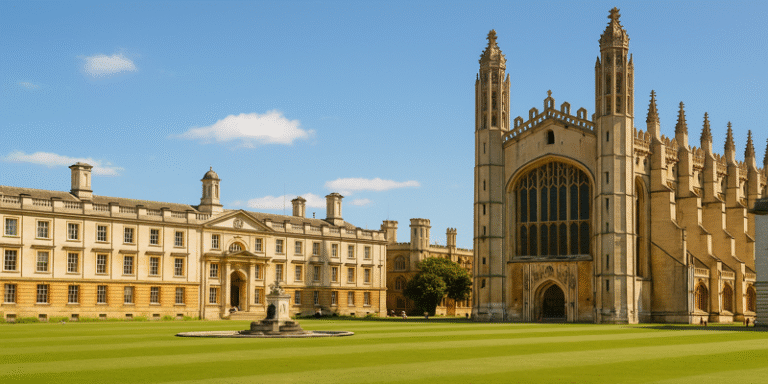
✧ Morning light on ancient courts, the quiet pull of the River Cam, and the sound of bicycle wheels moving between colleges help explain the lasting appeal of the University of Cambridge. Few institutions carry such a strong sense of historical continuity while remaining so closely connected to modern research and global change. For more than eight centuries, the University of Cambridge has stood as a centre of learning, discovery and intellectual ambition (Leader, 1988; Leedham-Green, 1996).
Yet its significance cannot be reduced to age or ceremony alone. The University of Cambridge remains one of the world’s most influential universities because it combines a distinctive collegiate structure with internationally respected teaching and research. From medieval theology to molecular biology, from literary culture to artificial intelligence, the institution has shaped debates and discoveries that reach far beyond Britain (Judson, 1996; University of Cambridge, n.d.-a). Its enduring strength lies in the ability to preserve tradition while adapting to new intellectual and social demands.
1.0 The University of Cambridge and Its Origins
1.1 The University of Cambridge in the Thirteenth Century
The accepted origin of the University of Cambridge dates to 1209, when scholars left Oxford after conflict with townspeople and settled in Cambridge, where a new scholarly community began to take shape (Leader, 1988). Royal recognition followed in 1231, helping to establish the institution’s legal standing and privileges within medieval England (Leader, 1988). Like other early European universities, Cambridge developed first as a community of masters and students rather than as a unified campus.
During the medieval period, the University of Cambridge grew in reputation through the study of theology, philosophy and the liberal arts. Over time, a series of colleges were founded to provide accommodation, discipline, financial support and educational structure. This growth laid the foundation for the collegiate university that still exists today.
1.2 The Collegiate Identity of the University of Cambridge
A central feature of the University of Cambridge is its collegiate organisation. Officially, Cambridge is made up of 31 autonomous colleges, alongside faculties, departments and schools that form the wider university structure (University of Cambridge, n.d.-a; n.d.-b). Students therefore belong both to a department or faculty and to a college community, creating a dual system of academic and pastoral life.
This structure gives Cambridge a distinctive character. Colleges are not merely residential spaces. They provide teaching support, social belonging and welfare, while the central university organises broader academic activity. The result is an institution that feels at once large and intimate, formal and communal.
2.0 Why the University of Cambridge Teaching Model Matters
2.1 The University of Cambridge and the Supervision System
One of the defining features of the University of Cambridge is the supervision system, a form of small-group teaching often regarded as one of the strongest elements of Cambridge education. Official university guidance describes supervisions as personal tutorials led by subject specialists, usually involving close discussion of essays, problem sheets or readings (University of Cambridge, n.d.-c).
The educational value of this model lies in its intensity. Students are required to present ideas clearly, defend arguments and respond to criticism in a focused environment. Ashwin (2005) found that student experiences of Oxford and Cambridge tutorials varied, but the small-group format could promote strong academic engagement and deeper understanding. This helps explain why the University of Cambridge is so closely associated with critical thinking, independent study and intellectual discipline.
2.2 Tradition and Rigour in Cambridge Learning
Teaching at Cambridge is not confined to supervisions alone. Lectures, seminars, laboratory work and independent research all play major roles, especially in science and engineering subjects (University of Cambridge, n.d.-c). What distinguishes the university is the way these elements are combined with regular small-group discussion. The result is a demanding but highly personalised academic culture.
3.0 The University of Cambridge and Research Excellence
3.1 Scientific Discovery and the University of Cambridge
The global reputation of the University of Cambridge rests heavily on its extraordinary record of research. The institution has been associated with some of the most influential developments in modern science. The Cavendish Laboratory, for example, became one of the most important centres in the history of physics, while Cambridge more broadly played a vital part in the development of twentieth-century biology. Judson (1996) highlights Cambridge’s central place in the scientific revolution surrounding the discovery of the structure of DNA.
This legacy matters because it shows that the University of Cambridge has not simply preserved prestige; it has repeatedly produced new knowledge with lasting international consequences. Its influence reaches across medicine, computing, public health, engineering and environmental research.
3.2 Research Beyond the Sciences
Although science often attracts the most public attention, the University of Cambridge has been equally important in the humanities and social sciences. Its scholars have shaped work in history, literature, philosophy, economics and political thought. Cambridge’s research culture is therefore broad rather than narrow. It is one of the few institutions whose influence is visible across both laboratory science and humanistic scholarship.
4.0 Libraries, Museums and Cultural Reach
No account of the University of Cambridge would be complete without attention to its intellectual resources. The university’s libraries, archives and museums are central to its academic life, supporting both specialist research and public engagement. These collections help sustain a culture in which historical evidence, manuscripts, scientific specimens and artistic heritage remain part of active scholarly inquiry.
This cultural richness strengthens the wider identity of the University of Cambridge. Learning there is not limited to classrooms and laboratories. It is embedded in museums, libraries, performances, debates and societies that extend academic life into the wider public sphere.
5.0 The University of Cambridge and Global Influence
5.1 Alumni and Public Leadership
The international reputation of the University of Cambridge is also reflected in its alumni. Its graduates and former scholars include major figures in science, literature, politics and philosophy. Isaac Newton, Charles Darwin and Stephen Hawking are among the most recognisable names linked to Cambridge, while literary and political life has also been shaped by those educated there.
This long record of influence helps explain why Cambridge continues to occupy such a prominent place in global imagination. The institution is not merely respected for teaching current students; it is known for contributing to the formation of ideas and leaders with worldwide impact.
5.2 Tradition, Student Life and Public Identity
Cambridge’s public identity is strengthened by ceremonies, rowing traditions, college formals and musical life. The annual Boat Race with Oxford remains one of the best-known events in British university culture, while college choirs and student societies contribute to a distinctive sense of place (Dodd, 2012). These traditions are not incidental. They help preserve continuity and community within an institution that is otherwise highly competitive and intellectually demanding.
6.0 Challenges Facing the University of Cambridge
Like all elite universities, the University of Cambridge faces serious questions about access, representation and fairness. Prestige can attract admiration, but it can also reinforce inequality if opportunity is unevenly distributed. Boliver (2015) has shown that status differences within UK higher education remain socially significant, and such findings have shaped debate around admissions and widening participation.
Cambridge has sought to respond through outreach, access work and contextual admissions practices, but the challenge remains ongoing. The university’s future reputation will depend not only on excellence in research and teaching, but also on how convincingly it broadens access to that excellence.
∎ The University of Cambridge remains one of the world’s most influential universities because it unites historical depth, collegiate community and research ambition in a rare and powerful way. From its medieval beginnings to its role in major scientific and cultural developments, it has repeatedly shown an ability to renew itself without losing its identity.
Its lasting significance lies in that balance. The University of Cambridge is both ancient and contemporary, ceremonial and innovative, local in structure yet global in influence. That combination ensures its continuing importance in higher education and in the wider intellectual life of the world.
References
Ashwin, P. (2005) ‘Variation in students’ experiences of the Oxford and Cambridge tutorial’, Higher Education, 50(4), pp. 631–644. https://doi.org/10.1007/s10734-004-6369-4.
Boliver, V. (2015) ‘Are there distinctive clusters of higher and lower status universities in the UK?’, Oxford Review of Education, 41(5), pp. 608–627. https://doi.org/10.1080/03054985.2015.1082905.
Dodd, C. (2012) The Story of the Cambridge Boat Races. London: Bloomsbury.
Judson, H.F. (1996) The Eighth Day of Creation: Makers of the Revolution in Biology. New York: Cold Spring Harbor Laboratory Press.
Leader, D.R. (1988) A History of the University of Cambridge. Cambridge: Cambridge University Press.
Leedham-Green, E.S. (1996) A Concise History of the University of Cambridge and the University of Oxford. Cambridge: Cambridge University Press.
University of Cambridge (n.d.-a) About the University. Available at: https://www.cam.ac.uk/about-the-university (Accessed: 11 April 2026).
University of Cambridge (n.d.-b) How the University and Colleges work. Available at: https://www.cam.ac.uk/about-the-university/how-the-university-and-colleges-work (Accessed: 11 April 2026).
University of Cambridge (n.d.-c) Teaching and supervisions. Available at: https://www.undergraduate.study.cam.ac.uk/courses/teaching-supervisions (Accessed: 11 April 2026).