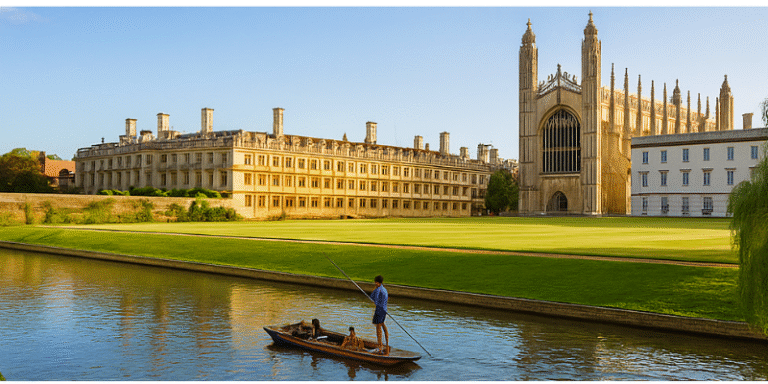
There is something quietly spellbinding about Cambridge. At dawn, mist rises gently from the River Cam, softening the outlines of Gothic spires and honey-coloured stone. Cyclists glide past ancient courts, the echo of chapel bells mingling with birdsong. Unlike cities that rush to impress, Cambridge reveals itself gradually — through winding medieval lanes, scholarly whispers beneath vaulted ceilings, and green meadows stretching towards the horizon.
More than a university town, Cambridge is a living tapestry of heritage, intellectual legacy and slow tourism. Visitors do not merely sightsee here; they linger, reflect and absorb. As research on slow tourism suggests, meaningful travel emerges from immersion rather than haste (Oh, Assaf and Baloglu, 2014). In Cambridge, that philosophy feels instinctive.
1.0 Brief Background and History
Cambridge’s origins date back to Roman settlement, yet it was the founding of the University of Cambridge in 1209 that defined its global reputation (Wikipedia, 2025a). Established by scholars fleeing Oxford, the university evolved into one of the world’s leading centres of learning. Colleges such as King’s, Trinity and St John’s stand as architectural masterpieces, their courts and chapels representing centuries of academic tradition.
The magnificent King’s College Chapel, begun in 1446, is celebrated for its Perpendicular Gothic architecture and extraordinary fan vaulting (The Times, 2024a). Across the river lies the elegant Mathematical Bridge at Queens’ College — an enduring symbol of scientific ingenuity.
Today, Cambridge attracts millions of visitors annually, contributing an estimated £750 million to the local economy (Wikipedia, 2025a). Yet, like many heritage destinations, it must carefully balance preservation and popularity. Butler’s (1980) Tourism Area Life Cycle model reminds us that destinations evolve through stages of growth and potential stagnation, requiring sensitive management. Encouragingly, studies suggest Cambridge has largely maintained its cultural integrity while benefiting economically (Hakeem, 2018; Shepherd, 2002).
2.0 Accommodation: From Collegiate Grandeur to Cosy Retreats
Staying overnight deepens the Cambridge experience. Options range from refined luxury to charming guesthouses:
- University College Rooms: During vacations, several colleges open their historic rooms to guests, allowing visitors to sleep within centuries-old courts.
- The Varsity Hotel & Spa: A boutique choice offering rooftop views across the city skyline.
- Graduate Cambridge: Overlooking the River Cam, blending modern comfort with academic nostalgia.
- Independent B&Bs near Mill Road or Chesterton provide a more local, residential feel.
For travellers embracing slow tourism, smaller family-run establishments often foster deeper connection with the city’s rhythms (Oh, Assaf and Baloglu, 2014).
3.0 Food and Drink: History on the Plate
Cambridge’s culinary landscape reflects both tradition and cosmopolitan flair.
Historic Pubs
The Eagle Tavern holds scientific legend: it was here that Watson and Crick announced their discovery of DNA in 1953 (The Sun, 2025a). Its ceiling still bears graffiti from WWII airmen. Equally atmospheric are The Pickerel Inn, reputedly one of Cambridge’s oldest pubs, and The Maypole, beloved for hearty fare.
Cafés and Fine Dining
- Fitzbillies, famous for its sticky Chelsea buns, has been a local institution since 1920.
- Midsummer House, a Michelin-starred restaurant beside the river, offers refined modern British cuisine (The Times, 2024b).
- Along Mill Road, visitors find Lebanese bakeries, Korean eateries, Spanish tapas bars and independent coffee shops — a vibrant multicultural corridor (The Times, 2024a).
Dining here is not simply sustenance; it is participation in Cambridge’s evolving social fabric.
4.0 Things to Do: Exploring Scholarship and Serenity
4.1 Explore the Colleges and The Backs
A guided walking tour unlocks access to hidden courts and chapel interiors (TripAdvisor, 2024). The view along The Backs, where college gardens sweep down to the river, is quintessential Cambridge.
4.2 Visit World-Class Museums
The Fitzwilliam Museum houses remarkable collections of art and antiquities, free to enter (Travel Magazine, 2021). The Museum of Zoology and the Polar Museum at the Scott Polar Research Institute illuminate scientific discovery and exploration.
4.3 Punting and Kayaking
No visit is complete without time on the River Cam. Traditional punting offers leisurely views beneath stone bridges. However, summer congestion can test inexperienced punters (The Sun, 2025a). A quieter alternative is kayaking upstream towards Grantchester Meadows, where pastoral landscapes invite picnics and reflection (The Times, 2024b).
4.4 Hidden Lanes and Local Life
Escape King’s Parade and wander through St Edward’s Passage, a medieval alleyway lined with bookshops and historic architecture (Wikipedia, 2025c). Explore Mill Road’s independent shops for a more authentic neighbourhood experience.
4.5 Parks and Festivals
Green spaces such as Parker’s Piece, Jesus Green, Midsummer Common, Coe Fen and Sheep’s Green provide tranquil respite (Wikipedia, 2025d). Parker’s Piece famously hosted early codifications of association football.
Annual events including the Midsummer Fair (chartered in 1211) and the colourful Strawberry Fair bring centuries-old traditions to life (Wikipedia, 2025d).
5.0 Sample Two-Day Itinerary
Day One: Heritage and River
- Morning: Guided college tour; visit King’s College Chapel.
- Lunch: Chelsea bun at Fitzbillies.
- Afternoon: Punt along the River Cam.
- Evening: Dinner at The Eagle; stroll through Market Square.
Day Two: Culture and Community
- Morning: Explore the Fitzwilliam Museum.
- Midday: Cycle through Coe Fen to Grantchester.
- Afternoon: Browse St Edward’s Passage and Mill Road.
- Evening: Riverside dinner at Midsummer House or relaxed drinks at The Maypole.
This balance of iconic highlights and quieter exploration embodies the ethos of immersive travel.
6.0 When to Visit
Late spring (May–June) and early autumn offer mild weather, blooming gardens or golden foliage, and fewer crowds than peak summer (The Sun, 2025a; The Times, 2024b). These shoulder seasons enhance the contemplative quality for which Cambridge is known.
Summer brings lively festivals but heavier footfall. Winter, though quieter, offers atmospheric misty mornings and festive markets.
7.0 Travel Tips
- Book college tours in advance, especially in summer.
- Choose guided punting for ease and historical commentary.
- Rent a bicycle to explore surrounding meadows.
- Support independent cafés and shops to sustain local character.
- Respect college rules regarding photography and access.
- Consider visiting lesser-known colleges to ease congestion.
Sustainable engagement ensures Cambridge avoids the stagnation stage identified in tourism life-cycle theory (Butler, 1980).
8.0 Why Cambridge Is Worth Visiting
Cambridge is not defined solely by prestige or architecture; it is defined by atmosphere. It is the hush of chapel choirs beneath fan vaults, the ripple of water beneath willow branches, the murmur of debate in centuries-old courts. Here, history is lived rather than displayed.
While tourism inevitably shapes the city, thoughtful management and visitor awareness have preserved its essence (Hakeem, 2018). In an era of hurried travel, Cambridge offers something rare: the invitation to pause.
Whether you are drawn by scholarship, scenic beauty, culinary charm or riverside tranquillity, Cambridge rewards curiosity. It is, ultimately, a city best experienced not as a checklist, but as a conversation between past and present — and every visitor becomes part of that dialogue.
References
Butler, R.W. (1980) ‘The concept of a tourist area cycle of evolution: implications for management of resources’, The Canadian Geographer, 24(1), pp. 5–12.
Hakeem, S.M.A. (2018) ‘The perspective on tourism impacts in Cambridge, United Kingdom’, Marketing and Management of Innovations, 9(3), pp. 240–250.
Oh, H., Assaf, A.G. and Baloglu, S. (2014) ‘Motivations and goals of slow tourism’, Journal of Travel Research, 53(5), pp. 205–219.
Shepherd, R. (2002) ‘Commodification, culture and tourism’, Tourist Studies, 2(2), pp. 183–201.
The Sun (2025a) The charming UK city where tourists visit for its world-class university. Available at: https://www.thesun.co.uk/travel (Accessed: 4 August 2025).
The Times (2024a) Cambridge travel guide. Available at: https://www.thetimes.co.uk (Accessed: 4 August 2025).
The Times (2024b) Best things to do in Cambridge. Available at: https://www.thetimes.co.uk (Accessed: 4 August 2025).
Travel Magazine (2021) Oxford vs Cambridge: a tourist’s perspective. Available at: https://www.travelmagazine.com (Accessed: 4 August 2025).
TripAdvisor (2024) Help with Cambridge University tour. Available at: https://www.tripadvisor.co.uk (Accessed: 4 August 2025).
Wikipedia (2025a) Cambridge. Available at: https://en.wikipedia.org/wiki/Cambridge (Accessed: 4 August 2025).
Wikipedia (2025c) St Edward’s Passage. Available at: https://en.wikipedia.org/wiki/St_Edward%27s_Passage (Accessed: 4 August 2025).
Wikipedia (2025d) Midsummer Common. Available at: https://en.wikipedia.org/wiki/Midsummer_Common (Accessed: 4 August 2025).