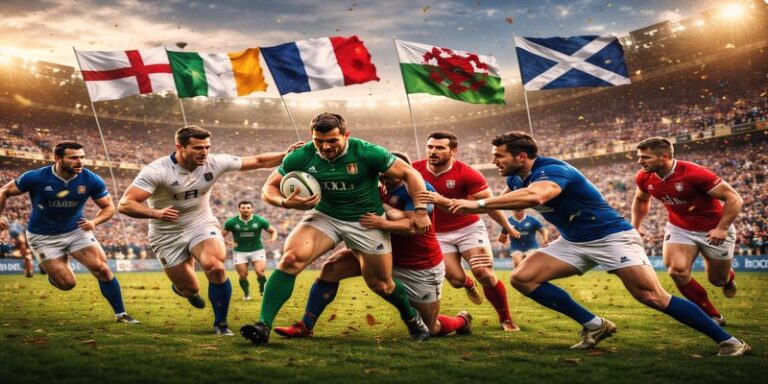
Each winter and early spring, stadiums across Europe come alive with thunderous anthems, roaring crowds and bone-rattling tackles as the Six Nations Championship unfolds. Featuring England, Scotland, Wales, Ireland, France and Italy, the tournament is one of the oldest and most prestigious competitions in international rugby union. For many supporters, it is more than a sporting contest — it is a ritual steeped in history, rivalry and national pride.
The Six Nations combines elite athleticism with centuries-old tradition. It captures the imagination not only of devoted rugby followers but also of casual viewers drawn in by the drama of close contests and iconic fixtures. As Collins (2009) observes, rugby union in the British Isles has long been intertwined with questions of class, identity and regional allegiance. The Six Nations embodies these themes on a continental stage.
1.0 From Home Nations to Six Nations: A Brief History
1.1 Origins in the 19th Century
The tournament began in 1883 as the Home Nations Championship, contested by England, Scotland, Wales and Ireland. It was one of the earliest international sporting competitions, reflecting rugby’s rapid expansion following its codification at Rugby School in 1845 (Collins, 2009).
In 1910, France joined, transforming the competition into the Five Nations Championship. Italy’s inclusion in 2000 marked the birth of the modern Six Nations format (Six Nations Rugby, 2023). Each expansion reflected rugby’s growing popularity and the desire to strengthen competition across Europe.
1.2 The Evolution of Professionalism
For much of its history, rugby union was officially amateur. However, the sport turned professional in 1995, fundamentally reshaping its structure and economics (Holt, 2000). The Six Nations adapted accordingly, embracing commercial sponsorship, global broadcasting and enhanced player conditioning. Despite these changes, the tournament has retained its distinctive traditions, including the singing of national anthems and historic venues such as Twickenham, the Principality Stadium and the Stade de France.
2.0 Tradition and Rivalry
2.1 Iconic Fixtures
Few sporting rivalries rival the intensity of those within the Six Nations. The annual clash between England and Scotland for the Calcutta Cup dates back to 1879, making it one of rugby’s oldest contests. Similarly, Ireland versus England fixtures often carry political and historical undertones, adding emotional depth to the competition.
Wales and England share a particularly fierce rivalry, fuelled by geographic proximity and cultural pride. As Richards (2011) notes, rugby in Wales has historically symbolised working-class solidarity and national identity. Victories over England therefore resonate beyond sport.
2.2 Trophies and Traditions
In addition to the championship trophy itself, several sub-competitions enrich the tournament. The Triple Crown is awarded when one of the Home Nations defeats the other three. The Grand Slam — achieved by winning all five matches — represents the pinnacle of success. France’s flair and Ireland’s recent consistency have produced memorable Grand Slam campaigns in the professional era.
3.0 National Identity and Cultural Significance
3.1 Rugby as a Marker of Identity
The Six Nations is deeply embedded in the cultural fabric of participating countries. Rugby has long played a role in constructing and expressing national identity (Collins, 2009). In Ireland, for example, the national team represents both Northern Ireland and the Republic, symbolising a rare instance of all-island unity. Matches at Dublin’s Aviva Stadium feature a specially composed anthem, Ireland’s Call, reflecting this unique political context.
In France, rugby is particularly associated with the south-west, where it forms part of regional identity (Holt, 2000). Meanwhile, in Scotland and Wales, victories in the Six Nations often serve as affirmations of distinct national character within the United Kingdom.
3.2 Anthems and Atmosphere
The pre-match rendition of national anthems remains one of the tournament’s defining rituals. “La Marseillaise” echoing through the Stade de France or “Hen Wlad Fy Nhadau” reverberating around Cardiff encapsulate the emotional intensity of the competition. These moments reinforce the connection between sport and nationhood.
4.0 Playing Style and Evolution
4.1 Contrasting Approaches
One of the tournament’s enduring attractions lies in its contrasting playing styles. Traditionally, France has been associated with flair and unpredictability — the so-called jeu à la française. England’s game has often emphasised structure and physicality, while Ireland’s recent success has been built upon tactical precision and cohesive teamwork.
The professional era has accelerated the evolution of tactics. Advances in sports science, video analysis and conditioning have transformed preparation methods (Holt, 2000). Modern matches are faster, more strategic and increasingly data-driven.
4.2 Memorable Moments
The Six Nations has produced countless dramatic finishes. Scotland’s remarkable comeback against England in 2019, overturning a 31–0 deficit to draw 38–38, stands as one of the greatest matches in championship history. Similarly, Ireland’s Grand Slam triumph in 2018 showcased the heights attainable through collective discipline and technical excellence.
5.0 Economic and Commercial Impact
5.1 Broadcasting and Revenue
Today, the Six Nations is a major commercial enterprise. Broadcasting deals ensure global coverage, attracting millions of viewers. According to Deloitte (2023), international rugby tournaments generate substantial revenue through media rights, sponsorship and matchday income.
The tournament also boosts host cities’ economies, filling hotels, restaurants and transport networks. Twickenham alone can accommodate over 80,000 spectators, generating significant local revenue during match weekends.
5.2 Grassroots Influence
Beyond elite competition, the Six Nations inspires participation at grassroots level. The visibility of national teams encourages youth engagement in rugby clubs across Europe. Sport England (2022) reports that major tournaments often stimulate increased youth interest and registration in community sport.
6.0 Challenges and Criticisms
Despite its prestige, the Six Nations faces ongoing challenges. Player welfare has become a central concern, given rugby’s physical intensity. Research highlights the importance of concussion management and long-term health monitoring (World Rugby, 2023).
There have also been debates regarding promotion and relegation. Critics argue that Italy’s struggles since joining in 2000 raise questions about competitive balance. However, supporters contend that sustained participation is essential for developing emerging rugby nations.
7.0 The Global Context
Although geographically European, the Six Nations holds global significance. Success in the championship often signals strength ahead of the Rugby World Cup. Northern Hemisphere teams have increasingly challenged Southern Hemisphere dominance in recent decades, reflecting the narrowing gap in global rugby standards.
The tournament’s timing — during the northern winter — also distinguishes it from the southern hemisphere’s Rugby Championship, reinforcing rugby’s seasonal rhythm.
The Six Nations Championship is far more than a rugby tournament. It is a living expression of history, rivalry and national identity, combining tradition with modern professionalism. From its origins as the Home Nations Championship to its current global prominence, it has evolved while preserving its distinctive character.
Each February and March, the Six Nations transforms stadiums into theatres of passion and pride. Whether through a last-minute drop goal, a thunderous tackle or the collective swell of an anthem, it captures the drama that makes sport so compelling. As Collins (2009) suggests, rugby’s enduring appeal lies in its capacity to reflect the societies that play it. In the Six Nations, that reflection is vivid, emotional and fiercely contested.
References
Collins, T. (2009) A Social History of English Rugby Union. London: Routledge.
Deloitte (2023) The Economic Impact of Major Sporting Events. Available at: https://www2.deloitte.com.
Holt, R. (2000) Sport and the British: A Modern History. Oxford: Oxford University Press.
Richards, H. (2011) A Game for Hooligans: The History of Rugby Union. Edinburgh: Mainstream Publishing.
Six Nations Rugby (2023) History of the Six Nations Championship. Available at: https://www.sixnationsrugby.com.
Sport England (2022) Active Lives Survey Report. Available at: https://www.sportengland.org.
World Rugby (2023) Player Welfare and C.oncussion Guidelines. Available at: https://www.world.rugby.