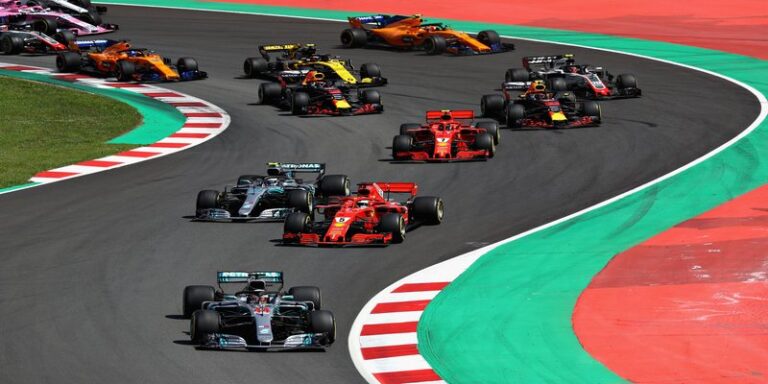
Formula One is more than a motor race. It is a global sporting and technological contest in which elite drivers, engineers, strategists and commercial partners compete at the highest level of single-seater motorsport. Since the first World Championship season in 1950, Formula One has developed into a sport defined by innovation, precision, risk management, and international appeal (Codling, 2017). What makes Formula One distinctive is not simply speed, but the way it brings together cutting-edge design, team strategy, strict regulation and huge economic value. From legendary teams such as Ferrari and McLaren to races in Monaco, Silverstone and Suzuka, the sport blends heritage with constant change. This article explores the history, technology, economics, safety and cultural significance of Formula One, showing why it remains one of the world’s most fascinating sporting competitions.
1.0 The History of Formula One
1.1 How Formula One Began
The modern Formula One World Championship began in 1950, although its roots lie in earlier European Grand Prix racing. The term “formula” refers to the set of technical rules that cars and teams must follow. From the outset, the sport was built around the idea that engineering excellence and driver skill would be tested under a common regulatory framework (Codling, 2017).
Early Formula One racing was dangerous, mechanical failures were common, and circuits often lacked today’s safety standards. Yet even in its early years, the sport attracted iconic figures such as Juan Manuel Fangio, whose success helped establish the prestige of the championship. Over time, the sport evolved from a largely European competition into a global series with races across the Middle East, Asia, the Americas and Australia.
1.2 An Era of Constant Change
One of the defining features of Formula One has been technological change. Jenkins and Floyd (2001) describe the sport as an ideal setting for studying technological evolution because teams compete not only on the track but also through innovation. Major turning points have included the introduction of rear-engine design, aerodynamic wings, carbon-fibre chassis, semi-automatic gearboxes and hybrid power units.
A good example is the shift to hybrid engines in 2014. This was not simply a technical update. It changed competitive balance, fuel efficiency and the broader image of the sport, showing that Formula One can function as both entertainment and a laboratory for automotive progress.
2.0 Formula One Technology and Engineering
2.1 Why Technology Matters in Formula One
At the heart of Formula One lies the search for performance through engineering. Cars are designed to maximise downforce, reduce drag, preserve tyre life and maintain reliability across race distance. A fraction of a second per lap can decide pole position or victory, which is why teams invest heavily in simulation, wind tunnel testing, data analysis and materials science (Frömmig, 2023).
In simple terms, a Formula One car is not just fast because of its engine. It is fast because every component, from suspension geometry to airflow around the bodywork, is carefully optimised. Codling (2017) notes that understanding the sport means understanding the relationship between rules and innovation: teams must push boundaries while staying within technical limits.
2.2 A Sport Shaped by Innovation
Research on Formula One often uses it as a case study in innovation. Jenkins (2010) argues that technological discontinuities in the sport can alter competitive advantage over long periods. In other words, when a team interprets new technology better than its rivals, it may dominate for seasons.
Examples include Lotus with ground effect aerodynamics in the late 1970s, Williams and McLaren with active technologies in later decades, and Mercedes during the hybrid era. These changes show that Formula One success depends on more than driver talent alone; it is also shaped by design insight, research capability and organisational learning.
3.0 The Business and Economics of Formula One
3.1 A Global Commercial Machine
Formula One is also a major business. It generates revenue through broadcasting, sponsorship, race hosting fees, hospitality and licensing. Mourão (2017) shows that the economics of motorsport, and especially Formula One, depend on balancing sporting competition with commercial visibility. Teams are not only racing for trophies; they are also racing for prize money, brand exposure and investor confidence.
This explains why sponsor logos are so prominent on cars and driver overalls. A multinational company backing a leading Formula One team gains global television exposure associated with speed, prestige and technical excellence. For many brands, this association is commercially valuable even beyond direct sales.
3.2 The Cost of Competing
Competing in Formula One has historically been extremely expensive. Research and development, staff salaries, logistics and equipment create enormous financial pressure. This is one reason why regulations increasingly include spending controls and shared components. Without some financial balance, wealthier teams could outspend smaller ones to an unsustainable degree.
An obvious example is the challenge faced by smaller constructors trying to compete with established giants. Even when talented drivers are available, performance often depends on resources, infrastructure and technical depth. This makes Formula One both a sporting contest and a management challenge.
4.0 Safety in Formula One
4.1 From Danger to Advanced Protection
No discussion of Formula One is complete without recognising its long and painful relationship with danger. In earlier decades, fatal accidents were far more common. However, the sport has changed profoundly through advances in chassis design, barrier technology, circuit layout, medical response and driver equipment.
Braithwaite et al. (2025) show how regulations such as the survival cell, improved barriers, pit-lane speed limits and other reforms have significantly changed driver safety over time. The introduction of the halo cockpit protection device is one recent example. Initially controversial in visual terms, it later proved its value in several serious incidents by preventing catastrophic head injuries.
4.2 Why Safety Matters Beyond the Track
The significance of Formula One safety extends beyond racing. Lemov (2015) argues more broadly that vehicle safety innovation often emerges through conflict between speed, design and public concern. In Formula One, this tension is especially visible. Improvements made for racing can influence attitudes and sometimes technologies in wider automotive engineering.
5.0 Formula One and sustainability
5.1 A Sport Under Environmental Pressure
In the twenty-first century, Formula One has also had to respond to environmental expectations. Its official sustainability strategy states that the sport aims for a net zero carbon footprint by 2030, covering operations, logistics and race-related activity (Formula 1, 2021). The document also highlights the importance of ultra-efficient hybrid power units and sustainable fuels.
This matters because critics often assume Formula One is environmentally careless simply because it involves racing cars. In reality, the direct fuel use of the cars themselves represents only a small proportion of the total carbon footprint compared with logistics and travel (Formula 1, 2021). That does not remove the challenge, but it does clarify where the biggest sustainability issues lie.
6.0 The Cultural Appeal of Formula One
6.1 Why Audiences Keep Watching
Part of the enduring attraction of Formula One is its combination of drama and expertise. Fans do not watch only for overtaking. They also follow tyre strategy, weather calls, team orders, pit-stop execution and championship narratives. A race can be decided by a brilliant qualifying lap, an undercut in the pits, or a safety car at exactly the right moment.
For example, a driver may not have the fastest car yet still win through tactical precision and consistency. This adds intellectual appeal to the spectacle. It is one reason Formula One attracts viewers who enjoy both sport and engineering.
6.2 A Sport with Global Identity
Today, Formula One functions as a global media product as well as a championship. Its audience includes long-term traditional supporters and newer fans drawn in by documentaries, social media and digital coverage. The sport’s appeal lies in its ability to present national pride, individual brilliance and technical rivalry all at once.
Formula One remains one of the most compelling forms of modern sport because it combines history, technology, economics, safety innovation and global entertainment in a single competitive arena. It has evolved from a dangerous post-war championship into a sophisticated international industry shaped by engineering excellence and commercial power. At the same time, it continues to adapt to new expectations around fairness, sustainability and fan engagement. Whether viewed as a sporting contest, a technological laboratory or a cultural spectacle, Formula One stands apart because it tests human and mechanical performance at the very edge of what is possible.
References
Braithwaite, J.P., Geffken, S.J., Modica, A. and others (2025) ‘A comprehensive review of post-traumatic injuries among Formula 1 drivers from 1950 to 2023: an epidemiological study’, JAAOS Global Research & Reviews. Available at: https://journals.lww.com/jaaosglobal/fulltext/2025/05000/a_comprehensive_review_of_post_traumatic_injuries.2.aspx.
Codling, S. (2017) Speed Read F1: The Technology, Rules, History and Concepts Key to the Sport. London: Motorbooks. Available at: https://books.google.com/books?id=ec85DwAAQBAJ.
Formula 1 (2021) Sustainability Strategy. Available at: https://corp.formula1.com/wp-content/uploads/2021/09/Environmental-sustainability-Corp-website-vFINAL_UPDATED-040821-1.pdf.
Frömmig, L. (2023) Basic Course in Race Car Technology. Cham: Springer. Available at: https://link.springer.com/content/pdf/10.1007/978-3-658-38470-8.pdf.
Jenkins, M. (2010) ‘Technological discontinuities and competitive advantage: A historical perspective on Formula 1 motor racing 1950–2006’, Journal of Management Studies, 47(5), pp. 884–910. Available at: https://dspace.lib.cranfield.ac.uk/bitstreams/87919863-c8cb-4a94-98d9-2f0c6f847d20/download.
Jenkins, M. and Floyd, S. (2001) ‘Trajectories in the evolution of technology: A multi-level study of competition in Formula 1 racing’, Organization Studies, 22(6), pp. 945–969. Available at: https://dspace.lib.cranfield.ac.uk/bitstreams/7e588c0d-e699-4283-aaf8-b9c14c641bab/download.
Lemov, M.R. (2015) Car Safety Wars: One Hundred Years of Technology, Politics, and Death. Baltimore, MD: Johns Hopkins University Press. Available at: https://books.google.com/books?id=vmZ2EQAAQBAJ.
Mourão, P. (2017) The Economics of Motorsports: The Case of Formula One. Cham: Springer. Available at: https://books.google.com/books?id=sgImDwAAQBAJ.
Smith, D.J. (2012) ‘Technological discontinuities, outsiders and social capital: a case study from Formula 1’, European Journal of Innovation Management, 15(3), pp. 332–347. Available at: https://www.emerald.com/insight/content/doi/10.1108/14601061211243666/full/pdf.
Solitander, M. and Solitander, N. (2010) ‘The sharing, protection and thievery of intellectual assets: The case of the Formula 1 industry’, Management Decision, 48(1), pp. 37–57. Available at: https://www.emerald.com/md/article-pdf/48/1/37/1884837/00251741011014445.pdf.